You've found a Chinese LED filament bulb factory with competitive pricing, solid samples, and fast lead times. But before you place the order, your freight forwarder asks: "ETL or CE?" If you're not sure which certification your market requires — or what each one actually verifies — this guide is for you.
What ETL Certification Means for LED Bulbs
ETL is a North American safety certification issued by Intertek, recognized by OSHA and required for products sold in the United States and Canada. For LED bulbs, ETL certification verifies that the product has been tested against the relevant UL standards (typically UL 1993 for LED lamps).
When a bulb carries the ETL mark, it means:
- It has been tested by a Nationally Recognized Testing Laboratory (NRTL)
- The manufacturer's facility is subject to periodic follow-up inspections
- The product meets US electrical safety requirements for voltage, insulation, and heat dissipation
For distributors supplying US retailers, hotel chains, or commercial contractors, ETL-listed LED bulbs are effectively mandatory. Many US buyers will not place an order — or clear customs — without it.
What CE Marking Means for LED Bulbs
CE marking is a self-declaration that a product conforms to EU directives. For LED bulbs sold in the European Union, the key directives are:
- LVD (Low Voltage Directive) — electrical safety
- EMC Directive — electromagnetic compatibility
- ErP Directive (Energy-related Products) — energy efficiency requirements
- RoHS Directive — restriction of hazardous substances
Unlike ETL, CE marking does not require third-party laboratory certification for most LED bulbs — the manufacturer can self-certify with a Declaration of Conformity (DoC). However, test reports from accredited laboratories are still required and must be available for inspection.
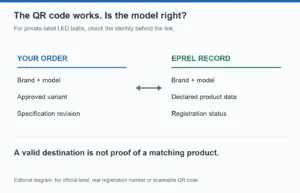
From 2021, the EU also tightened ErP requirements under the Ecodesign Regulation (EU) 2019/2020, raising minimum energy efficiency thresholds and requiring full product registration in the EPREL database before a product can legally enter the EU market.
Key Differences at a Glance
| Factor | ETL (North America) | CE (European Union) |
|---|---|---|
| Issued by | Intertek (third-party NRTL) | Manufacturer self-declaration |
| Third-party lab required | Yes | No (but test reports are required) |
| Key standards | UL 1993, FCC Part 15 | LVD, EMC, ErP, RoHS |
| Energy efficiency rules | FTC labeling (lumens, wattage) | ErP / Ecodesign Regulation 2019/2020 |
| Market | USA, Canada | EU 27 + UK (UKCA post-Brexit) |

Do You Need Both?
If you sell exclusively in the United States, you need ETL (or UL). If you sell exclusively in the EU, CE is sufficient. If you supply both markets — common for distributors with a global customer base — you need both certifications, and they must each appear on the packaging and product.
Some importers mistakenly assume CE certification is "accepted" in the US. It is not. Similarly, ETL is not recognized as equivalent to CE by EU customs authorities.
What to Ask Your Supplier
Before confirming any LED bulb order, ask your factory for:
- A copy of the ETL listing certificate (including the file number, which you can verify on Intertek's directory)
- CE Declaration of Conformity and the underlying test reports
- EPREL registration number if you're importing into the EU
- FCC Part 15 compliance documentation if the bulb includes any wireless components or driver electronics that emit RF
Legitimate manufacturers will provide all of these without hesitation. If a supplier is vague about certification, treats it as optional, or only provides a generic "CE certificate" without the underlying test reports, treat that as a red flag.
How HongYu Bulb Handles Certification
Our LED filament bulbs are available in both ETL-listed and CE-certified versions. ETL-listed products are manufactured to UL 1993 and carry a valid ETL file number that can be independently verified. CE-certified products include full test reports, DoC, and EPREL registration support where required.
We maintain separate SKUs for US and EU market specifications because the two markets have different nominal voltage requirements (120V/60Hz vs 230V/50Hz), different base type priorities (E26 vs E27), and different energy labeling rules.
Real-World Scenario: What Happens When Certification Is Missing
A mid-sized US lighting distributor sourced 10,000 LED filament bulbs from a new Chinese supplier in 2023. The supplier provided a "CE certificate" — a single-page document with no test report attached. The distributor assumed CE and ETL were interchangeable and placed the order without verifying the ETL listing.
At the Port of Los Angeles, CBP flagged the shipment because the bulbs lacked a valid ETL or UL listing, which is required for electrical products entering US commerce. The shipment was held for 19 days while the distributor scrambled for documentation. The supplier could not produce a valid ETL file number. The shipment was ultimately refused and returned at the distributor's cost — approximately $23,000 in landed goods, freight, and detention fees — plus a 10-week delay that cost them a key retail account.
The lesson: CE and ETL are not interchangeable, and a certificate without a verifiable file number is not a certificate.
Frequently Asked Questions
Can a CE-certified LED bulb be legally sold in the United States?
No. CE marking is a European conformity declaration and carries no legal weight in the United States. Products sold in the US must be certified by an OSHA-recognized NRTL such as Intertek (ETL) or UL. Selling CE-only products through US retail channels can result in product recalls, fines, and retailer chargebacks.
What is the difference between ETL and UL certification?
ETL (issued by Intertek) and UL (issued by Underwriters Laboratories) are both OSHA-recognized NRTLs and are legally equivalent in the United States. Both test to the same underlying standards (e.g., UL 1993 for LED lamps). Many US buyers accept either mark. ETL is generally faster and less expensive to obtain, which is why it is more common among Chinese export manufacturers.
Does ETL certification expire?
The listing itself does not expire, but it is tied to a specific product configuration. Any significant change to the bulb — a different LED driver, a new base manufacturer, a revised PCB layout — requires the manufacturer to notify Intertek and may trigger re-testing. Always confirm with your supplier that the current production configuration matches the certified configuration.
What is EPREL and do I need it for EU imports?
EPREL (European Product Registry for Energy Labelling) is a mandatory EU database for energy-related products, including LED lamps. Since March 2021, LED bulbs must be registered in EPREL before they can be legally placed on the EU market. Ask your supplier for the EPREL registration number — it can be verified at the official EU EPREL portal. Products without EPREL registration cannot legally be sold in the EU, regardless of CE marking.
Can I request both ETL and CE certification on the same product?
Yes, but they require separate SKUs in most cases because US market products run at 120V/60Hz and use E26 bases, while EU products run at 230V/50Hz and typically use E27 bases. A single bulb cannot be certified for both voltage systems simultaneously. Manufacturers serving both markets maintain separate production lines and separate certification files for each.
Browse from HongYu Bulb: US ETL Clear Filament Bulbs → · EU Standard LED Filament Bulbs → · US ETL Dim to Warm Bulbs →
Sourcing LED filament bulbs at wholesale? HongYu Bulb is a China-based LED manufacturer supplying wholesalers, importers, and hospitality brands worldwide. Request a quote → or browse our full LED filament bulb range →.
Related HongYu Bulb product pages
- LED Filament Bulb Product Range → — standard and decorative LED filament bulbs for wholesale and project sourcing.
- ETL, CE & RoHS Certification Guide → — sourcing guidance for certification and import compliance.
- Contact HongYu Bulb → — send specifications, target market, quantity and packaging requirements for quotation.