Certifications are among the most important — and most misunderstood — aspects of LED bulb sourcing. Buyers often know they need certain marks on their products but are less clear on what those marks actually guarantee, how they are obtained, and what to look for when evaluating supplier documentation. This guide provides a comprehensive breakdown of the major certification requirements for LED filament bulbs in the European and North American markets, with practical guidance for buyers on verification and documentation.
Why Certifications Matter: Legal and Commercial Consequences
Selling non-certified LED products in regulated markets carries real legal and commercial risk. In the EU, non-CE-marked electrical products can be seized by customs authorities or withdrawn from sale by market surveillance bodies. The importer — not the manufacturer — is typically the responsible party for ensuring CE compliance of goods placed on the EU market. Product liability insurance may be invalidated for non-compliant products. Retailers receiving non-compliant goods from distributors can pursue legal remedies against the distributor.
In the North American market, major retail chains (Home Depot, Lowe's, Target, Walmart) require ETL or UL listing as a contractual condition of supply. Unlisted products will not pass product review. For commercial and hospitality projects, specifications routinely require ETL or UL certification as a minimum — without it, the product cannot be installed by licensed electricians in many US jurisdictions.
Beyond legal compliance, certifications provide commercial credibility. A buyer evaluating two otherwise identical LED filament bulb suppliers — one with full certification documentation and one without — has a clear risk-management basis for choosing the certified supplier, even at a higher price. The certification package is a tangible signal of manufacturing quality and regulatory awareness.
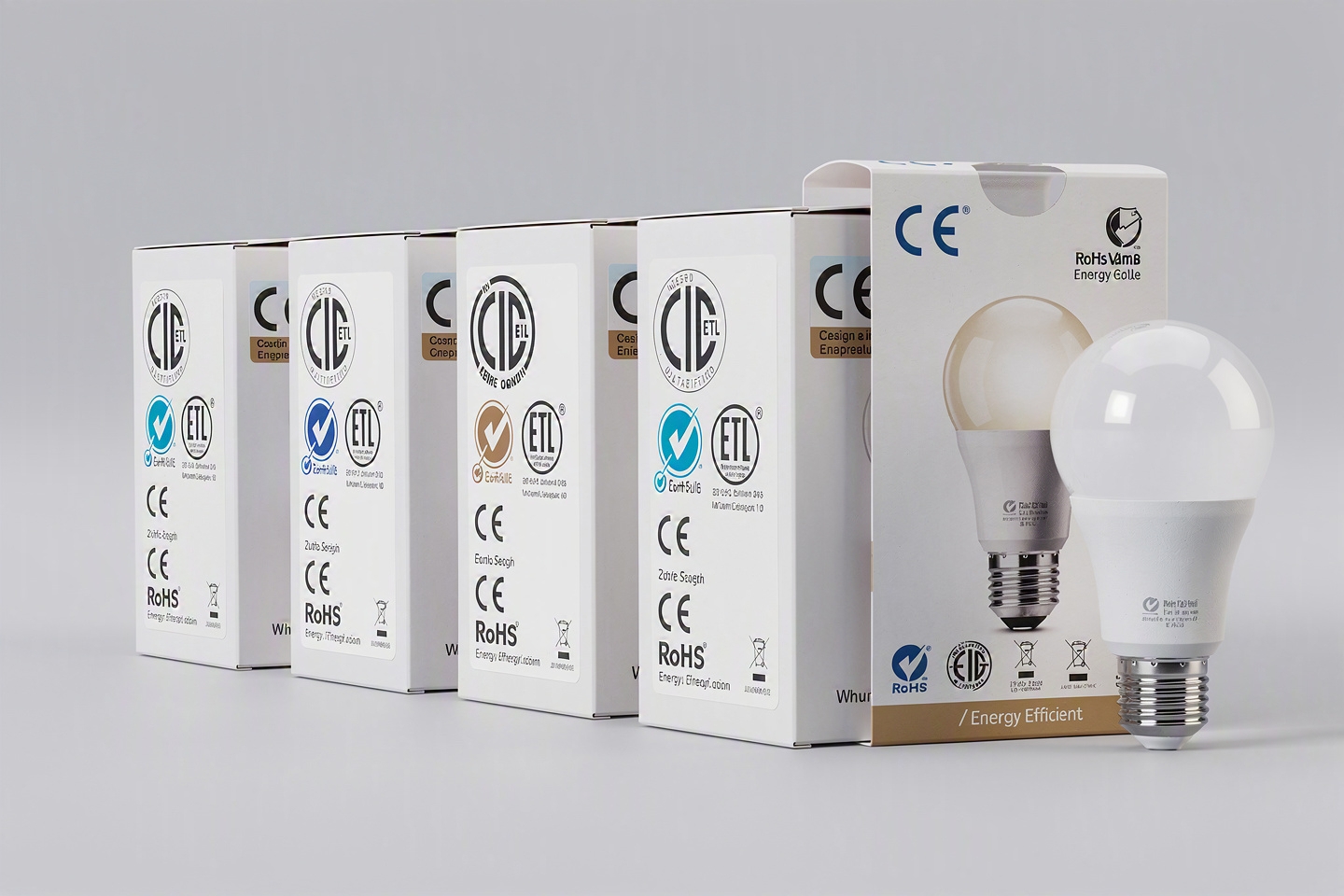
CE Marking: The European Framework
The CE mark is a mandatory conformity marking for products sold in the European Economic Area (EEA). For LED filament bulbs, CE certification typically requires conformity with three EU directives:
Low Voltage Directive (LVD) 2014/35/EU
The LVD covers electrical equipment designed to operate within the voltage range of 50–1000 V AC. It requires that the product is designed and manufactured to prevent hazards from electrical shock, fire, and other electrical phenomena under normal operating conditions and foreseeable misuse. For LED bulbs, LVD testing includes dielectric strength testing, insulation resistance, temperature rise, and short-circuit protection verification. Test standards typically applied are EN 62560 (self-ballasted LED lamps for general lighting services) and EN 60598-1 (luminaires).
Electromagnetic Compatibility Directive (EMCD) 2014/30/EU
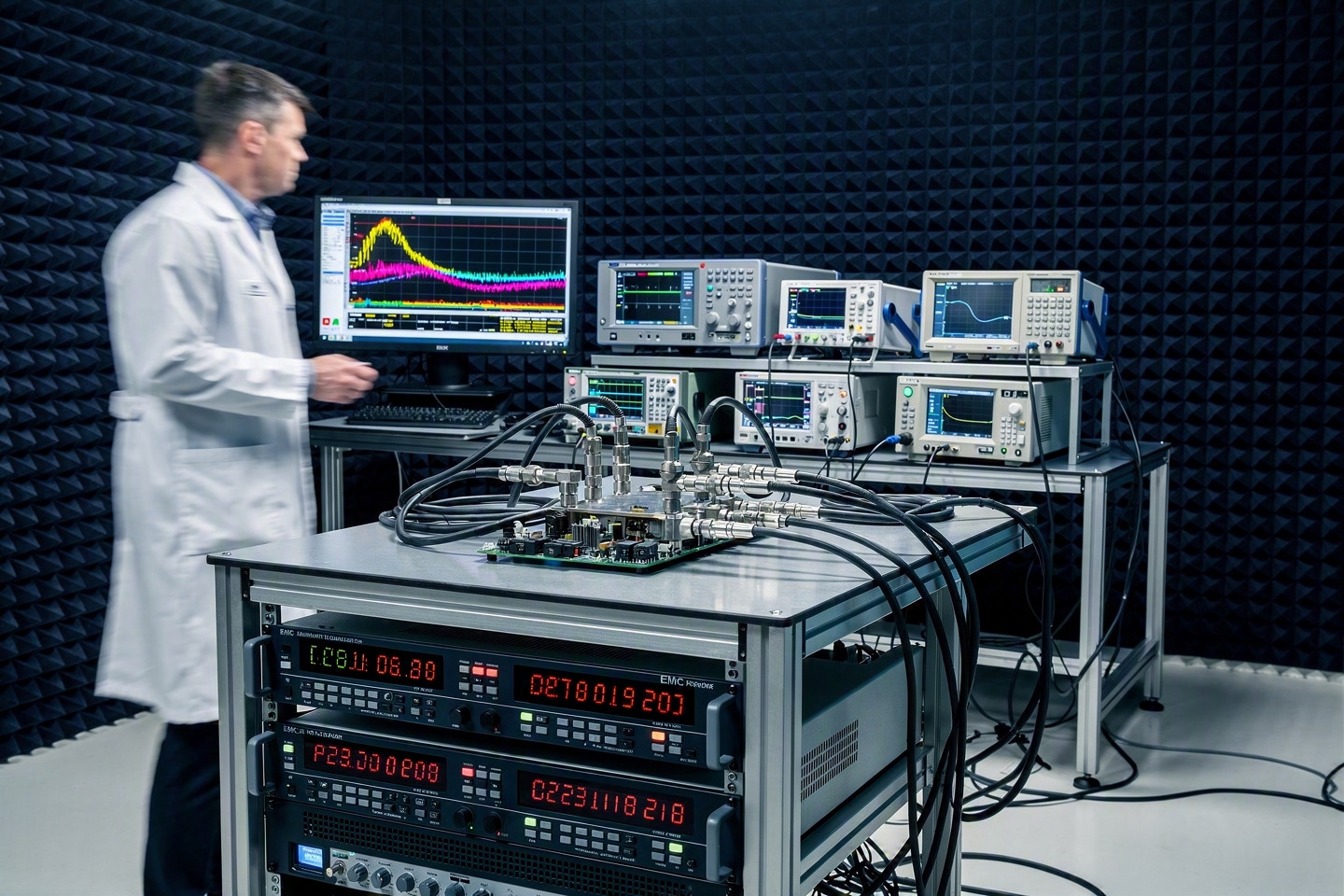
The EMCD requires that electrical equipment does not emit electromagnetic interference above defined limits AND is sufficiently immune to typical electromagnetic disturbances. LED drivers switch at high frequencies (typically 50–500 kHz) and can generate significant conducted and radiated emissions if not properly designed. EMC testing for LED bulbs includes conducted emissions testing on a LISN (Line Impedance Stabilisation Network) and radiated emissions testing in an anechoic chamber or GTEM cell. Standards typically applied include EN 55015 and EN 61547.

Ecodesign Regulation (ErP) 2019/2020
The Ecodesign Regulation establishes minimum energy efficiency requirements for light sources sold in the EU. From September 2021, this regulation effectively eliminated most fluorescent, halogen, and lower-efficiency LED products from the EU market. For LED filament bulbs, the ErP regulation requires minimum efficacy thresholds (expressed in lm/W) and places limits on power factor, standby power, and colour rendering. LED filament bulbs generally meet ErP requirements with their standard performance specifications, but buyers should verify that the declared wattage and lumen output in the test report match the product specification — misrepresented wattage is a common non-compliance issue.
The CE Self-Declaration Process
The CE mark is self-declared by the manufacturer or the EU-market importer — there is no mandatory pre-market approval by a government authority. However, this does not mean that CE marking is informal or unverifiable. The Declaration of Conformity (DoC) must reference specific harmonised standards; test reports from accredited laboratories must exist and be available on request; and the technical documentation supporting the DoC must be maintained and available for inspection by market surveillance authorities for 10 years after the product is placed on the market.
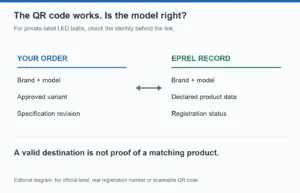
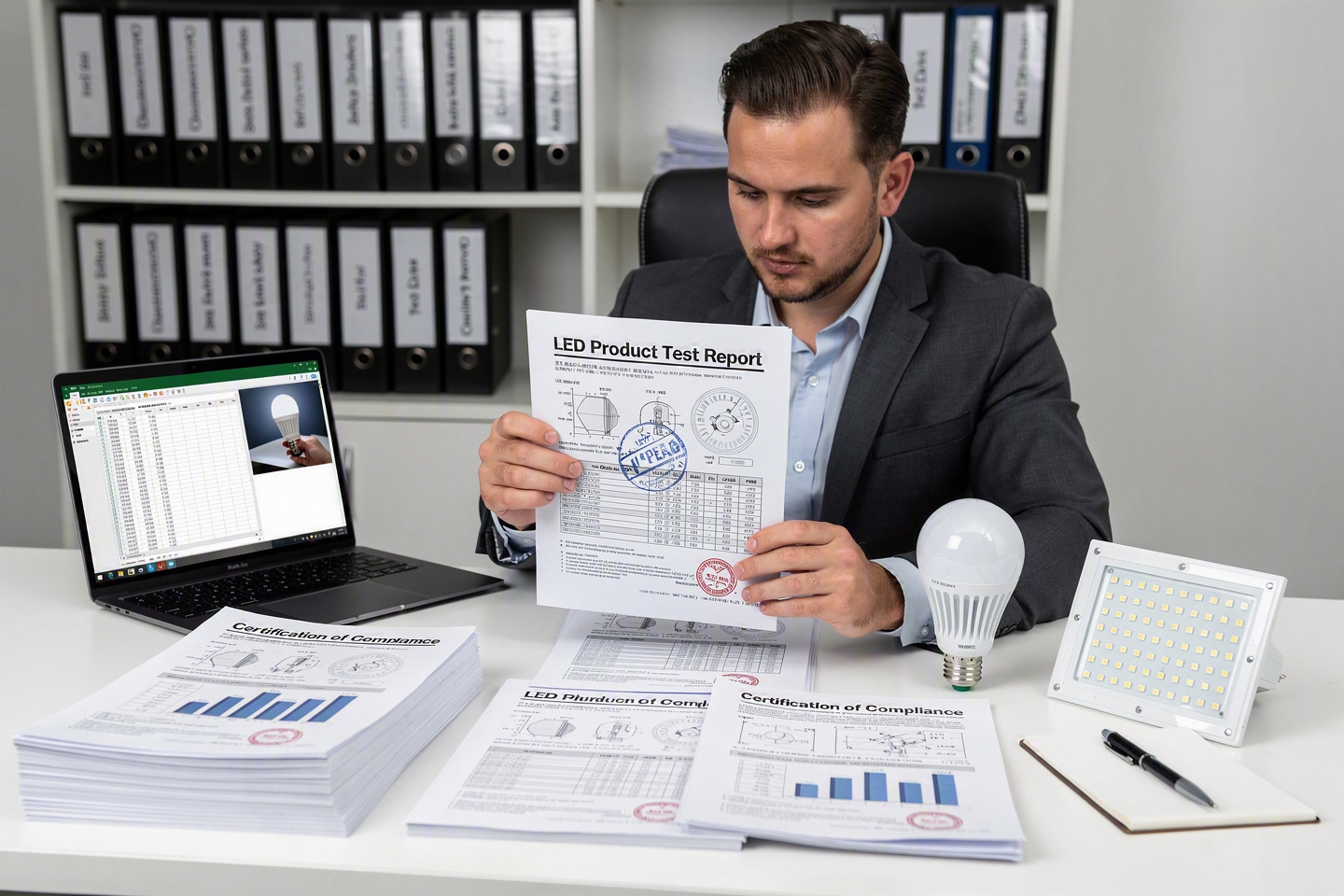
Buyers should request and review the full Declaration of Conformity and associated test reports before placing a volume order. Red flags to look for: test reports from non-accredited laboratories; DoC dates that predate the current product specification; test reports that cover a "similar" model rather than the exact model being ordered; missing ErP compliance data.
RoHS: Restricting Hazardous Substances
The RoHS Directive (2011/65/EU, updated by 2015/863/EU) restricts the use of specific hazardous substances in electrical and electronic equipment placed on the EU market. The restricted substances for LED products are:
- Lead (Pb) — maximum 0.1% by weight in homogeneous materials
- Mercury (Hg) — maximum 0.1%
- Cadmium (Cd) — maximum 0.01%
- Hexavalent chromium (Cr VI) — maximum 0.1%
- Polybrominated biphenyls (PBB) — maximum 0.1%
- Polybrominated diphenyl ethers (PBDE) — maximum 0.1%
- Di(2-ethylhexyl) phthalate (DEHP), Butyl benzyl phthalate (BBP), Dibutyl phthalate (DBP), Diisobutyl phthalate (DIBP) — maximum 0.1% each
For LED filament bulbs, the primary RoHS concern is the solder used in the LED driver PCB (lead-free solder must be used) and the flame retardant materials in the PCB laminate (halogen-free is typically required for full compliance). RoHS compliance should be supported by a material declaration (IPC 1752 format) or, for the highest assurance, an XRF (X-ray fluorescence) test report confirming absence of restricted substances.

BSCI: Factory Social Compliance
The Business Social Compliance Initiative (BSCI) is not a product safety certification but a supply chain audit programme covering labour rights, working conditions, and management systems at the manufacturing facility level. A BSCI audit assesses:
- Workers' rights and freedom of association
- Fair remuneration and working hours
- Health and safety at the workplace
- Environmental protection measures
- Business ethics and anti-corruption
- Protection of young workers and prohibition of child labour
Factories achieve one of four grades: Outstanding (A), Good (B), Acceptable (C), or Unacceptable. Most European retail buyers require a minimum grade of B for ongoing supplier qualification. BSCI audits are conducted by approved audit firms and are valid for two years before re-audit is required.
For buyers who are members of the amfori BSCI programme, audit reports can be accessed through the shared platform, eliminating the need for duplicate audits of the same factory by multiple buyers. Equivalent programmes that are widely accepted include SMETA (Sedex Members Ethical Trade Audit) and SA8000 certification.
ETL Listed: The North American Safety Standard
ETL is a product safety certification issued by Intertek Testing Services, an OSHA-recognised Nationally Recognised Testing Laboratory (NRTL) in the United States. ETL listing certifies that the product has been tested against applicable US safety standards — primarily ANSI/UL 1993 (self-ballasted lamps) for LED filament bulbs — and found to meet those standards.
ETL listing is functionally equivalent to UL listing (Underwriters Laboratories). Both are accepted by local authority having jurisdiction (AHJ) bodies across the US and Canada. Both are required by major US retail chains as a condition of supply. The practical difference between ETL and UL for buyers is primarily commercial — some buyers or end clients have a preference for one over the other, but both provide the same level of regulatory assurance.
Unlike CE marking, ETL listing requires mandatory third-party testing by Intertek before the mark can be applied. The manufacturer cannot self-declare ETL status. This makes ETL listing a more robust certification from a verification standpoint — a valid ETL certificate with the correct model number, current date, and Intertek reference number is a reliable indicator of tested safety compliance.
FCC Part 15: Electromagnetic Compatibility for the US Market
The Federal Communications Commission (FCC) Part 15 certification is the US equivalent of the EU EMC Directive. It limits the electromagnetic emissions from electronic equipment to prevent interference with radio communications systems, including AM/FM radio, GPS, Wi-Fi, and cellular networks.
For LED drivers — which switch at high frequencies — FCC Part 15 Subpart B applies. Testing covers both conducted emissions (measured on the power line) and radiated emissions (measured in a calibrated test chamber). Products that pass testing receive a Grant of Equipment Authorization, which can be verified in the FCC's public database by searching the FCC ID number printed on the product label.
In the US market, LED bulbs are typically marketed with both ETL and FCC certification ("ETL+FCC"). Some products carry FCC certification alone (without ETL) — this may be acceptable for commercial and contractor channels but is generally insufficient for major retail chains. When sourcing for the US mass market, confirm ETL+FCC as a non-negotiable requirement.
Energy Star: The US Premium Certification
Energy Star is a voluntary certification programme administered by the US Environmental Protection Agency (EPA) and the Department of Energy (DOE). Energy Star certification for LED lamps requires compliance with specific performance requirements including minimum efficacy, minimum CRI (Ra ≥ 80), maximum power factor requirements, minimum lamp lifetime, and correlated colour temperature accuracy within specified tolerances.
Energy Star is not legally required but provides commercial advantages: Energy Star products qualify for utility rebate programmes (significant in commercial projects), are preferred by environmentally-conscious buyers, and command a modest premium in retail. For LED filament bulbs, Energy Star adds credibility to lumen output, CRI, and lifetime claims because each of these parameters must be independently verified by an accredited laboratory as part of the qualification process.
Verifying Certifications: A Practical Buyer's Checklist
The existence of a certification document does not guarantee its validity. Fraudulent certificates, expired certificates, and certificates covering different model numbers than those actually ordered are all documented risks in LED product sourcing. Use the following verification process:
| Certification | Verification Method | Red Flags |
|---|---|---|
| CE DoC | Review full DoC. Check standards listed, date, and authorised representative's EU address. | Missing ErP section; test reports from non-ILAC-accredited labs; model mismatch. |
| ETL | Search Intertek's Listing Directory at iq.intertek.com. Verify certificate number and model. | Expired certificate; model number not found; certificate shows different product. |
| FCC | Search fcc.gov/oet/ea/fccid using the FCC ID on the product. | FCC ID not found; description doesn't match; grantee code belongs to a different company. |
| RoHS | Request IPC 1752 material declaration or XRF test report from accredited lab. | Self-declaration without test evidence; no specific substance data. |
| BSCI/SMETA | Request audit report directly. amfori BSCI members can verify on the amfori platform. | Audit expired (>2 years); grade C or below; factory name on certificate doesn't match supplier. |
Documentation Package: What to Request Before Any Volume Order
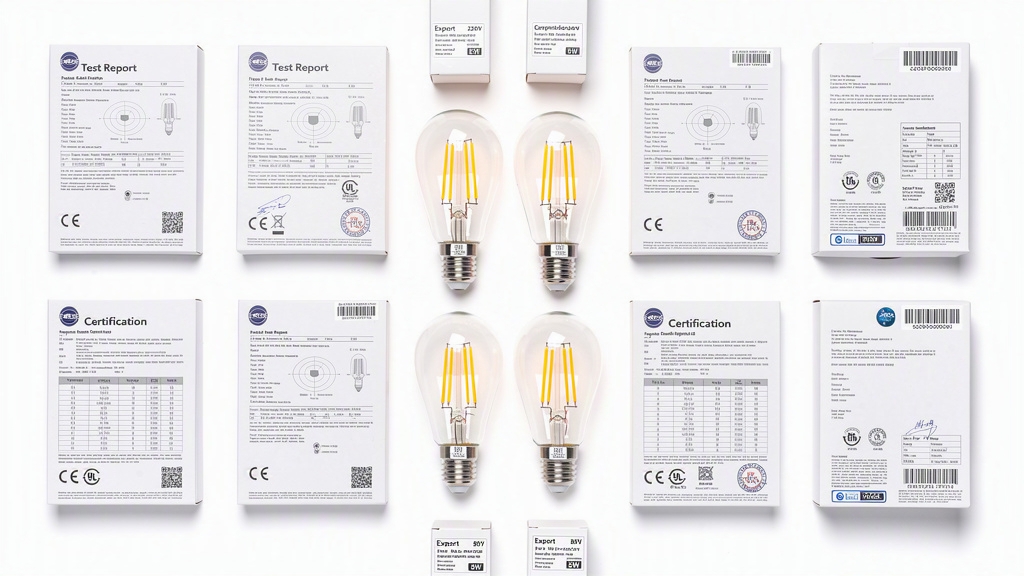
Before placing a volume order for LED filament bulbs, request and review the following documentation:
- CE Declaration of Conformity (must cover LVD, EMC, and ErP)
- LM-79 photometric test report from an accredited laboratory (covers lumen output, CCT, CRI, power factor)
- LVD test report (safety testing)
- EMC test report (conducted and radiated emissions)
- ErP compliance calculation
- RoHS material declaration (IPC 1752 or equivalent)
- ETL listing certificate with current date and matching model number (for North American market)
- FCC Grant of Equipment Authorization (for North American market)
- BSCI or SMETA audit report (for European retail supply)
- Factory Quality Manual or ISO 9001 certificate (indicates systematic quality management)
A factory that cannot produce this complete documentation package within 5 working days of being asked should be treated as a high-risk supplier, regardless of how competitive their pricing appears.
Related HongYu Bulb product pages
- LED Filament Bulb Product Range → — standard and decorative LED filament bulbs for wholesale and project sourcing.
- ETL, CE & RoHS Certification Guide → — sourcing guidance for certification and import compliance.
- Contact HongYu Bulb → — send specifications, target market, quantity and packaging requirements for quotation.
Conclusion
Certifications are not paperwork formalities — they are the documented evidence that a product has been tested, verified, and found to meet the legal requirements of the markets in which it is sold. For buyers sourcing LED filament bulbs at wholesale volume, building a rigorous certification verification process into the supplier qualification workflow is one of the highest-ROI risk-management steps available.
HongYu Bulb maintains full certification documentation for all product lines, including CE (LVD/EMC/ErP), RoHS, BSCI factory audit, ETL listing, and FCC Grant of Equipment Authorization for North American products. All documentation is available on request for qualified buyers. Contact us to start the qualification process.