Featured image: AI-generated editorial illustration, not a HongYu factory test, customer installation or measured result.
A decorative LED bulb passes a laboratory report, reaches the project, and then a small cluster fails after a storm, generator transfer, or heavy-load switching event. The buyer asks a fair question: if the lamp passed EMC, why did the driver die?
The usual supplier answer is a single number: "2 kV surge tested."
That number sounds precise. On its own, it is not an approval specification.
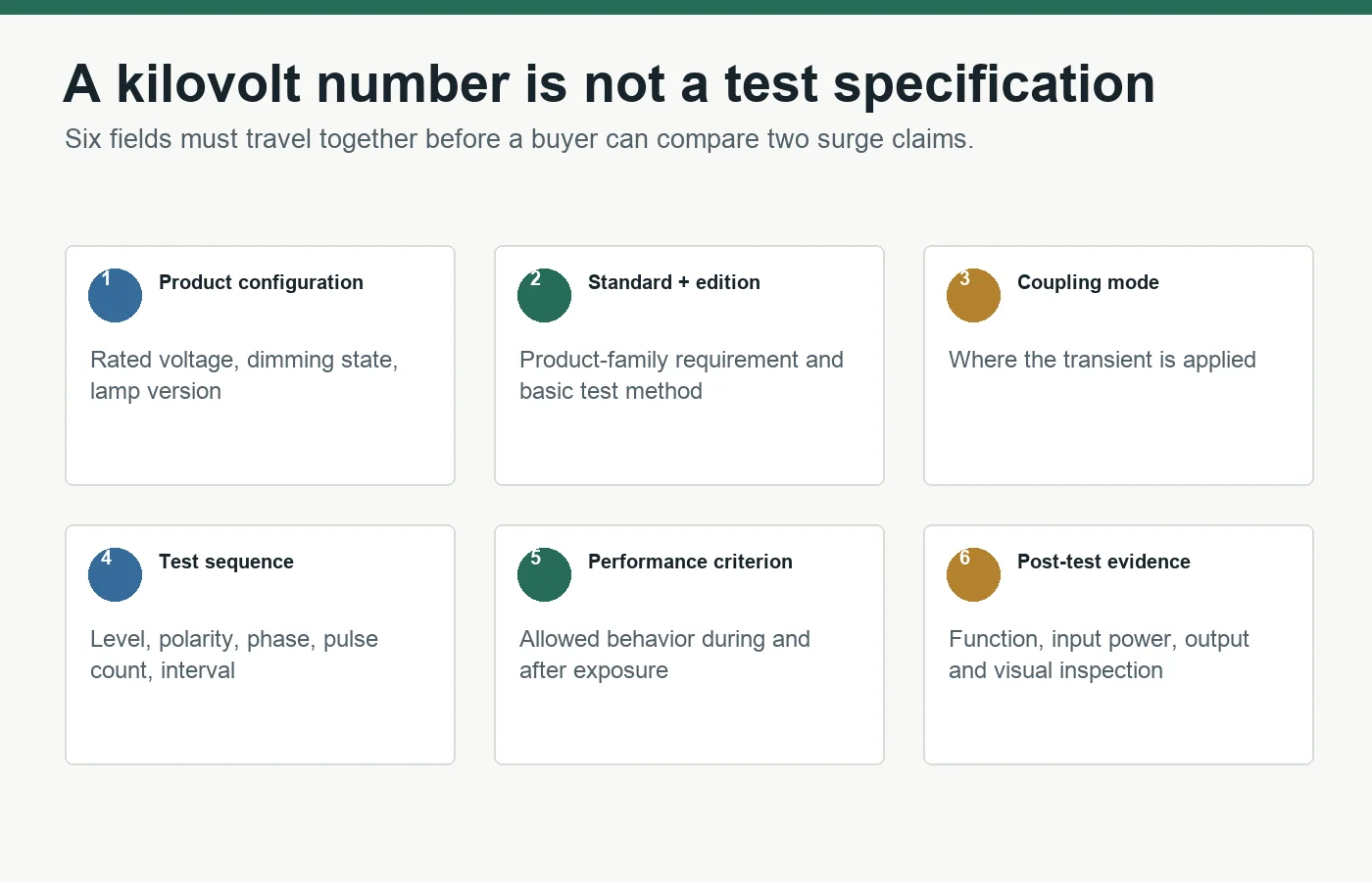
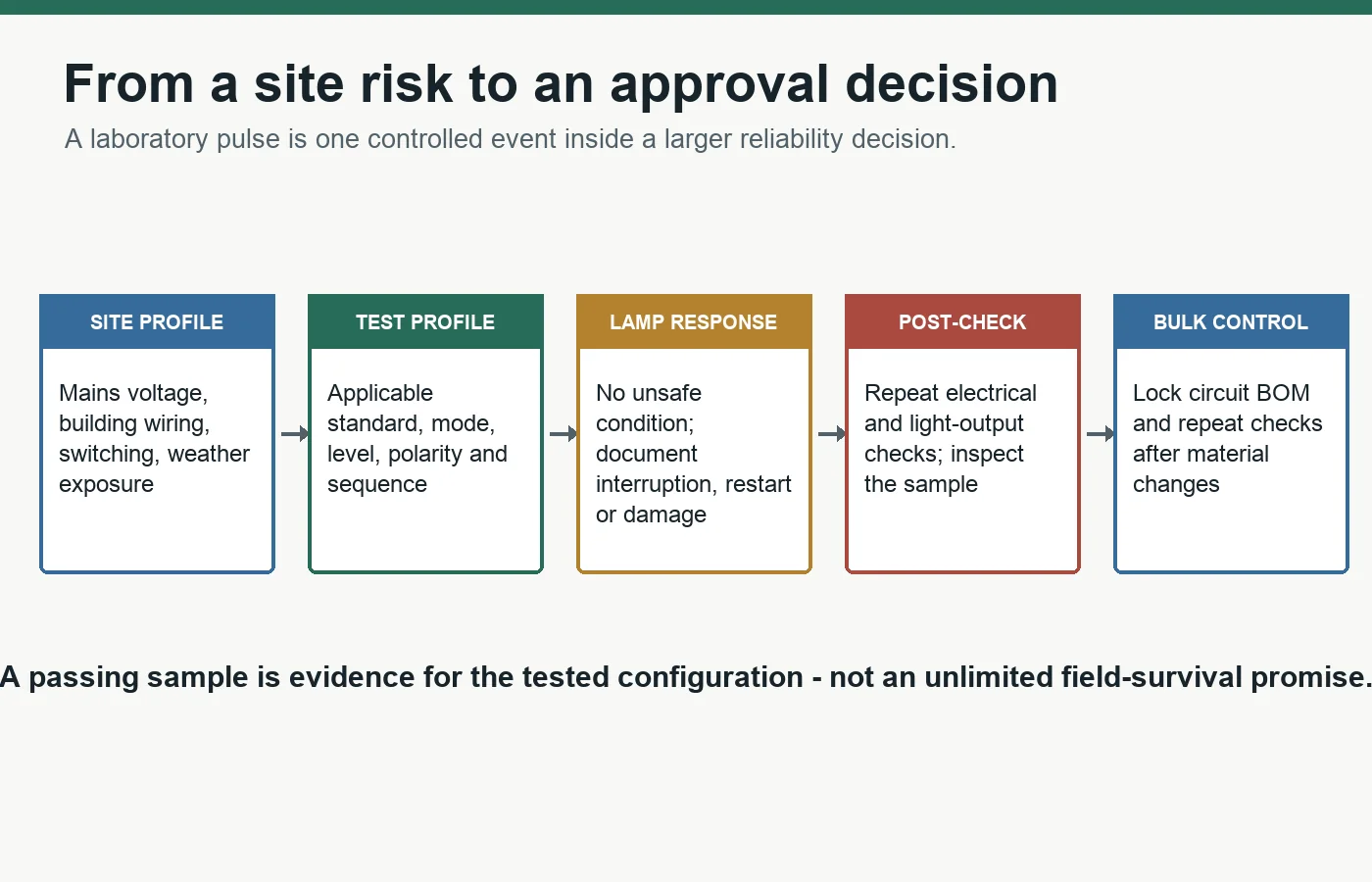
A surge-voltage claim becomes meaningful only when it is tied to the exact lamp configuration, applicable standard and edition, coupling mode, test sequence, performance criterion, and post-test checks. Even a complete laboratory result describes a controlled test. It does not promise survival from direct lightning, every building disturbance, or unlimited repeated transients.
This distinction matters for importers because the LEDs can remain visually perfect while the compact driver inside the cap becomes the weak link. A long rated life, a safety mark, and good steady-state photometry answer different questions from transient immunity.
For a bulk order, the correct decision is not "highest kV wins." It is: which tested configuration is appropriate for the intended electrical environment, and how will that configuration be preserved in production?
Start with the Event, Not the Marketing Number
IEC 61000-4-5 provides a common laboratory method for evaluating how electrical and electronic equipment reacts to defined unidirectional surges associated with switching and lightning effects. The IEC description is equally important for what it excludes: the method is not an insulation withstand test and does not represent direct lightning injection.[1]
That gives buyers their first judgment:
A lamp can pass an applicable surge-immunity test and still require appropriate installation-level protection for a harsher site.
The laboratory generator, coupling network, source impedance, operating condition, and sequence shape the energy delivered to the equipment under test. Two reports that show the same peak voltage can therefore describe different stresses. A supplier's comparison chart should not reduce all of that to a bigger number in a green box.
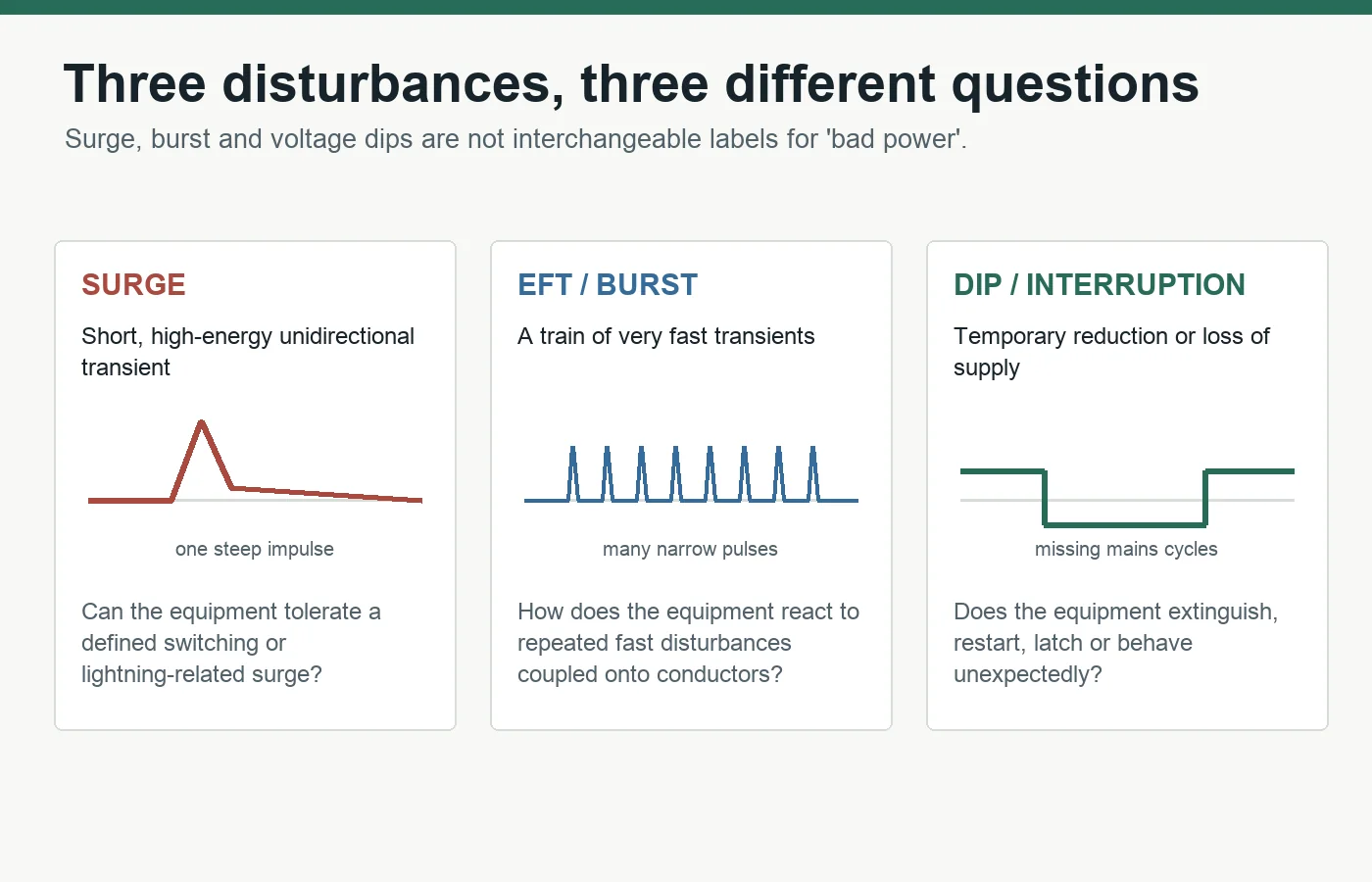
The event also has to be named correctly. "Bad power" can refer to several phenomena:
| Disturbance | Practical description | Buyer question |
|---|---|---|
| Surge | A short, high-energy unidirectional transient | Was the exact lamp tested under the applicable surge method and coupling conditions? |
| Electrical fast transient/burst | Repeated very fast pulses | Is the product robust against the relevant repetitive disturbance, not only one surge claim? |
| Voltage dip or interruption | A temporary reduction or loss of supply | Does the lamp extinguish, restart normally, latch, flash, or require a power cycle? |
| Long-duration overvoltage | Supply remains above the intended operating range | Is this inside the lamp's rated range, or a separate abnormal condition outside the surge test? |
IEC 61000-4-11, for example, defines test methods for voltage dips, short interruptions, and voltage variations on low-voltage AC networks. Those are not substitutes for the surge test in IEC 61000-4-5.[4]
"Tested to IEC 61547" Still Needs a Report
IEC 61547 is the product-family immunity standard for general lighting equipment, including lamps, luminaires, and modules. Its 2020 edition changed and clarified several requirements; the IEC summary specifically notes the removal of the line-to-ground surge test for self-ballasted lamps at or below 25 W.[2]
That is a valuable warning against purchasing by borrowed requirements. A street luminaire, a replaceable mains lamp, and a low-voltage module do not automatically share the same test modes or levels. Nor should a buyer copy a dramatic road-lighting surge value into a small decorative bulb RFQ without checking product scope, market requirements, construction, and intended installation.
Ask the supplier for the report pages that answer these questions:
- What exactly was tested? Record model, rated voltage and frequency, wattage, cap, dimming state, driver or PCB revision, and sample quantity.
- Which standard and edition applied? "IEC compliant" is incomplete. The edition matters because requirements change.
- Where was the transient coupled? The coupling mode and tested ports must be visible, not hidden behind a summary table.
- What was the complete sequence? Record level, polarity, phase angle where relevant, pulse count, interval, and operating state.
- What performance criterion was used? A lamp that momentarily extinguishes and restarts is not the same result as uninterrupted operation, permanent output loss, or unsafe failure.
- What was checked after exposure? At minimum, document function and visual condition. For a meaningful engineering comparison, repeat relevant electrical and photometric checks rather than recording only "still lights."
If the supplier cannot connect the summary page to identifiable samples, the buyer has a document, but not traceability.
Compliance, Robustness, and Site Protection Are Three Layers
The EU Electromagnetic Compatibility Directive requires equipment to achieve an adequate level of electromagnetic compatibility: it should function satisfactorily in its electromagnetic environment without creating intolerable disturbance. The directive defines immunity as the ability to perform as intended without degradation in the presence of electromagnetic disturbance.[5]
That regulatory purpose should not be rewritten as "survives every grid event for its entire warranty."
A practical procurement file separates three layers:
Layer 1: Market-access evidence
Confirm the applicable legislation, standards, declarations, certifications, and test reports for the destination market. A CE mark is not a standalone third-party lifetime certificate. A North American safety certification does not automatically communicate a custom surge-performance promise either.
When discussing a European mains-voltage range, HongYu's EU standard filament bulbs are a relevant product starting point. The exact ordered model still needs its own voltage, dimming, EMC, safety, and performance documentation; the range page itself is not a surge report.
Layer 2: Product robustness
Decide whether the baseline requirement is sufficient for the intended application or whether a documented project-specific margin is justified. This is where a buyer may request an additional engineering test, but the request must still define the full method and acceptance criteria.
DOE's LED Systems Reliability Consortium warns that transient immunity and surge protection affect the long-term reliability of electronic power supplies. Its guidance also stresses version control: an apparently small circuit change can cascade into a power-supply failure, so proposed changes should be tracked and tested.[3]
Layer 3: Installation protection
The building's distribution system, wiring, earthing, switching equipment, local storm exposure, and surge protective devices belong to the installation design. UL notes that SPD strategies vary with equipment withstand capability, desired protection, site geography, and equipment criticality.[7]
A stronger lamp does not make the electrical installation irrelevant. Conversely, a project-level SPD does not excuse an undocumented lamp driver. The two controls work at different boundaries.
For US projects, ETL clear filament bulbs provide a useful product-family route for discussing shape and certification options. Confirm the current certification scope and exact model with the supplier; do not infer a surge level from the product name or page.
Why the Driver Can Fail Before the Filament Looks Aged
The visible filament is only one part of an integral LED lamp. The mains input stage must rectify and condition power, limit current, suppress interference, and protect downstream components inside a very small thermal envelope.
DOE accelerated-stress research on solid-state-lighting drivers identifies several component-level failure mechanisms. Its report notes that electrical signal quality, especially transients, can stress film capacitors and semiconductor devices; it also describes the MOV as a surge-protection component that can fail when its rating is exceeded.[6]
This does not prove that every decorative filament bulb contains the same topology or component set. It supports a narrower procurement principle: driver architecture and protection-component selection matter, and the approved circuit revision must remain traceable.
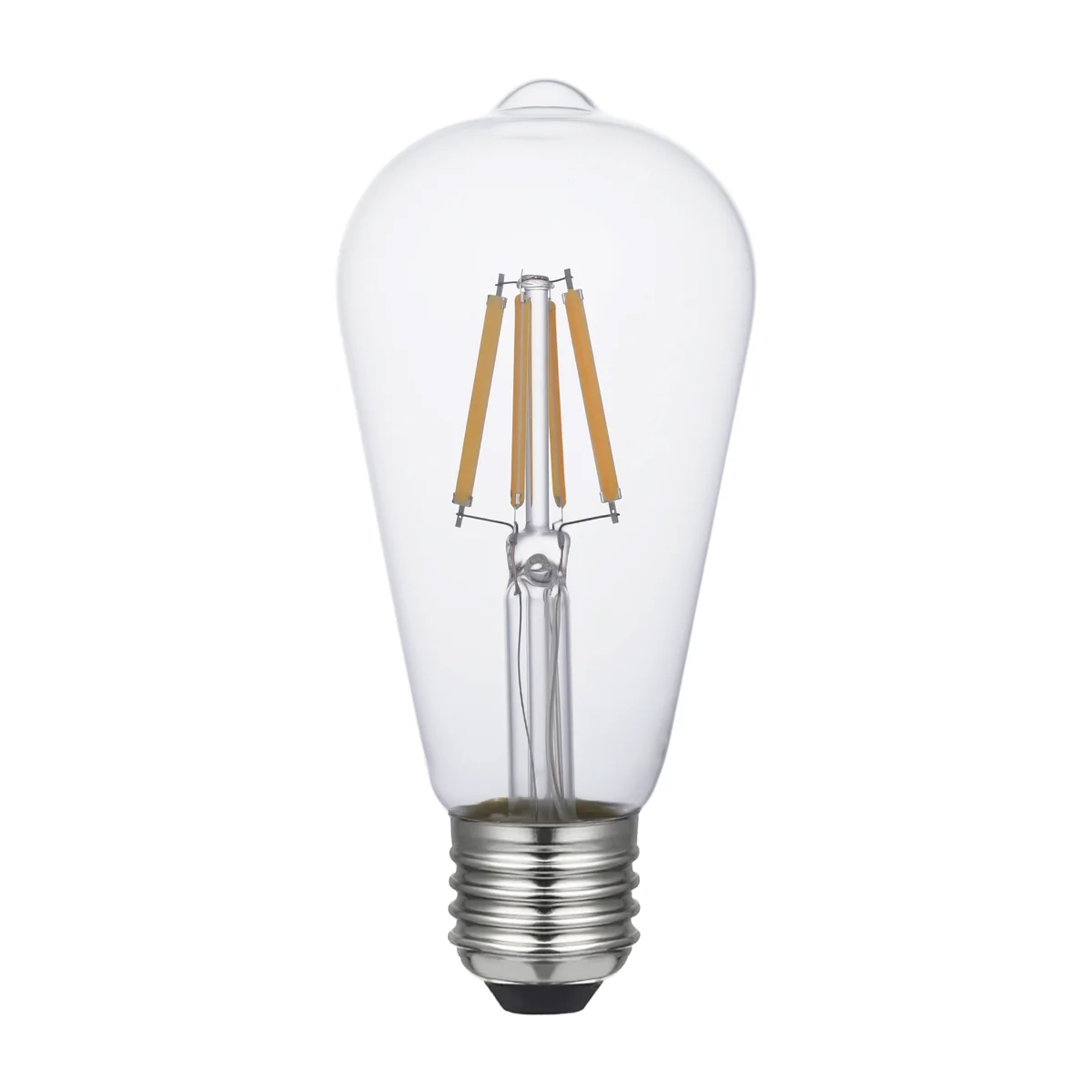
From a factory-control perspective, check the parts that can change without altering the catalogue photo:
- driver topology and PCB revision;
- rectifier, fuse or fusible element where applicable;
- suppression and protection components used in the approved design;
- capacitor type, voltage rating, supplier, and temperature rating;
- critical resistor and semiconductor substitutions;
- insulation spacing and assembly consistency;
- soldering quality and component placement;
- final test program and failure-analysis route.
Do not publish component values as universal quality rankings. A larger part is not automatically a better design, and an MOV alone is not a complete protection strategy. The circuit, thermal environment, failure mode, applicable safety requirements, and available space must be evaluated together.
Five Buyer Judgments Before Approving the Order
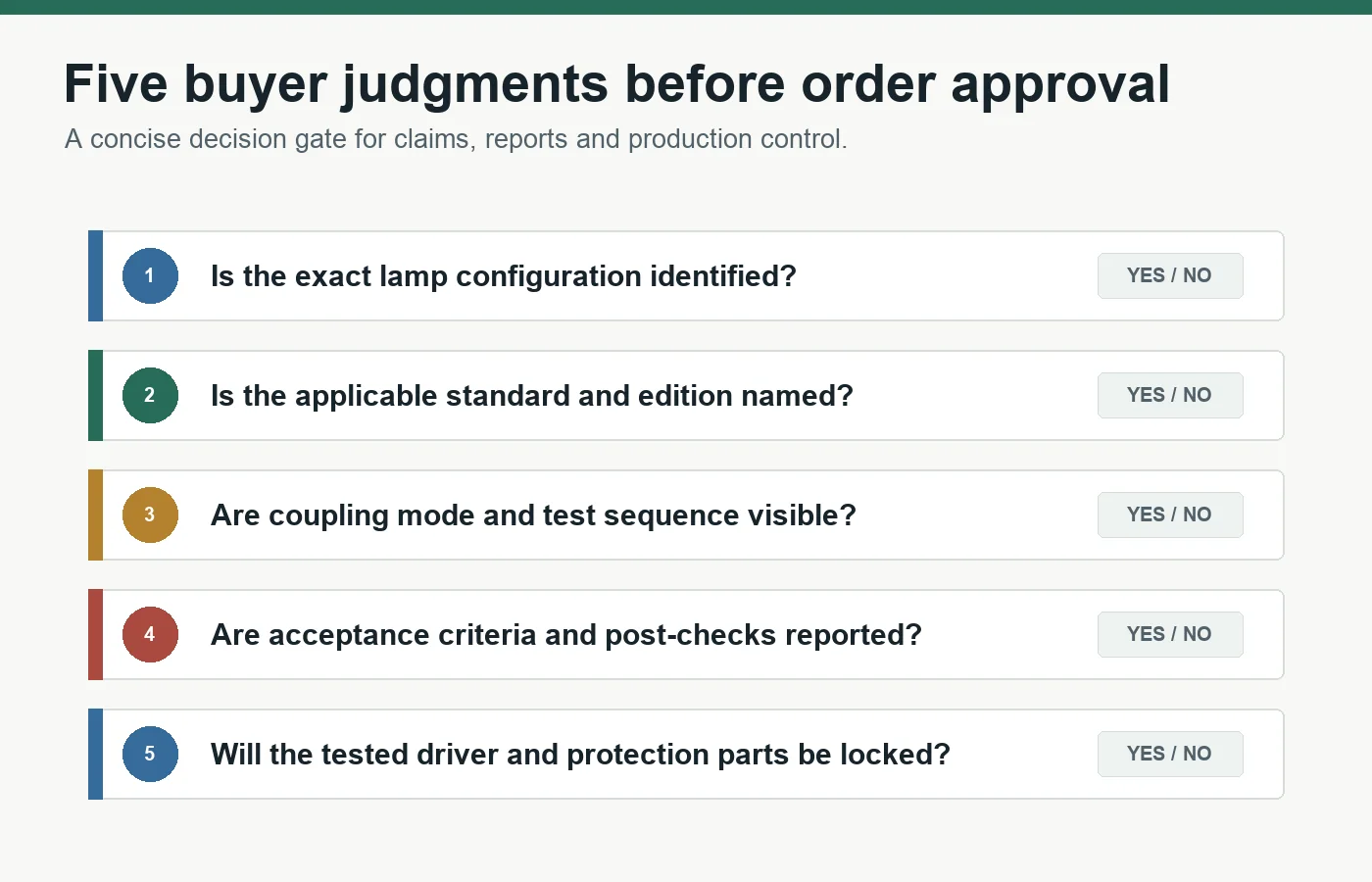
1. Is the tested lamp the lamp you will buy?
Match the report to the quotation and approved sample. Rated voltage, dimming function, power, cap, driver revision, and protection parts must not drift between documents. A report for a 230 V nondimmable lamp does not automatically approve a 120 V dimmable derivative with a different driver.
2. Is the requirement applicable to that product and market?
Use the product-family requirement and destination-market rules, not a test value copied from a different category. If the buyer requests an above-baseline engineering test, label it as a project requirement rather than suggesting that every market requires the same number.
3. Can two suppliers' claims actually be compared?
Put both reports into the same comparison table. If coupling, sequence, operating state, or criterion differs, highlight the difference instead of ranking only the peak voltage. "4 kV" in one context may not be a stronger commercial offer than "2 kV" in another.
4. Did the sample merely relight, or was performance checked?
Define failure before testing. Unsafe behavior and permanent functional failure are obvious rejects. Also decide how to handle automatic restart, intermittent flicker, parameter drift, visible component damage, or a sample that lights but no longer meets the agreed input-power or output tolerance.
5. Can the result survive a component substitution?
The report follows a configuration, not a product name forever. If a key driver or protection part changes because of availability or cost, the supplier should perform a documented engineering review and repeat the relevant verification before shipment.
From Golden Sample to Bulk Production
A useful factory control plan is built around change points rather than slogans.
| Stage | Evidence to retain | Buyer decision |
|---|---|---|
| RFQ | Market, mains range, fixture type, dimming/control system, site risk | Define the applicable baseline and any justified project margin |
| Engineering sample | Sample IDs, circuit revision, BOM, complete test conditions | Approve, reject, or revise the design |
| Golden sample | Photos, markings, electrical data, driver revision, report linkage | Freeze what "approved" means |
| Pilot run | Production-built sample checks and traceability | Confirm the report was not limited to hand-built engineering units |
| Mass production | Incoming-part control, final checks, lot records | Release only the approved configuration |
| Material change | Substitution request and risk review | Decide what must be retested before use |
| Field return | Site record, failed-unit traceability, failure analysis | Separate product defect, application mismatch, and installation event |
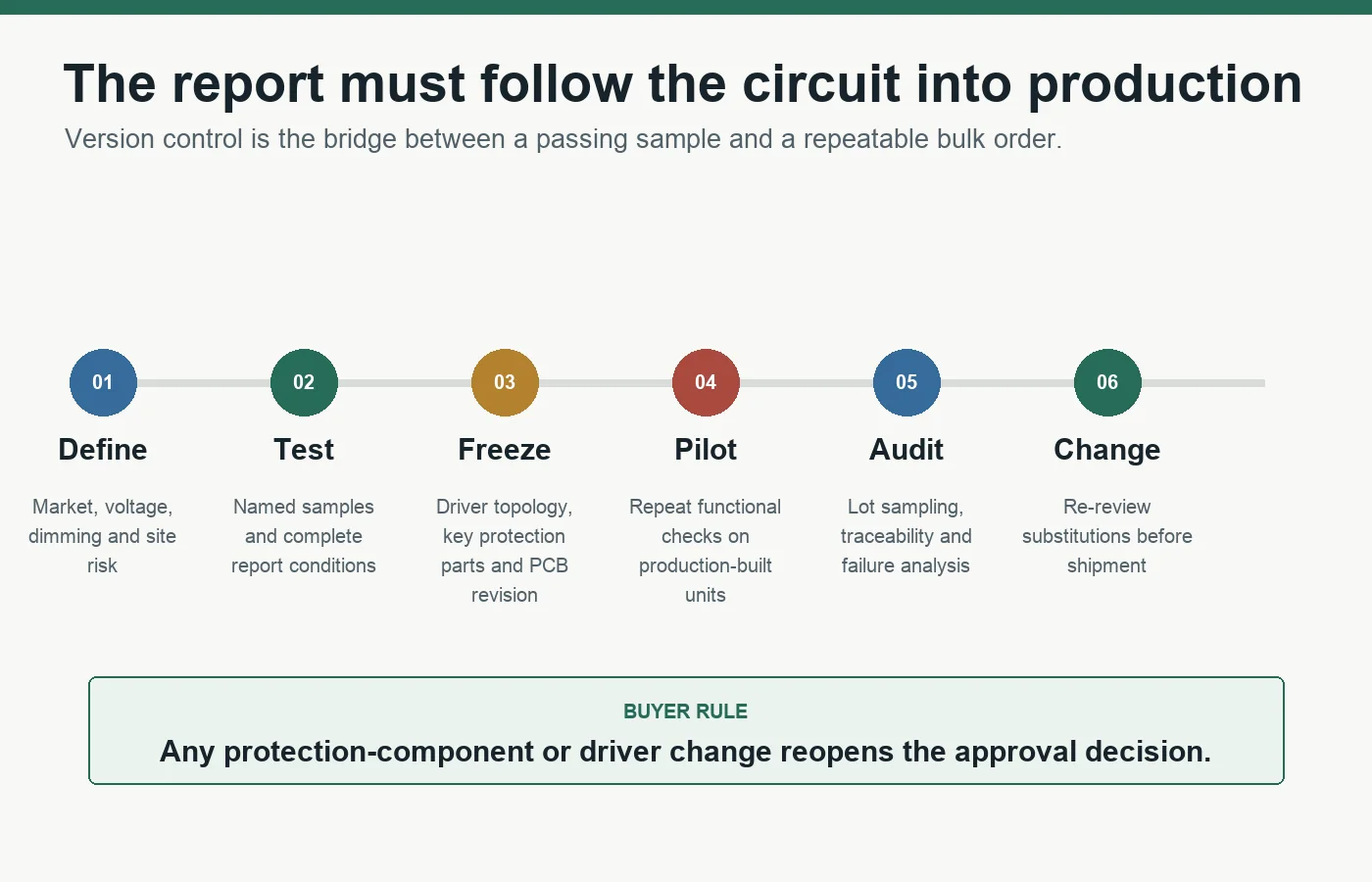
This process is especially important for decorative bulbs because the outer appearance can remain identical through an internal redesign. A buyer inspecting only glass shape, filament layout, and cap finish may not see the electrical change.
If the project primarily needs a specific vintage appearance, HongYu's EU vintage straight-filament bulbs offer a relevant visual range for discussion. Appearance approval and immunity approval should remain separate signoffs, even when they refer to the same sample.
What to Put in the RFQ
The following attachment is more useful than writing only "surge protection required":
| RFQ field | What to specify or request |
|---|---|
| Product identity | Shape, cap, wattage, rated voltage/frequency, dimming state, model and revision |
| Destination | Country/market and intended certification route |
| Application | Open or enclosed fixture, indoor/outdoor boundary, controls, switching equipment and operating hours |
| Baseline evidence | Applicable EMC product standard, edition, report number, laboratory and sample IDs |
| Surge record | Coupling mode, test level, polarity, phase, pulse count, interval and operating state |
| Acceptance criteria | Allowed behavior during exposure and required behavior afterward |
| Post-test checks | Function, visual inspection, input power, power factor where relevant, light output and any agreed tolerances |
| Production lock | Driver/PCB revision and critical protection-component change control |
| Lot verification | Sampling plan, records, and treatment of failures |
| Site protection | Information to be confirmed by the project electrical designer; do not treat lamp testing as the building SPD design |
Never invent a universal kV threshold from this article. The correct value and test configuration depend on the applicable product requirements and the project's electrical environment. Ask the qualified laboratory, compliance professional, supplier engineer, and site electrical designer to own their respective boundaries.
Conclusion
"2 kV tested" can be a valid line in a report. It is not enough information to approve a bulk LED bulb order.
A technically defensible decision identifies the tested lamp, applicable standard and edition, coupling and sequence, performance criterion, and post-test result. A commercially defensible decision goes further: it locks the tested driver configuration, controls substitutions, and treats building-level surge protection as a separate installation responsibility.
The most useful buyer question is therefore not "What is your highest surge number?"
It is "Show me exactly what was tested, what counted as passing, and how that circuit will remain unchanged in my production order."
References
- International Electrotechnical Commission. IEC 61000-4-5:2014, Electromagnetic compatibility - Surge immunity test. Back
- International Electrotechnical Commission. IEC 61547:2020, Equipment for general lighting purposes - EMC immunity requirements. Back
- U.S. Department of Energy, LED Systems Reliability Consortium. LED Luminaire Lifetime: Recommendations for Testing and Reporting. Back
- International Electrotechnical Commission. IEC 61000-4-11:2020, Voltage dips, short interruptions and voltage variations immunity tests. Back
- European Parliament and Council. Directive 2014/30/EU on electromagnetic compatibility. Back
- U.S. Department of Energy. Accelerated Stress Testing Results on Single-Channel and Multichannel Drivers: Final Report. Back
- UL Solutions. Surge Protection Device Testing and Certification Services. Back