Featured image: Original editorial timing illustration. It does not depict a measured waveform or a HongYu switching-cycle rating.
A supplier offers "50,000 switching cycles" for a sensor-controlled hotel corridor. Before approving the bulb, ask for the ON/OFF schedule behind that number. The same cycle count can describe very different powered hours, restart conditions and temperature histories.
A switching claim is useful only when its timing, test conditions, sample identity and failure criteria are defined. A larger number alone is not stronger evidence.
For buyers, approval has three steps: establish the project's actual starts, check what the report tested, and confirm that the delivered configuration matches. The examples below illustrate this process; they are not HongYu ratings or factory results.
Operating Hours and Starts Describe Different Demands
Operating hours measure time powered; starts measure transitions into operation. Both matter, alongside the driver and installation environment. DOE also distinguishes abrupt failure from declining output or light quality: a lamp can remain lit yet no longer meet its purpose.[1]
Powered hours = daily powered hours x operating days per year x years.
Starts = actual starts per day x operating days per year x years.
Consider two hypothetical installations, each running for eight hours per day over five years, using 365 operating days per year:
| Project assumption | Case A | Case B |
|---|---|---|
| Actual starts per day | 20 | 80 |
| Five-year powered hours | 14,600 | 14,600 |
| Five-year starts | 36,500 | 146,000 |
Switching demand differs fourfold despite identical powered hours. These estimates describe demand, not predicted service life; dividing a laboratory cycle rating by daily starts cannot establish a guarantee.
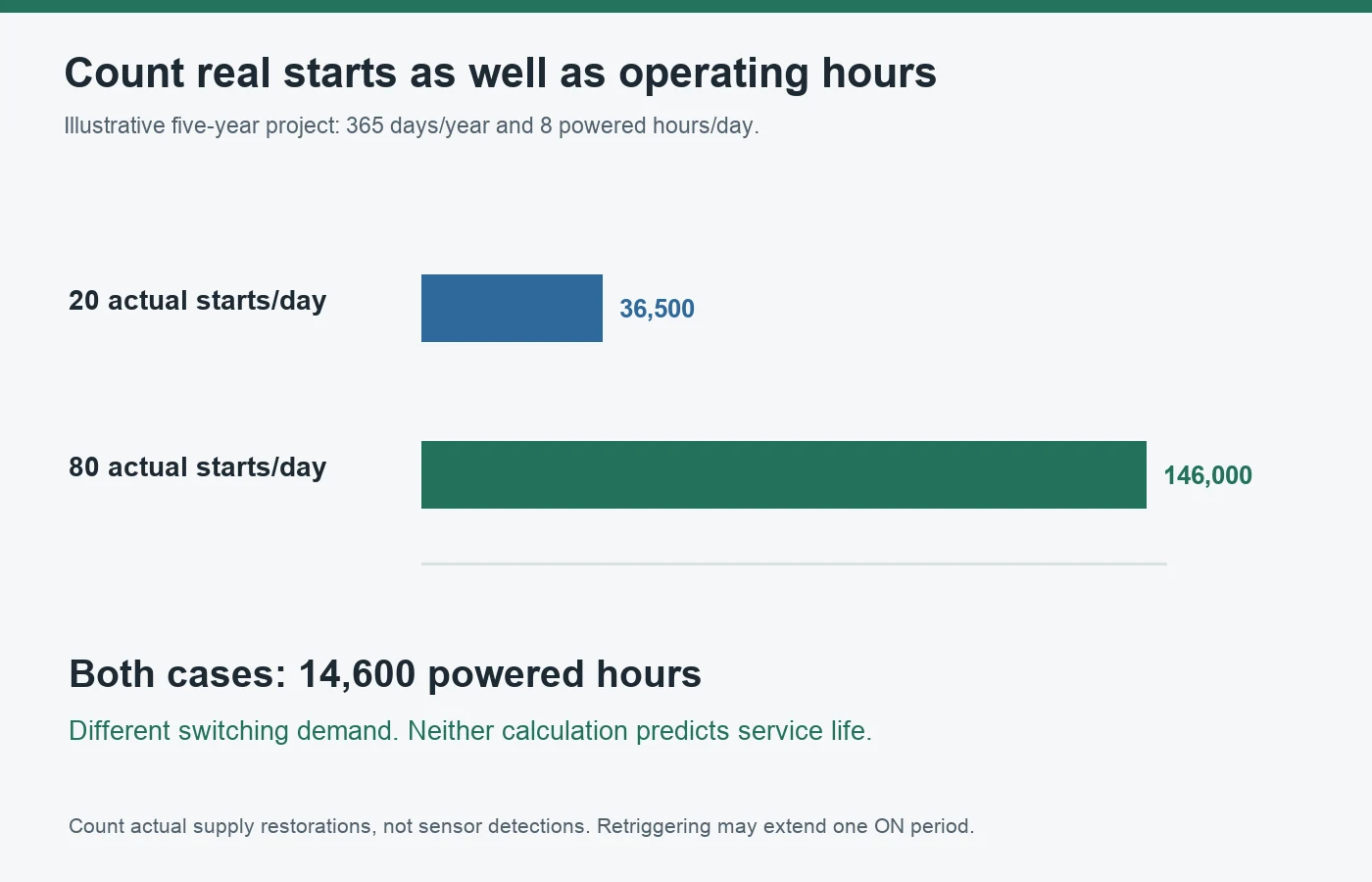
An occupancy detection is not automatically a start: retriggering may simply extend the existing ON period. Count actual supply interruptions and restorations, not foot traffic.
Buyer judgment 1: Record actual supply transitions and powered hours separately. Use a representative busy period and a quiet period to identify the range of ON and OFF durations.
The Same Cycle Count Can Hide 150 Times More Powered Time
Define a cycle first. Here it means one ON/OFF pair. A report counting each transition as an operation would produce a different total for the same history.
Annex V of EU Regulation 2019/2020 specifies an endurance sequence of 1,200 cycles, each with 150 minutes ON at full power and 30 minutes OFF. This corresponds to 3,000 powered hours and 3,600 total elapsed hours. The method includes initial and final luminous-flux measurements and recording failures.[2]
| Schedule | Cycles | ON/OFF duration | Powered hours | Elapsed hours |
|---|---|---|---|---|
| Hypothetical rapid-cycle test | 1,200 | 60 seconds / 60 seconds | 20 | 40 |
| EU Annex V endurance sequence | 1,200 | 150 minutes / 30 minutes | 3,000 | 3,600 |
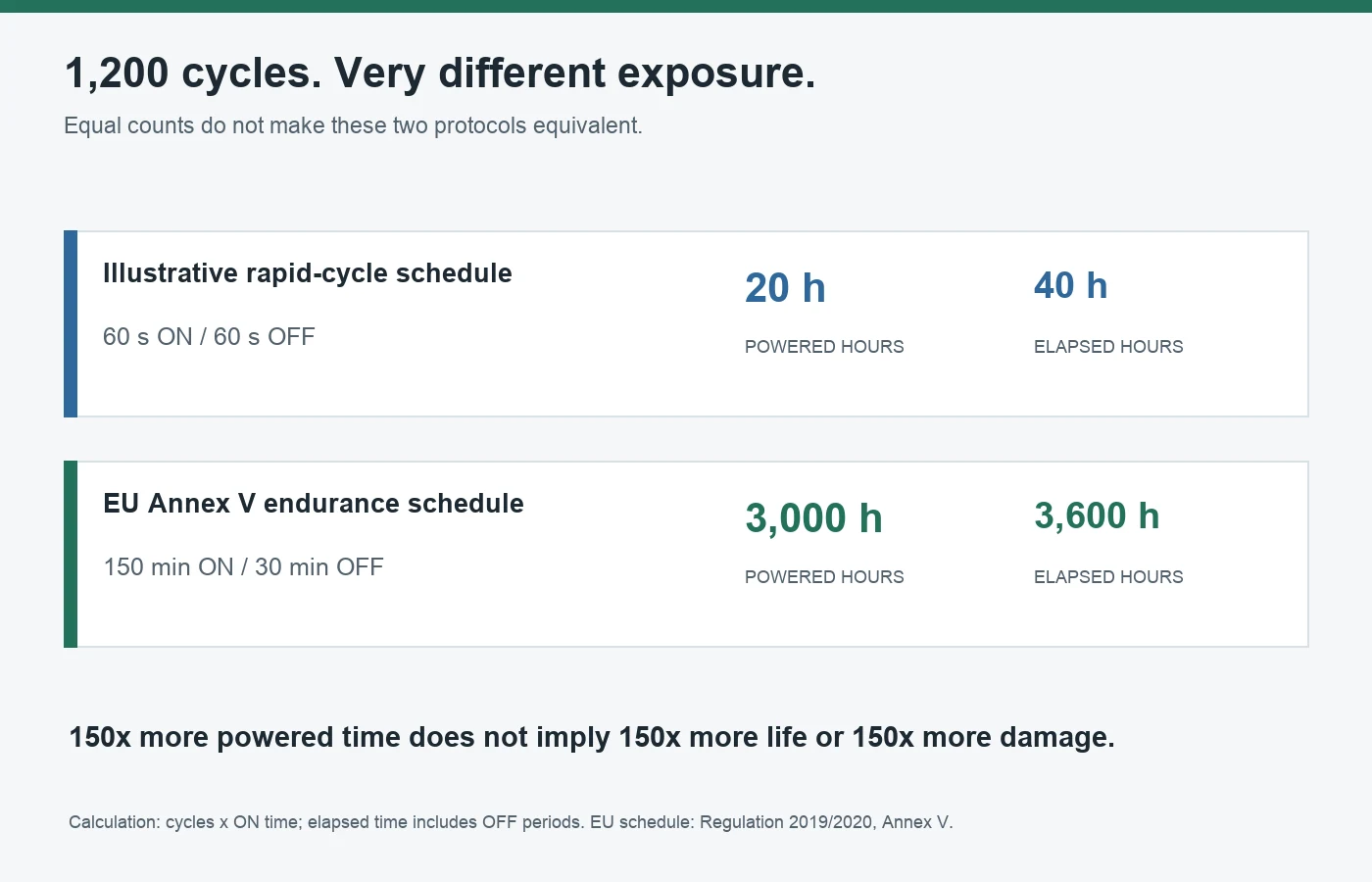
A rapid test can investigate restart behavior; longer dwell can expose behavior after more heating. The rapid example does not replace the Annex V method or establish compliance.
Check the calendar too. The longer sequence requires 150 days of uninterrupted cycling, before preparation and measurements. Parallel rigs test more samples; they cannot shorten each sample's prescribed history. A report promised next week must rely on a test started sufficiently long ago. Request dated logs to check that claim.
Buyer judgment 2: Compare the complete protocol before comparing cycle counts. Reject a summary that omits ON time, OFF time or whether the count refers to cycles or individual transitions.
OFF Time Changes the Next Start
Dark does not necessarily mean electrically discharged or thermally cooled. Depending on the driver, stored charge and component temperature can affect the next start.
For example, an NTC inrush limiter changes resistance with temperature. TDK explains why cooling matters to restoring its limiting behavior before another start.[3] This mechanism applies only where such a component is used; it does not establish the circuit or cooling time of a HongYu bulb.
ON duration matters too. In a DOE-funded dim-to-warm study, researchers measured thermal profiles and selected dwell times using a criterion based on reaching 95% of the temperature change toward stabilization.[4] That product-specific research protocol is not a universal timing rule.
Ask what the intervals represent: warm restarts, defined cooling, observed field operation or a named standard. Request the temperature history or method supporting the choice. A shorter schedule needs a technical justification before being treated as equivalent.
Buyer judgment 3: Include both relevant warm-restart behavior and cooling conditions in the qualification plan. Do not describe every short OFF interval as a cold start.
Test the Ordered Lamp and the Actual Control
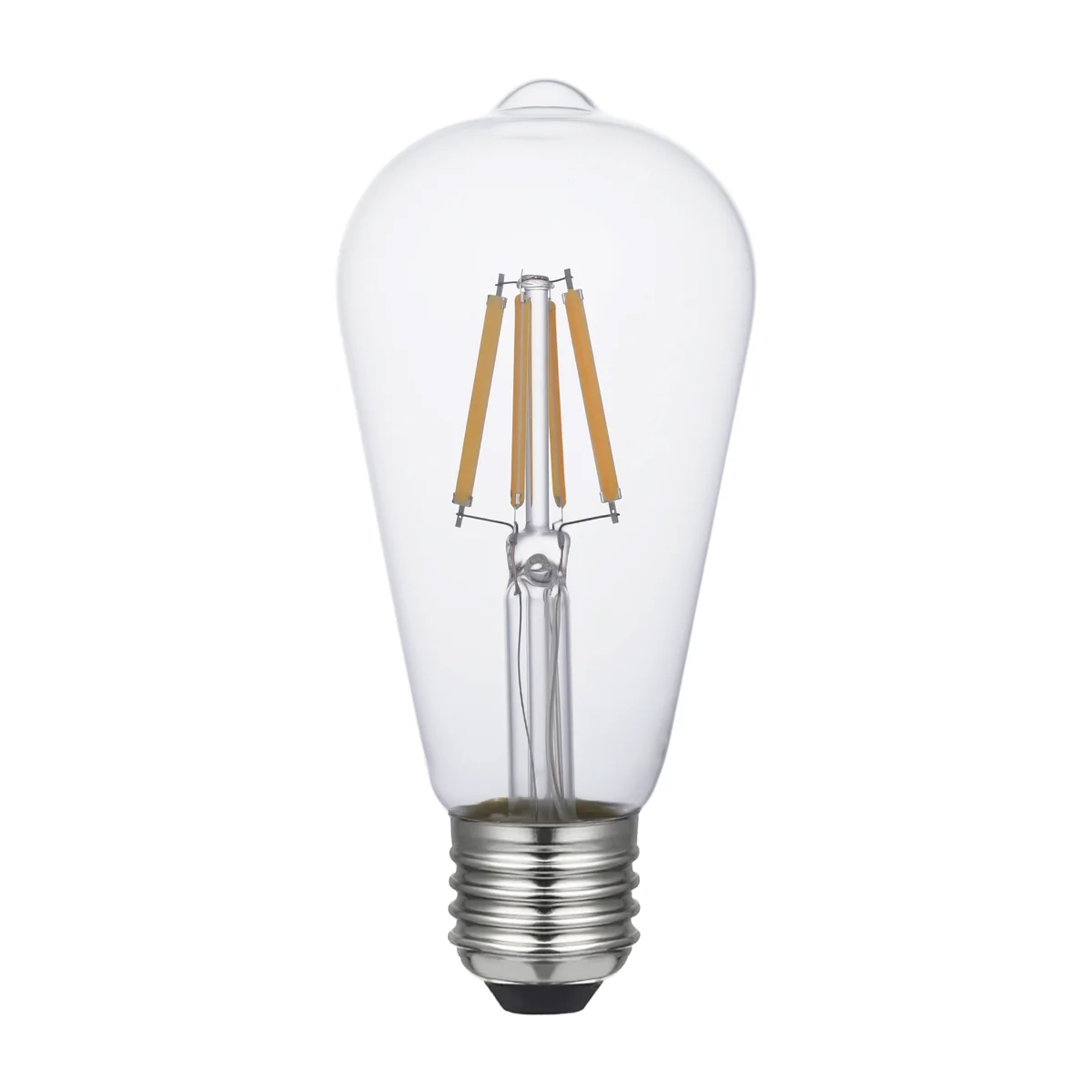
When specifying an ST64 from HongYu's EU standard filament bulb range, identify the exact item, voltage, wattage, dimming option and driver revision. A report for another ST64 does not establish equivalence just because the glass and cap match.
A bench relay may not reproduce an electronic sensor or dimmer. Lutron documents how leakage current and load requirements can cause LED glow or intermittent flashes.[5] Likewise, a smart command setting light output to zero may leave the driver powered. Identify whether the test switches mains power, a control signal or both.
For compact fittings using mini LED filament bulbs, confirm the permitted installation and evaluate the intended holder. An open-bench result does not describe temperature history inside a restricted fitting.
With dim-to-warm LED bulbs, check restart at the intended dimming settings and the expected color response, not merely full-power operation.
Use the actual controller, timeout settings, and minimum and normal connected loads. Record the configuration so later substitutions can be reviewed.
Define Failure Before Running the Test
"Still lights at the end" can miss intermittent restart faults or a progressive decline in useful output. Record initial performance and repeat the relevant measurements at agreed checkpoints, under comparable conditions.
| Observation | Evidence to record | Acceptance requirement to agree |
|---|---|---|
| Failure to start | Sample ID, cycle number, input present, recovery behavior | Treatment of a single missed start and repeat faults |
| Delayed restart | Time from supply restoration to the defined light level | Maximum delay under specified conditions |
| Flashing or unstable startup | Synchronized light response and supply record where needed | Permitted startup behavior and observation method |
| Output or color change | Baseline and checkpoint measurements | Product-specific limits and measurement conditions |
| Abnormal noise or physical change | Reproducible observations and photographs | Defined rejection and investigation criteria |
| Controller malfunction | Control state, load quantity and lamp response | Required operation of the complete combination |
A replacement sample cannot inherit a failed lamp's cycles. Keep both histories, record test-rig interruptions, and preserve intermittent faults even if the lamp subsequently restarts.
Buyer judgment 4: Require a per-sample result, the failure definition and the checkpoint schedule. A final photograph of illuminated bulbs cannot establish the history between the first and last cycle.
Keep Qualification, Production Screening and Lifetime Claims Distinct
IEC 62612's public description distinguishes its performance test regime from a real lifetime test.[6] Request the edition, applicable clauses and actual report when a supplier cites it.
Keep three production controls separate:
- Qualification: evidence for an identified design under defined conditions.
- Production screening: checks for the defects covered by that screen; a short check cannot establish long-duration endurance.
- Ongoing monitoring: sampling subsequent production to detect changes in behavior.
Trace the approved report to the order's driver/BOM and assembly revision. An internal component substitution may change startup or thermal behavior without changing the bulb's appearance.
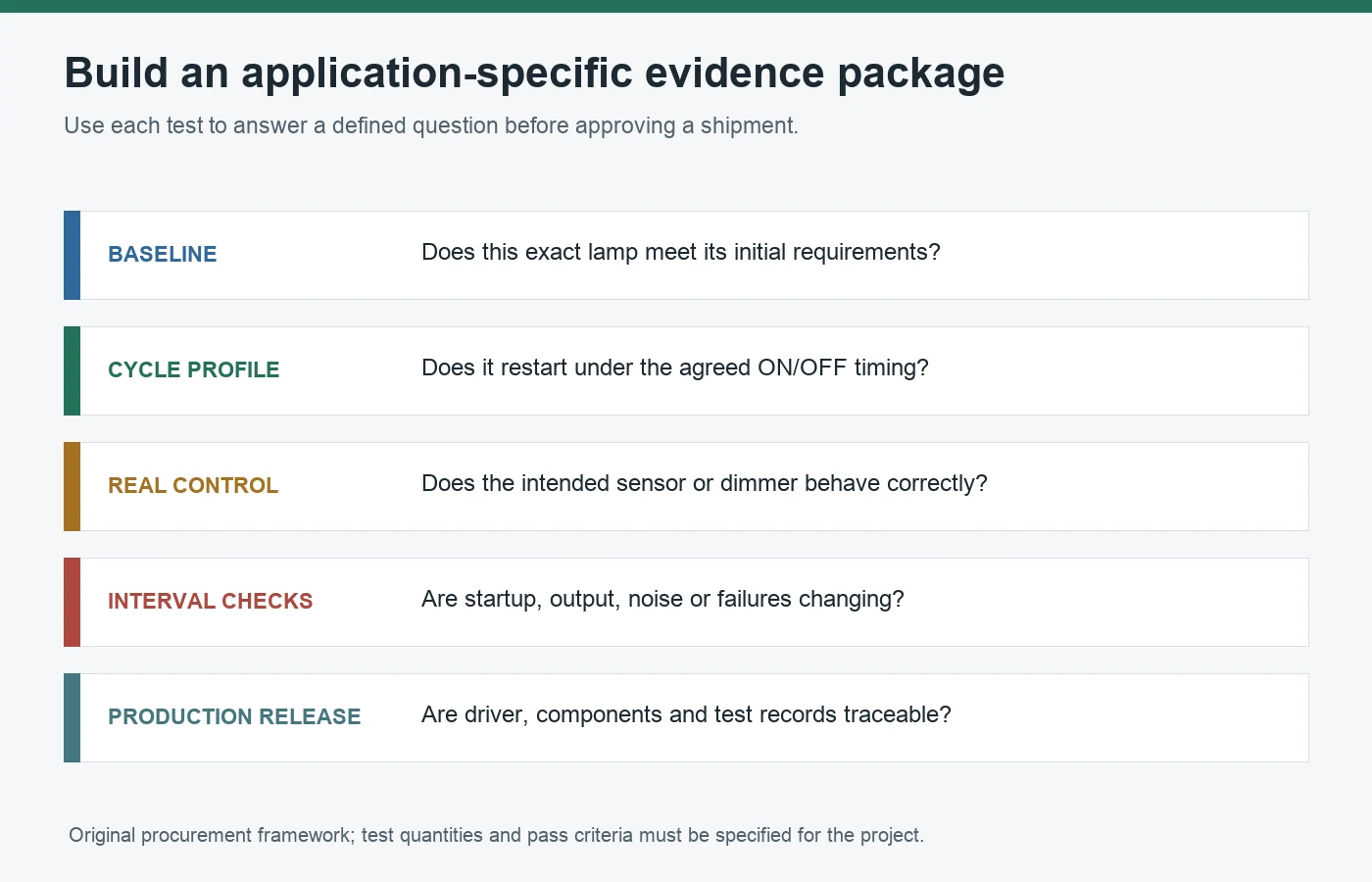
Buyer judgment 5: Tie the approved cycle report to the production revision and intended control. Treat a relevant change as a reason to review or repeat the affected tests.
What to Add to the RFQ
Use this attachment to request comparable evidence and a realistic validation schedule.
| RFQ field | Information to provide or request |
|---|---|
| Application | Location, fixture, daily powered hours and expected actual starts |
| Lamp identity | Model, cap, voltage/frequency, wattage, CCT, finish and dimming option |
| Definition of a cycle | One ON/OFF pair or individual transitions; counting method |
| Timing | ON duration, OFF duration, timing tolerances and any sequence variations |
| Electrical conditions | Supply voltage/frequency, switching method, control model and connected load |
| Thermal conditions | Ambient, orientation, permitted enclosure and cooling criterion |
| Test basis | Applicable standard and edition; separate application-specific protocol if needed |
| Samples | Quantity, selection method, lots/revisions and individual sample IDs |
| Checkpoints | Start reliability, output, color, noise and physical observations as applicable |
| Failure criteria | Predetermined limits, intermittent faults, failure logging and stop conditions |
| Production control | Screening, ongoing sampling, revision control and retest triggers |
| Deliverables | Full report, timing records, sample results and identified test configuration |
Ask the factory to separate existing evidence from proposed testing. Then make the approval decision explicit:
- Request clarification when the count is supplied without timing, sample identity or failure criteria. The omission makes the claim unassessable; it does not by itself prove the bulb is poor.
- Hold application approval when the report identifies a different driver, control or installation and no equivalence justification is available. Agree the missing review or test before release.
- Reject the submitted evidence when replacement samples inherit cycles, failed units disappear from the result, or dates cannot accommodate the stated sequence. Request corrected, traceable records.
A complete report enables assessment against agreed criteria. It does not automatically prove suitability for every sensor-controlled project.
Conclusion
Buy against the project's actual starts and operating conditions, then approve the identified lamp/control combination using traceable results. Keep the test protocol with the purchase specification so a later substitution triggers review.
Before accepting "50,000 switching cycles," ask: How long was the bulb ON and OFF, what condition did the next start begin from, and which failures would the test have recorded?
References
- U.S. Department of Energy. Lifetime and Reliability: Solid-State Lighting Technology Fact Sheet. Back
- European Commission. Regulation (EU) 2019/2020, Annex V: Functionality after endurance testing. Back
- TDK Electronics. Always on the Safe Side: Inrush Limiting and Restart Conditions. Back
- U.S. Department of Energy / RTI International. Dim-to-Warm LED Lighting: Stress Testing Results for Select Products, section 2.2.1. Back
- Lutron. Application Note 487: Minimum and Maximum Loads for LED and CFL Lamps/Fixtures. Back
- International Electrotechnical Commission. IEC 62612:2013, Self-ballasted LED Lamps: Performance Requirements. Back