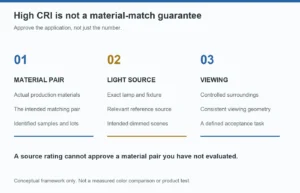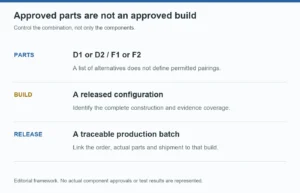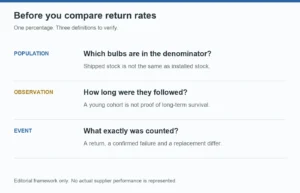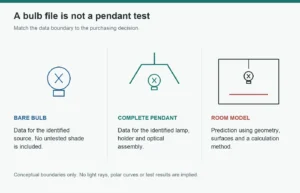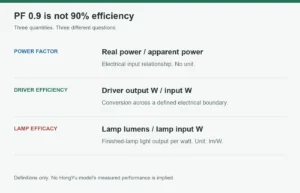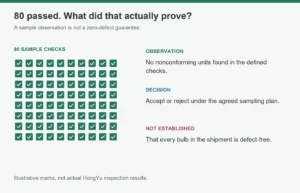
Featured image: Original editorial illustration of the report-review process, not a laboratory certificate.
A supplier sends a three-page LED bulb report: a spectrum, color diagrams, electrical readings and numbers to four decimal places. It looks more convincing than a quotation. But can you use it to approve the product you are ordering?
A useful report must connect the measured sample to the purchase specification. Numerical detail cannot replace sample identity, a stated method or a defined acceptance rule.
This guide follows five checks a buyer can complete before commissioning more testing. A real ST64 report supplied for this review provides the worked example. It is an instrument output used for document review here, not presented as an independently verified certification or a production-lot approval.
1. Establish Which Sample Was Actually Tested
Start with the report identity, before reading the attractive headline numbers.
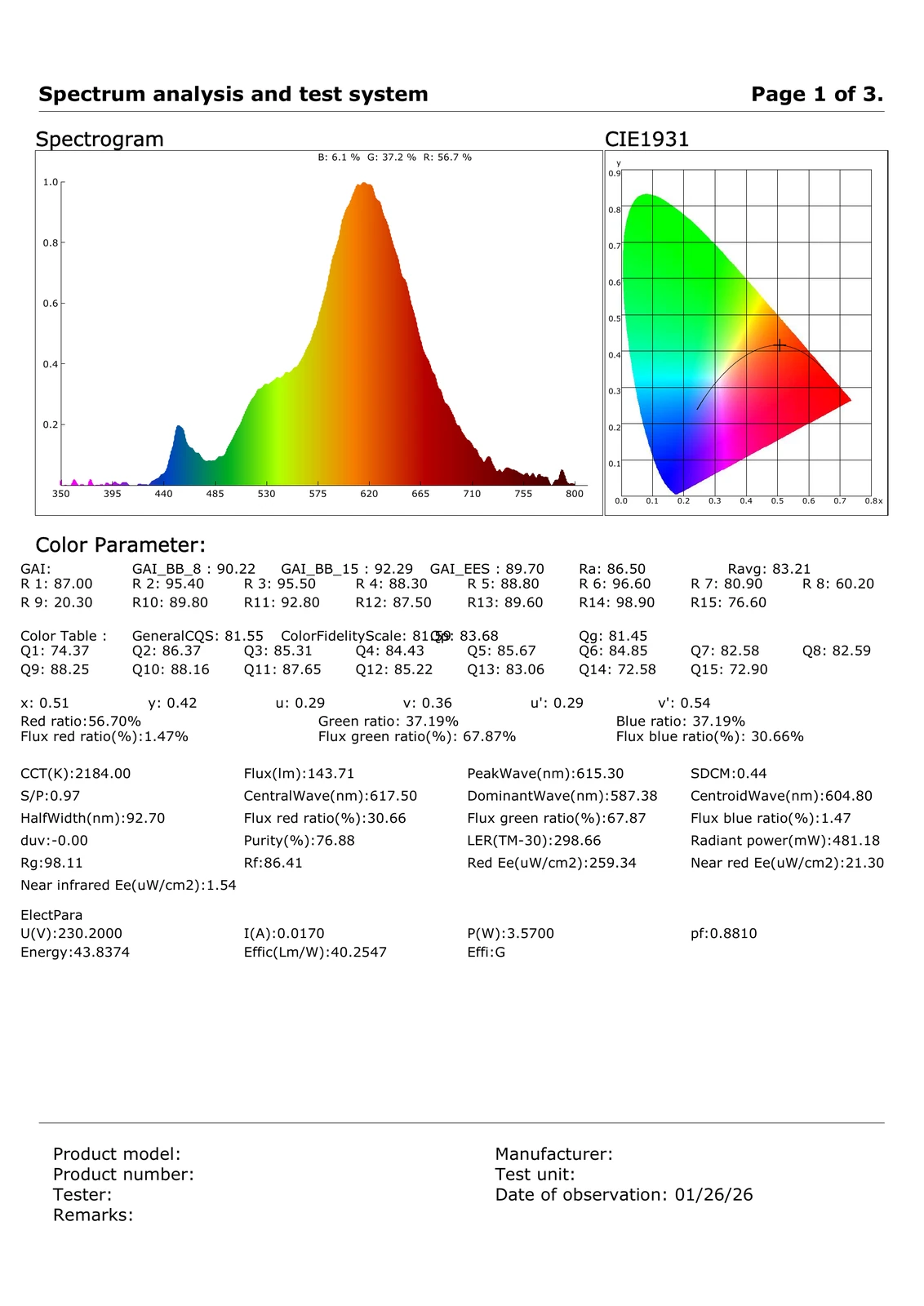
The supplied PDF is named for a 230V, 4W smoked-glass ST64 bulb with a 2200K filament. Its pages show an observation date of January 26, 2026, but the visible product model, product number, manufacturer, test unit and tester fields are blank. A descriptive filename helps organize a file; it does not create a traceable link to the sample or purchase order.
That does not make the measurements worthless. It means the buyer needs the missing identification before using them for approval.
For an ST64 selected from the EU standard filament bulb range, record more than the shape: item code, glass finish, rated input, dimming option, driver revision and sample ID. A clear-glass result should not automatically approve a smoked-glass order. Likewise, identical appearance does not establish an identical driver.
| Identity check | Evidence to request |
|---|---|
| Document | Report number, revision, issue date and complete page set |
| Physical sample | Unique ID, photograph and marking tied to the report |
| Ordered configuration | Item code, finish, voltage, wattage and dimming option |
| Production relationship | Sample source, lot or build revision, and any differences from the intended order |
Buyer judgment 1: Hold sample approval when the report cannot be tied to the ordered configuration. Request a traceable clarification or corrected report; do not fill the issuer's blank fields yourself.
2. Check the Method and the Laboratory's Actual Scope
An integrating-sphere printout is not automatically an LM-79 report. ANSI/IES LM-79-24 describes optical and electrical measurements of solid-state lighting products under stated conditions, including flux, input power, efficacy, distribution and color quantities.[1] A colorful spectrum alone does not show that its procedures were followed.
Ask which method and edition were used, which measurements the report covers, and whether any deviations were recorded. Check supply voltage and frequency, operating mode, orientation, ambient conditions and stabilization. A full-power measurement cannot establish performance at a dimmer's lowest setting.
For dim-to-warm LED bulbs, request results at the agreed operating points. One full-output CCT reading cannot demonstrate the dimming curve, low-end behavior or the intended change in color.
If accreditation is claimed, verify the laboratory in its accreditation body's directory and read the relevant scope. ILAC explains that accredited activities are defined by that scope and that the accreditation bodies maintain their laboratory lists. ILAC itself does not issue product test reports.[2]
An internal factory measurement can support development and production checks. When the contract requires accredited testing, that internal record cannot simply be relabeled as the required independent report.
Buyer judgment 2: Match the evidence level to the purchase requirement. A logo, instrument brand or spectrum image does not establish accredited coverage of the requested test.
3. Recalculate the Values That Should Agree
Arithmetic is an inexpensive screening tool. It can expose a transcription problem, a stale field or measurements taken at different operating points before the buyer spends money on retesting.
The supplied ST64 page lists these values:
| Report field | Displayed value |
|---|---|
| Luminous flux | 143.71 lm |
| Input power | 3.5700 W |
| Luminous efficacy | 40.2547 lm/W |
| Voltage | 230.2000 V |
| Current | 0.0170 A |
| PF | 0.8810 |
The optical calculation agrees
Luminous efficacy is luminous flux divided by electrical input power, expressed in lm/W.[3]
143.71 lm / 3.57 W = 40.2549 lm/W.
That is consistent with the displayed 40.2547 lm/W after allowing for the limited digits shown in the inputs. It is a useful cross-check, not proof that the instrument was calibrated or that another sample will match.
The electrical fields need clarification
For a single-phase load, true power factor relates real power to apparent power: PF = P / (V RMS x I RMS).[4] If the page's voltage and current are RMS measurements from the same operating point, the displayed values imply:
3.57 / (230.2 x 0.0170) = approximately 0.912, rather than 0.881.
Conversely, 3.57 W at 230.2 V and PF 0.881 implies approximately 0.01760 A, or 17.60 mA, rather than 17.0 mA. Ordinary rounding at the displayed current resolution does not bridge that difference.
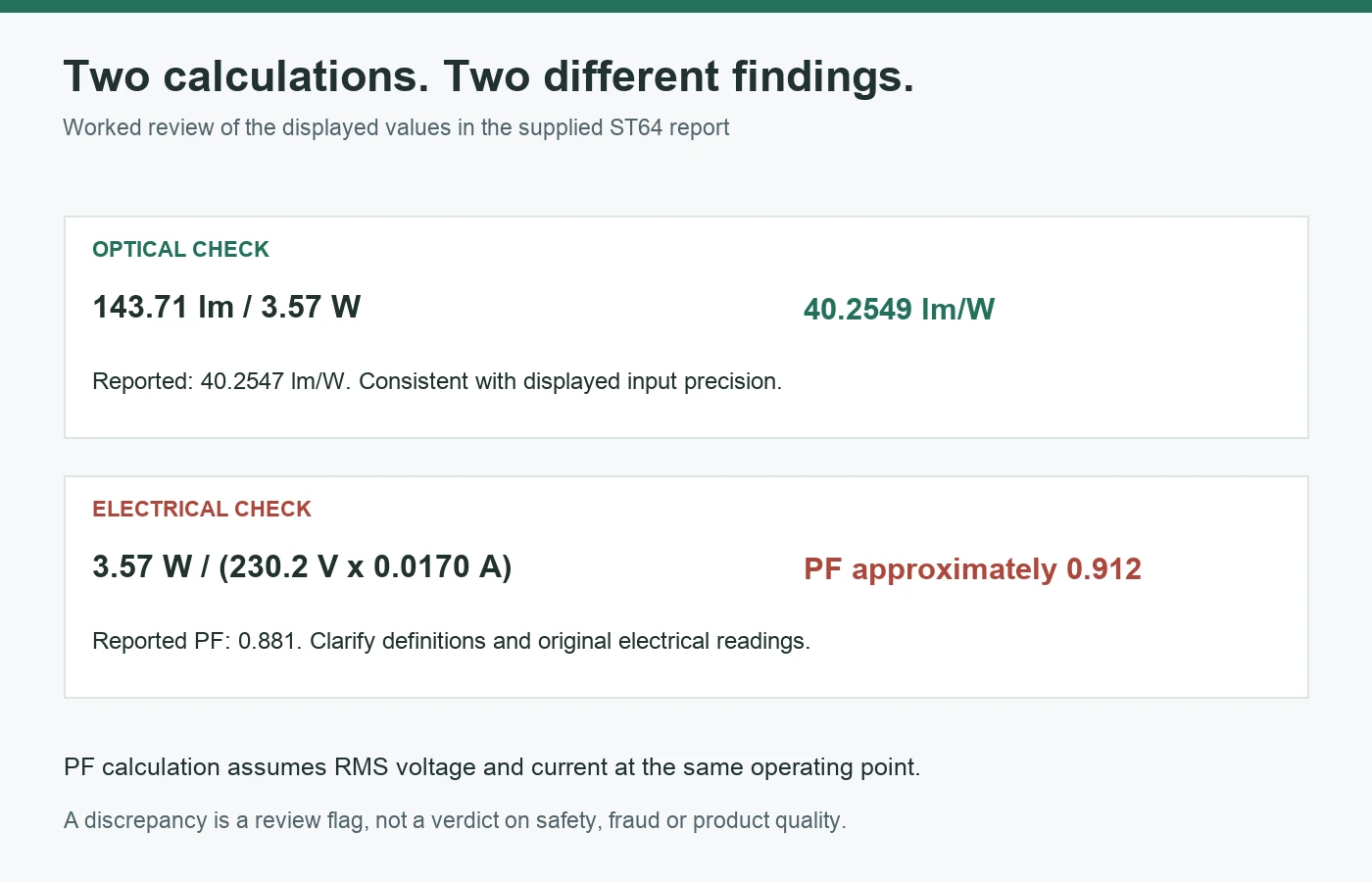
Ask the issuer for the original electrical export, definitions of the fields and measurement timestamps. Confirm whether PF means true power factor or another reported quantity, and whether the values were captured together. Preserve the original file and request a dated revision if a correction is needed. Do not silently replace the displayed current or PF with your calculation.
Buyer judgment 3: Resolve inconsistent fields before relying on them. An arithmetic discrepancy justifies a question; it does not establish fraud, an unsafe bulb or the cause of the discrepancy.
4. Separate Display Precision From Measurement Confidence
Four decimal places are a display choice, not a certificate of accuracy. Measurement uncertainty describes the range of values reasonably attributable to the measured quantity using the available information; the BIPM's metrology vocabulary treats uncertainty as part of a measurement result.[5]
The same report illustrates why the complete page set matters. Page 1 prints Duv as -0.00; page 2 prints -0.00001. Those displays can be consistent at different rounding levels. Reading the first as proof of exactly zero Duv would overstate what it says.
For borderline acceptance, ask for the measurement uncertainty, relevant test conditions and the agreed decision rule. ILAC G8 provides guidance on using decision rules when reporting conformity with specifications.[6] Do not invent an uncertainty allowance after seeing an inconvenient result, or use instrument resolution as a substitute for uncertainty.
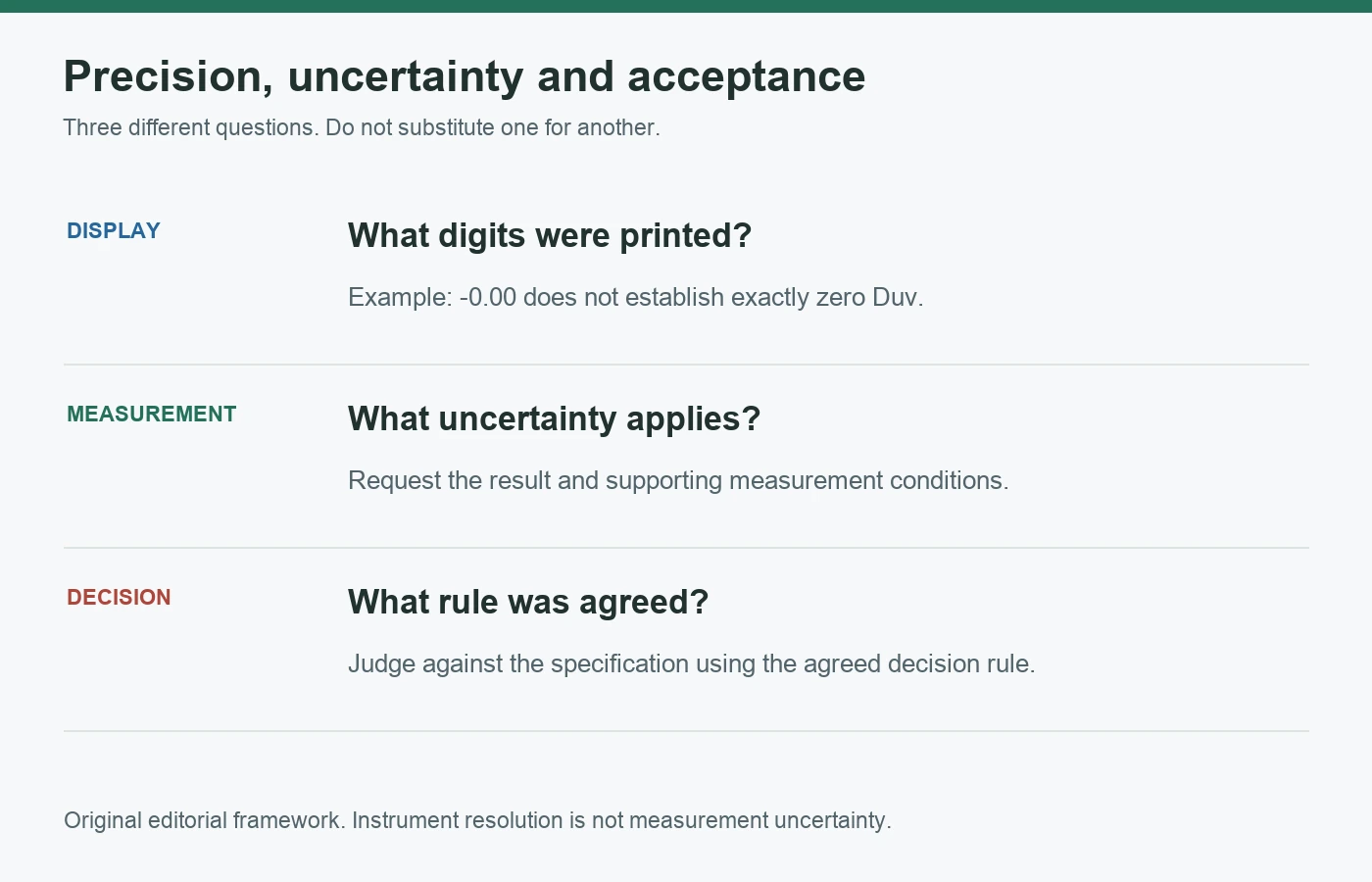
Buyer judgment 4: Agree how close-to-limit results will be judged before testing. Request the complete result, rather than declaring a pass from the most favorable rounded number.
5. Limit Approval to What the Report Actually Demonstrates
A sample report is useful evidence about identified measurements under identified conditions. It is not a universal product passport.
| Evidence in hand | What still needs separate evidence |
|---|---|
| Initial flux, CCT and color data | Long-term maintenance and production consistency |
| Electrical readings at full power | Compatibility with the intended control and load |
| One tested sample | A lot acceptance decision under the agreed sampling plan |
| A report for one finish or driver | Justification for applying it to a different configuration |
| Photometric measurements | Applicable safety, EMC and other market-entry requirements |
This matters when ordering oversized decorative bulbs: a shared filament description does not establish that a larger finished lamp has the same optical, thermal or electrical behavior as the tested model. Ask for evidence covering the actual item or a documented explanation of what can be transferred and what needs testing.
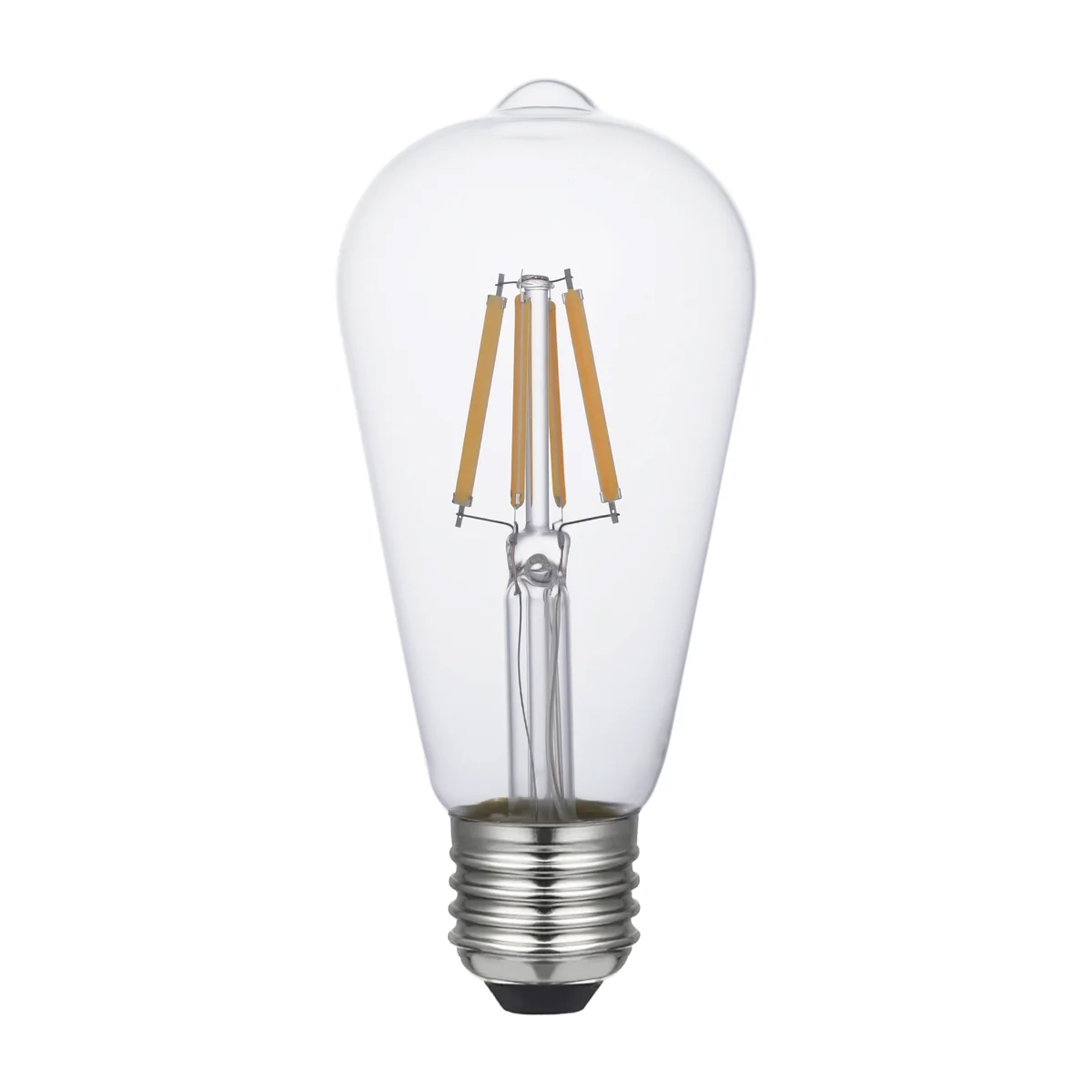
Buyer judgment 5: State what is approved, for which model and revision, and what remains unverified. A good sample result does not authorize an undocumented substitution or release an entire shipment.
Turn the Review Into a Clear Supplier Request
Keep the review actionable. Use a short issue register instead of returning the PDF with a general complaint that it is "not professional."
| Finding | Requested response | Approval status |
|---|---|---|
| Missing sample linkage | Identified report, sample photograph and order mapping | Pending identity confirmation |
| Method or accreditation unclear | Method, edition, test conditions and applicable scope | Pending evidence required by contract |
| Numbers do not reconcile | Raw export, field definitions and explained correction if needed | Affected conclusion on hold |
| Result close to a limit | Uncertainty and the agreed decision rule | Apply that rule, not ad hoc rounding |
| Evidence is for another model or lot | Equivalence rationale, additional test or lot inspection | No automatic extension of approval |
For the worked example, the immediate requests are specific: complete the sample linkage and clarify the electrical fields. Repeating the entire photometric test is not automatically the first step. The optical arithmetic already agrees; the unresolved questions should determine the next action.
Conclusion
Review an LED bulb report in this order: identity, method, arithmetic, uncertainty and scope of approval. This separates an impressive-looking file from evidence that can support a purchase decision.
Keep the original report, the issuer's clarifications and the final approval together with the order specification. The useful deliverable is not more decimal places; it is a record showing exactly which product was assessed, on what basis, and with which questions resolved.
References
- Illuminating Engineering Society. ANSI/IES LM-79-24: Optical and Electrical Measurements of Solid State Lighting Products. Back
- ILAC. Frequently Asked Questions: Reports, Accreditation and Laboratory Scope. Back
- U.S. Department of Energy. Energy Efficiency of LEDs. Back
- NIST. Characterization of Residential Distributed Energy Resource Potential to Provide Ancillary Services, electrical-power definitions. Back
- BIPM / JCGM. International Vocabulary of Metrology: Measurement Uncertainty. Back
- ILAC. Guidance Documents: G8 Decision Rules and Statements of Conformity. Back