Why Glass Type Is a Hidden Variable in Bulb Sourcing
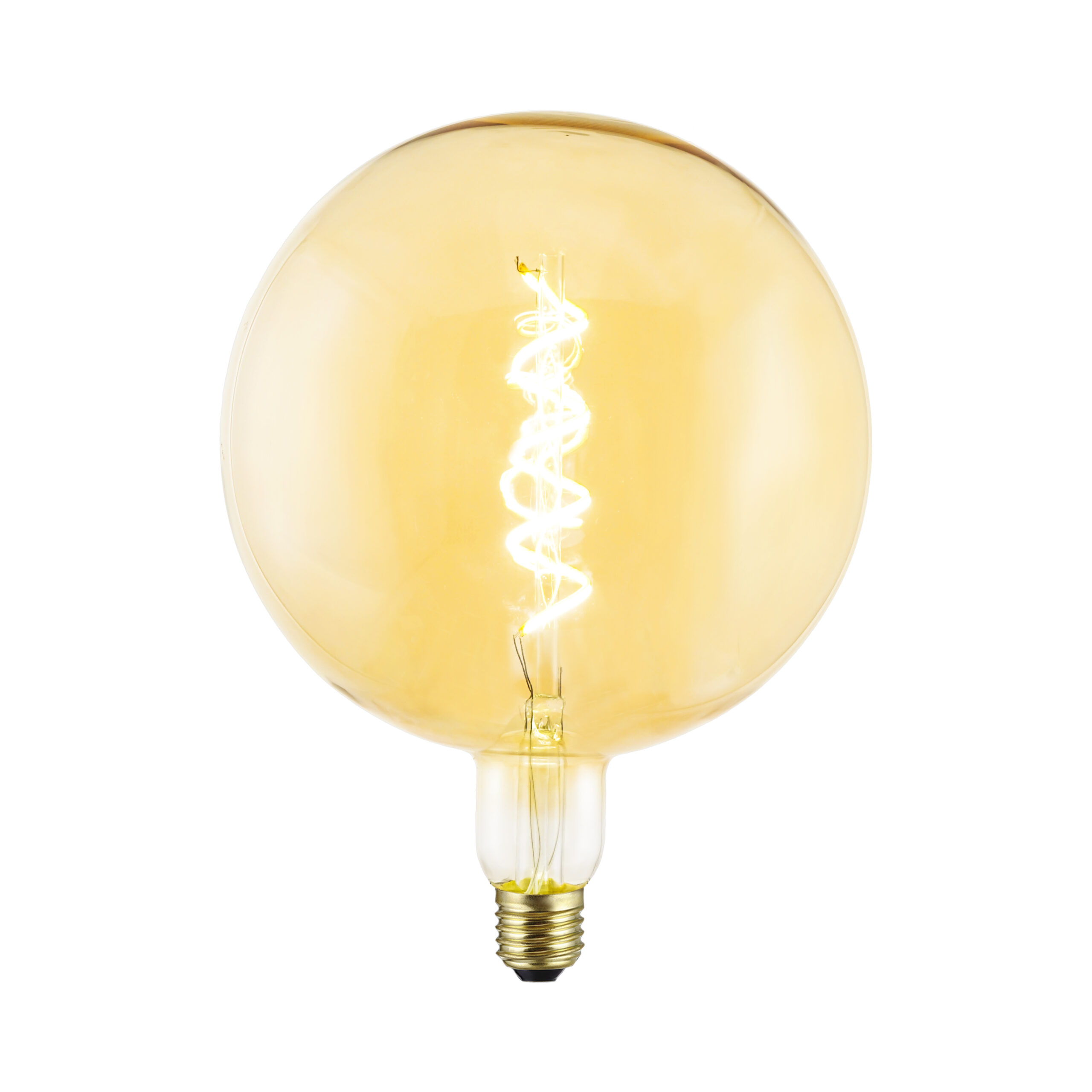
Here is a sourcing error that happens quietly: a buyer adds an oversized G200 globe to a product line, sends an RFQ to their existing supplier, and receives a quote that is three times the expected price — followed by a lead time that blows the launch schedule. The reason is never disclosed clearly. It is simply that the G200 requires borosilicate hand-blown glass, and that supplier does not make it. Glass type is one of the most commonly overlooked variables in decorative LED filament bulb sourcing, and it carries real cost and schedule consequences when it is wrong.
The reason is structural. Glass type is not just a material choice; it is a manufacturing process choice. The glass used in a standard A60 bulb and the glass used in an oversized G200 globe are produced by entirely different methods, by different workers or machines, and often by different factories. A supplier who quotes confidently on a 10,000-unit order of A60 filament bulbs may have zero capability to produce G150 bulbs — not because of any deficiency, but because borosilicate hand-blowing is a distinct craft operation that most high-volume LED factories do not maintain in-house.
For B2B buyers — importers, private-label lighting brands, project-specification wholesalers — understanding the glass divide is a prerequisite for accurate sourcing. According to the U.S. Department of Energy's LED Lighting resource[1], LED filament technology has expanded rapidly into decorative and vintage-style segments, precisely where glass shape variety is greatest and where this specification gap most often appears. Getting it wrong means delayed samples, renegotiated prices, and occasionally being redirected to a second supplier mid-development.
This article breaks down the two glass systems used in LED filament bulb production, explains where each applies, and details the specific sourcing mistakes that trip up buyers who treat glass as an afterthought.
Soda-Lime Glass: The Standard Choice for Most LED Filament Bulbs
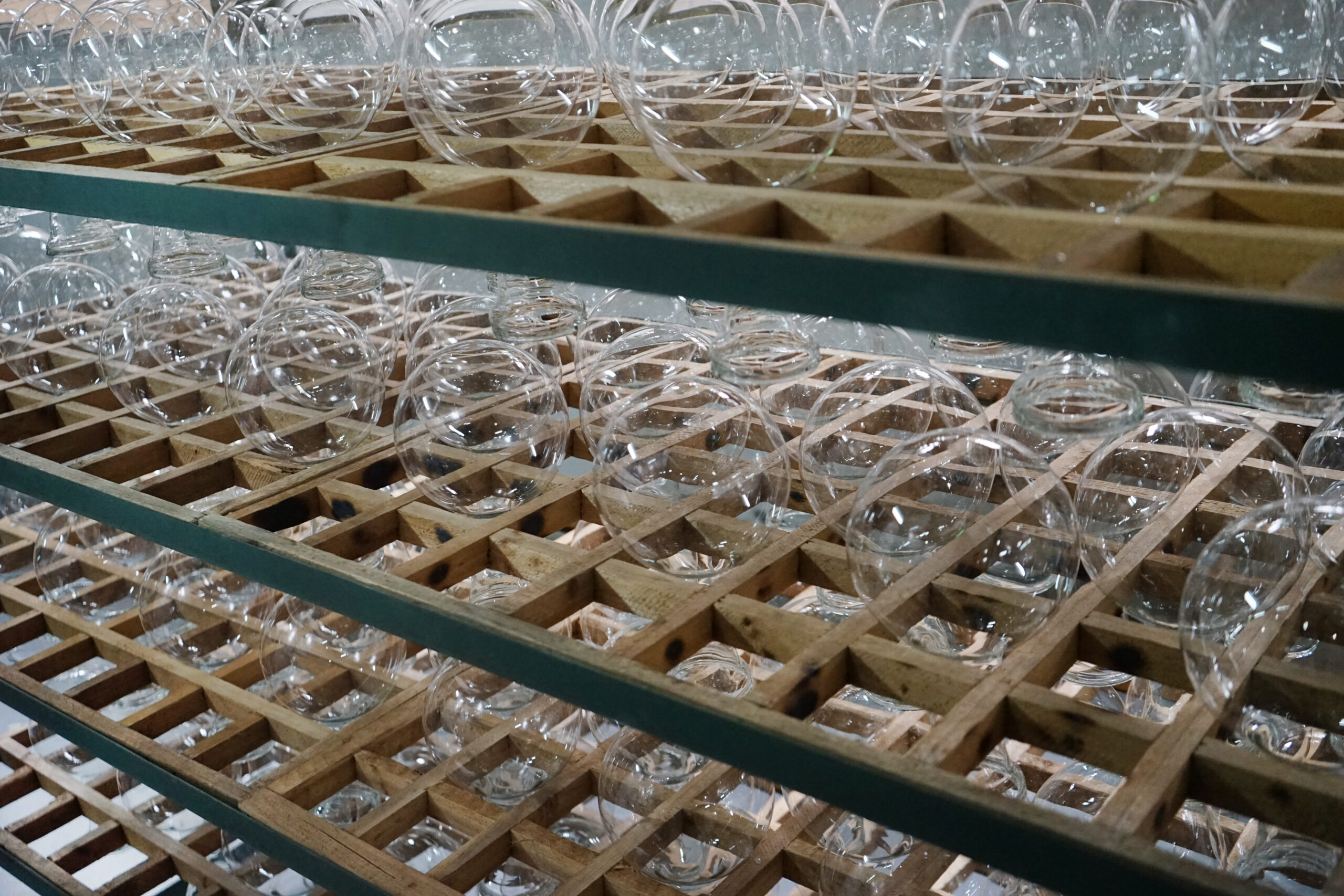
Soda-lime glass — also called soft glass — is the material behind the vast majority of LED filament bulbs on the market. It is the same glass composition used in standard incandescent bulbs for over a century, and its production is highly automated and cost-optimized at scale.
In LED filament bulb production, soda-lime glass covers the following shapes:
- C35 (B10) — candle/torpedo shape, common in chandeliers and wall sconces
- G45 (G16) — small globe, popular in string lights and decorative fixtures
- A60 (A19) → — the standard household bulb shape, highest global volume
- ST58 (S19) and ST64 (S21) — Edison-style tubular globes, widely used in vintage/retro fixtures
- G80 (G25) and G95 (G30) — medium globe shapes
- G125 (G40) → — large globe, common in pendant fixtures
- T20 (T6), T25 (T8), T10 (T30) — tubular shapes used in decorative and industrial-style applications (for a larger tubular format, see the T45 sourcing guide →)
The key production distinction within this category is between mechanical blowing and kiln/furnace blowing:
- Mechanical blowing is used for the highest-volume shapes — C35, G45, and A60 — where fully automated glass-blowing machines operate at thousands of units per hour. Tolerances are tight, consistency is high, and unit costs are very low.
- Kiln/furnace blowing is used for the larger or less geometrically uniform soda-lime shapes (ST64, G80, G95, G125, T-series), where semi-automated or manually assisted processes are employed. These are still soda-lime glass, still produced at commercial scale, but with somewhat more variability and slightly higher per-unit cost than the fully automated shapes.
Soda-lime glass has a softening point around 700–730°C and a linear thermal expansion coefficient of approximately 8–9 × 10⁻⁶/°C. For standard LED filament bulbs — which generate significantly less heat than incandescent predecessors — these thermal properties are entirely adequate. The NEMA lamp standards[2] for standard lamp shapes have been developed with soda-lime glass as the assumed envelope material, and most LED filament products targeting those shape families require nothing more.
For buyers: if your product line consists of standard decorative shapes in the size range listed above, soda-lime glass is almost certainly the right specification. The cost efficiency, supplier availability, and production scalability are unmatched.
| Soda-Lime Glass (Soft Glass) | Borosilicate Glass (Hard Glass) | |
|---|---|---|
| Also known as | Soft glass | Hard glass, hand-made glass |
| Typical shapes | C35, G45, A60, ST58, ST64, G80, G95, G125, T-series | G150, G200, PS160, irregular/custom shapes |
| Production method | Mechanical or kiln blowing | Hand-blown by skilled craftsmen |
| Thermal expansion | ~8–9 × 10⁻⁶/°C | ~3.3 × 10⁻⁶/°C (more stable) |
| Unit cost | Lower | Significantly higher |
| MOQ | Lower | Higher |
| Sample lead time | 2–4 weeks | 4–8 weeks |
| Supplier availability | Wide — most factories | Limited — specialist capability required |
Borosilicate Glass: When You Need It and Why It Costs More
Borosilicate glass — known in the industry as hard glass or, colloquially, hand-made glass — is the material used for large, non-standard, and specialty LED filament bulb shapes. In LED filament production, this means:
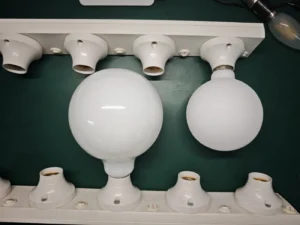
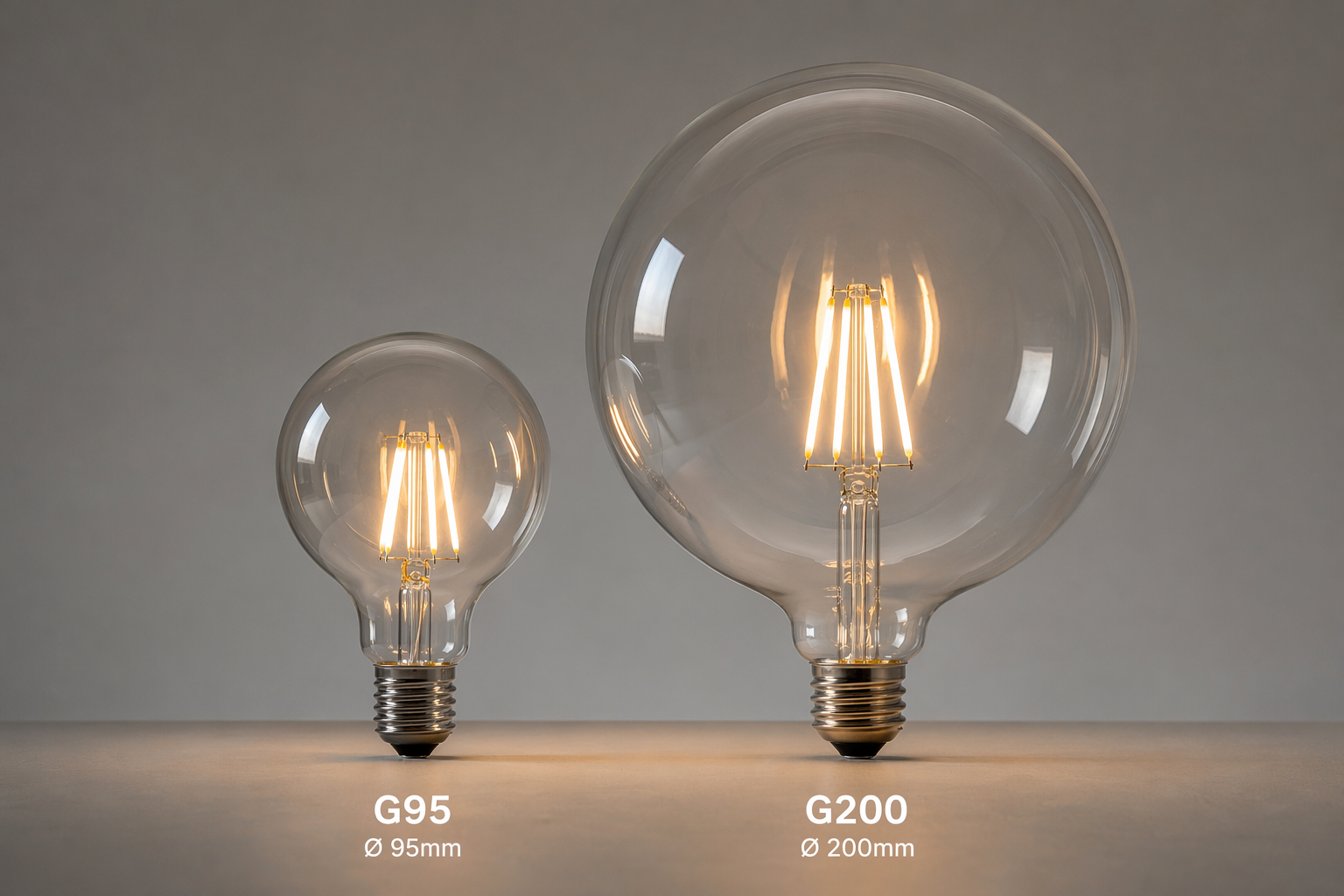
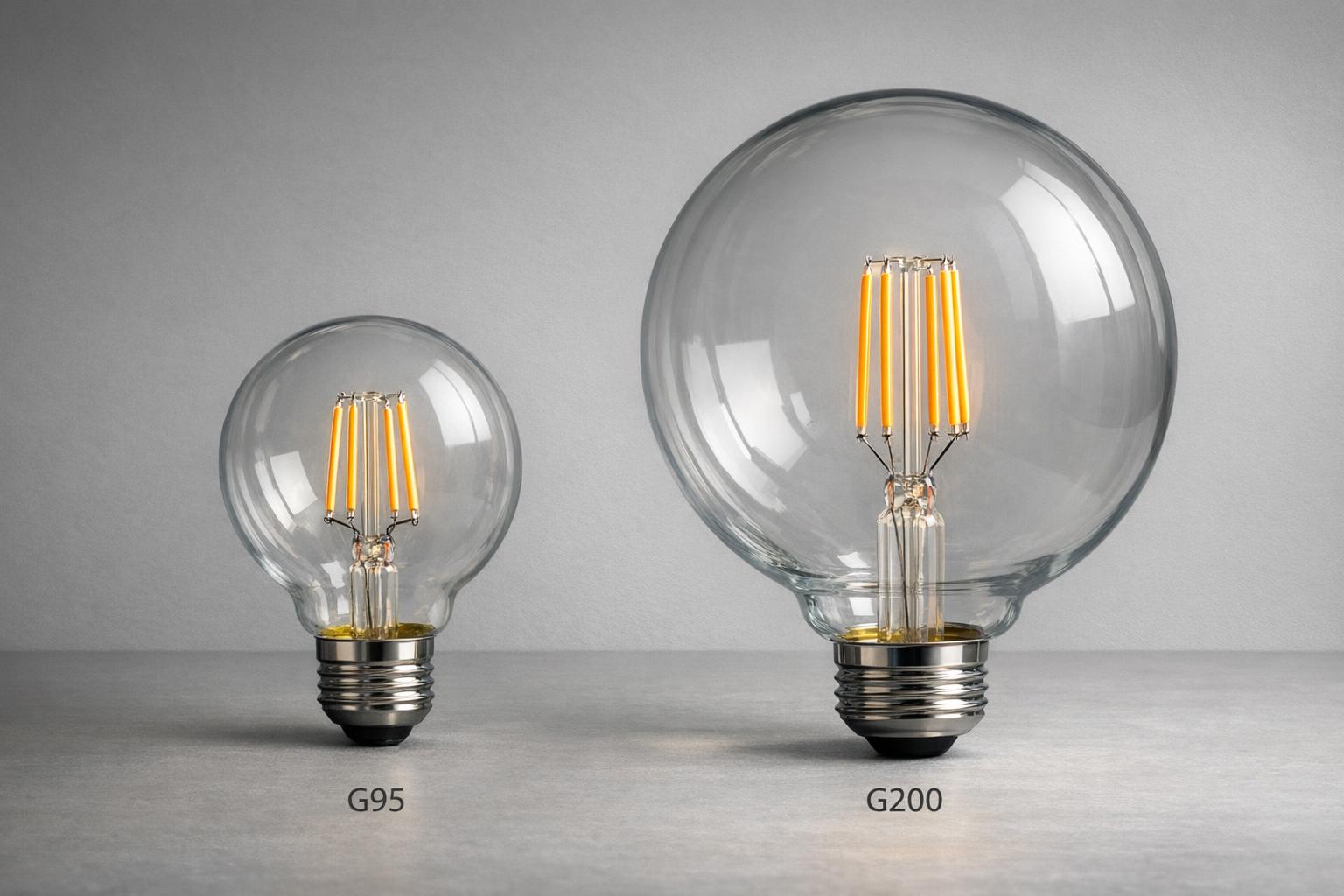
- G150 — large globe, approximately 150mm in diameter
- G200 — oversized globe, approximately 200mm in diameter
- PS160 → — pear/PS shape at oversized scale
- Irregular and custom shapes — specialty silhouettes, elongated forms, artistic or bespoke configurations not achievable through standard mold-based processes
Borosilicate glass has a significantly lower thermal expansion coefficient — approximately 3.3 × 10⁻⁶/°C — meaning it expands and contracts far less with temperature changes than soda-lime glass. It is also harder, more chemically resistant, and able to tolerate higher operating temperatures without stress fracturing. These properties matter more in large-envelope bulbs, where the glass surface area is substantial and temperature gradients across the envelope can create mechanical stress if the glass responds unevenly to heat.
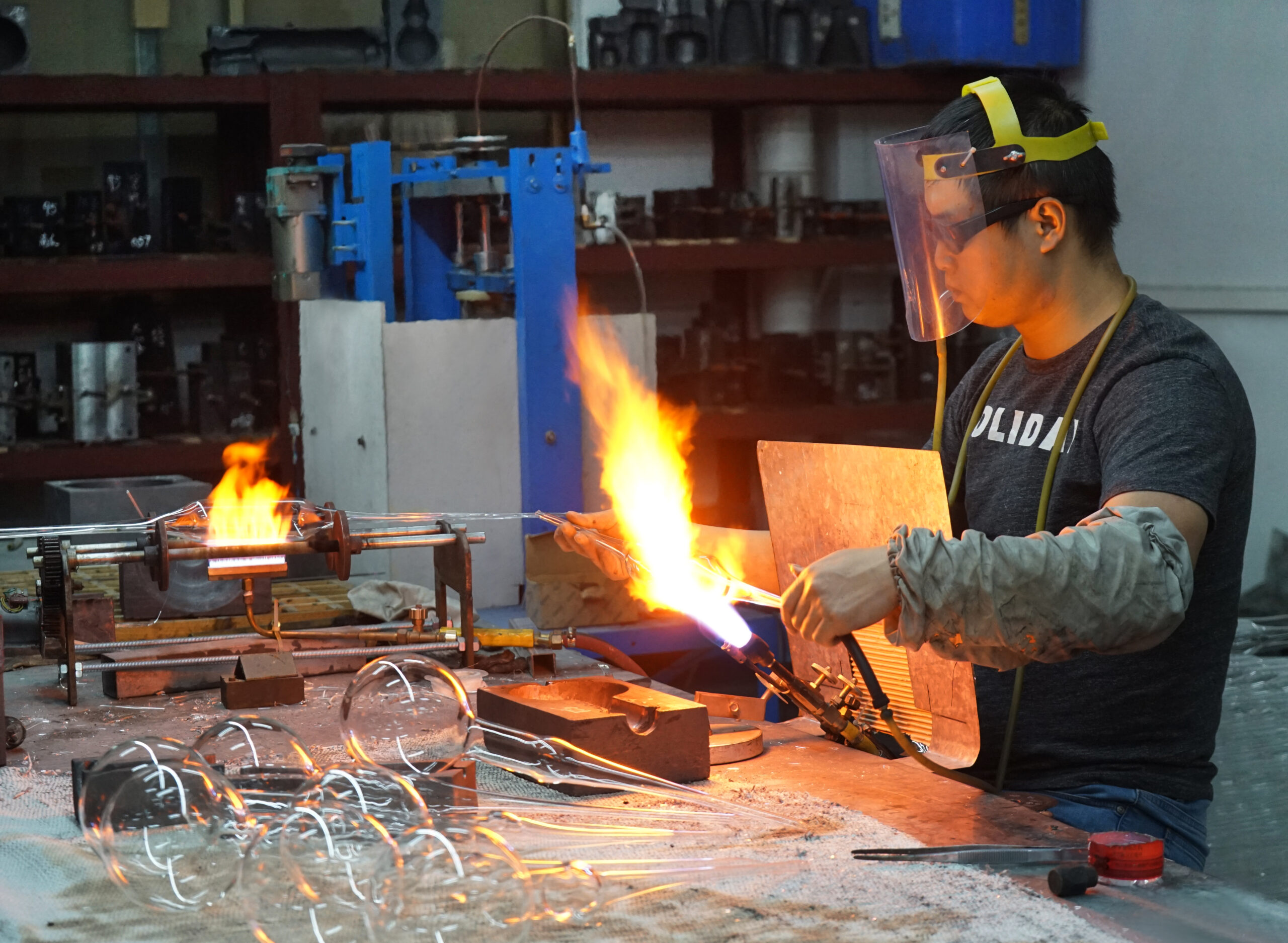
But the more decisive reason borosilicate is used for large and irregular shapes is a manufacturing one: these shapes cannot be produced efficiently by automated mechanical blowing. The geometry is too large, too variable, or too complex for mold-based machines. They require skilled glassblowers working with blow pipes, gathering molten glass from a furnace, and forming the shape manually or with minimal tooling assistance. This is genuine craft production — slower, more labor-intensive, and dependent on experienced personnel.
The International Electrotechnical Commission (IEC)[3] addresses lamp envelope materials in several product standards, and borosilicate is explicitly called out in higher-temperature and specialty-application contexts. For decorative LED filament bulbs, the operative concern is thermal cycling performance over product lifetime — relevant for shapes where heat management is less predictable due to geometry.
The cost differential is meaningful. Borosilicate glass itself is more expensive than soda-lime glass as a raw material. But the dominant cost driver is labor: hand-blowing a G200 globe takes significantly more skilled-labor time than mechanically blowing an A60. For buyers pricing a specialty product line, this is not a rounding error — expect borosilicate bulbs to carry substantially higher unit costs than comparable soda-lime shapes.
The Specification Mistake: Assuming All Bulbs Use the Same Glass
Here is the mistake we see most often: a buyer adds a G200 or G150 globe to a product range that already includes G95, G125, and ST64 bulbs — all sourced from the same supplier — and assumes the new shape will be quoted and produced on the same terms.
It won't be. And the confusion typically surfaces at the worst possible moment: after samples have been requested, after initial pricing has been discussed, and sometimes after a purchase order has been placed.
What happens in practice:
- The supplier quotes the G200 with a significantly higher unit price, which the buyer didn't budget for
- The supplier's sample lead time is 6–8 weeks instead of the usual 2–3, because borosilicate forming requires scheduling a separate production run with their hand-blowing team — or outsourcing to a specialist glass supplier
- The MOQ for the G200 is higher than expected, because the economics of hand-blown production don't compress the same way as automated lines
- In some cases, the supplier doesn't have borosilicate capability at all and quietly substitutes soda-lime glass in the large shell — producing a product that looks similar but has inferior thermal and optical properties
That last scenario is the one that creates real downstream problems. A G200 bulb produced in soda-lime glass by a supplier who isn't equipped for the shape may show dimensional inconsistency, glass stress cracks over time, or simply fail quality inspection when the buyer finally tests against their specification. By that point, months of development time have been lost.
The fix is straightforward: make glass type an explicit field on your sourcing RFQ for any bulb shape outside the standard soda-lime range. Ask your supplier directly: "Is this shape produced in soda-lime or borosilicate glass? Is the glass blown mechanically or by hand?" A supplier who can answer those questions clearly and confidently is a supplier who actually makes the product. For buyers also considering custom bulb shapes, understanding how glass molds work → is a useful companion topic.
How Glass Type Affects Your MOQ, Lead Time, and Supplier Selection
Glass type has direct, practical implications for three of the most important sourcing variables: minimum order quantity, sample and production lead time, and which suppliers can actually fulfill your order.
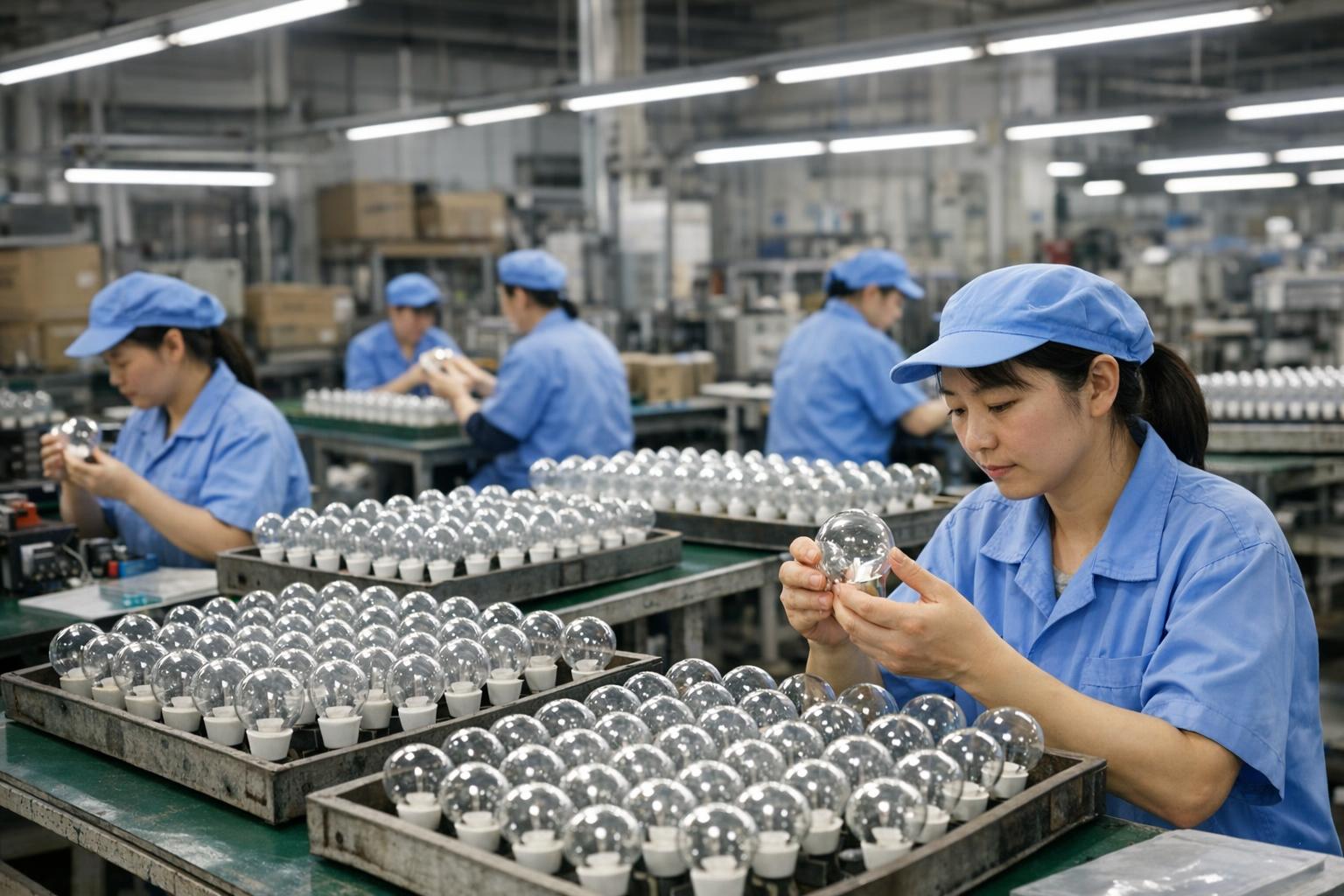
Minimum Order Quantity
For soda-lime glass shapes produced on automated lines (C35, G45, A60), MOQs are typically low relative to the investment — the economics of high-speed mechanical blowing support smaller runs. For kiln-blown soda-lime shapes (G95, G125, ST64), MOQs are moderately higher. For borosilicate hand-blown shapes (G150, G200, PS160), MOQs tend to be the highest of all three categories, because the labor cost per unit is significant and factories need to justify the scheduling commitment of their hand-blowing capacity.
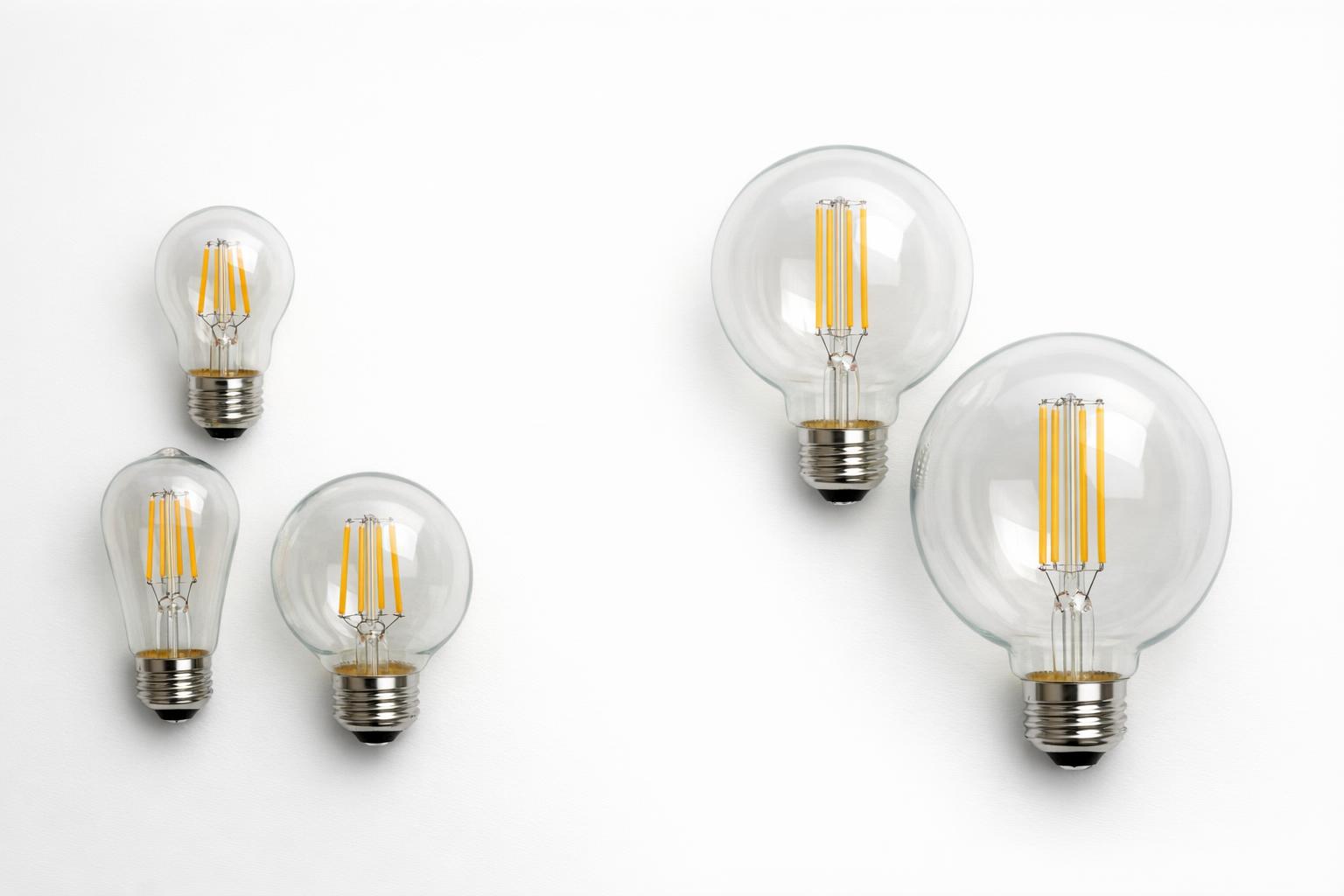
Lead Time
Standard soda-lime shapes: 2–4 weeks for samples, 4–6 weeks for production. Borosilicate shapes: add 2–4 weeks to both figures as a baseline. If your supplier outsources their borosilicate glass to a specialist glass house, add further time for inter-supplier coordination. For product launches with hard retail deadlines, this lead time difference needs to be planned into your development calendar explicitly.
Supplier Selection
Not all LED filament bulb factories handle both glass types. A factory optimized for high-volume soda-lime production may have no borosilicate capability. A specialist hand-blown glass supplier may lack the LED electronics assembly infrastructure to build a complete luminaire. For product lines that span both glass types, buyers often end up with two suppliers — or with a primary supplier who manages the borosilicate glass externally and assembles in-house. Neither arrangement is inherently wrong, but both require clear quality oversight and supply chain visibility. The Global Lighting Association[4] provides useful supplier evaluation frameworks for decorative lamp categories.
Practical Guide: Matching Glass Type to Your Product Line
Translating the above into a practical decision framework:
Default to Soda-Lime Glass When:
- Your product shapes are within the standard size range: C35, G45, A60, ST58, ST64, G80, G95, G125, T-series
- You are sourcing at commercial scale with cost efficiency as a priority
- Your target market is mainstream retail, hospitality, or residential project supply
- Supplier availability and production flexibility are important (more suppliers can fulfill)
Specify Borosilicate Glass When:
- Your shapes include G150, G200, PS160, or any custom/irregular silhouette
- You are building a premium or architectural product range where perceived quality and visual weight of the glass matters
- Your customer's fixture or application calls for a large-format decorative lamp that soda-lime glass simply cannot produce at the required scale
- You have confirmed that your supplier specifically produces — not merely sells — borosilicate hand-blown glass
When Reviewing Supplier Capability:
- Ask for photos of their glass-blowing workshop — automated lines and hand-blowing stations look very different
- Request samples in both glass types if you're planning a mixed product line
- Verify that large-format shapes are produced with borosilicate glass, not substituted with soda-lime to reduce cost
- Include glass type as an explicit acceptance criterion in your purchase order specification
Most sourcing problems in this area are not the result of supplier dishonesty — they are the result of buyers not asking the right questions. Glass type is a foundational variable. Build it into your specification process from the first RFQ, and the downstream surprises largely disappear.
Final Thoughts
Glass type is not a detail — it is a supplier capability gate. Soda-lime glass covers the vast majority of decorative LED filament bulb shapes and can be sourced from a wide range of manufacturers. Borosilicate glass requires a specialist, carries higher cost and longer lead times, and cannot be substituted without redesigning the product.
The most common and most expensive mistake buyers make is discovering this distinction only after sending an RFQ. A supplier who cannot make your glass type will either decline the inquiry, give you an inflated quote, or — worst of all — quietly substitute soda-lime glass in an oversized shell and hope you do not notice until the product is in a container. Specifying glass type explicitly in your RFQ, and asking suppliers to confirm their production capability directly, eliminates all three outcomes.
If you are sourcing oversized globe shapes, irregular custom shapes, or any bulb format larger than G125, clarify glass type requirements before you go to quote. It will save you weeks of misaligned back-and-forth and give you a more accurate read on which suppliers can actually deliver what you need.
For specific shape and glass type combinations, or to verify whether your target shape requires borosilicate capability, contact us directly → and we can advise based on your exact specification.
References
- U.S. Department of Energy — LED Lighting Overview
- NEMA — Lamp and Lighting Standards
- International Electrotechnical Commission (IEC) — Lamp Product Standards
- Global Lighting Association — Supplier Evaluation and Industry Resources
- Wikipedia — Borosilicate Glass (Material Properties Reference)
- Illuminating Engineering Society — Technical Resources for Decorative Lamp Applications
Related HongYu Bulb product pages
- LED Filament Bulb Product Range → — standard and decorative LED filament bulbs for wholesale and project sourcing.
- Big Decorative Bulbs → — oversized decorative filament bulbs for hospitality, retail and statement fixtures.
- Contact HongYu Bulb → — send specifications, target market, quantity and packaging requirements for quotation.