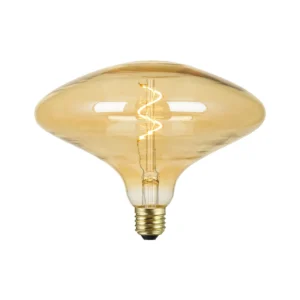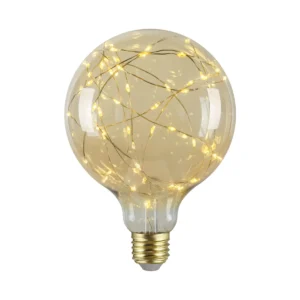
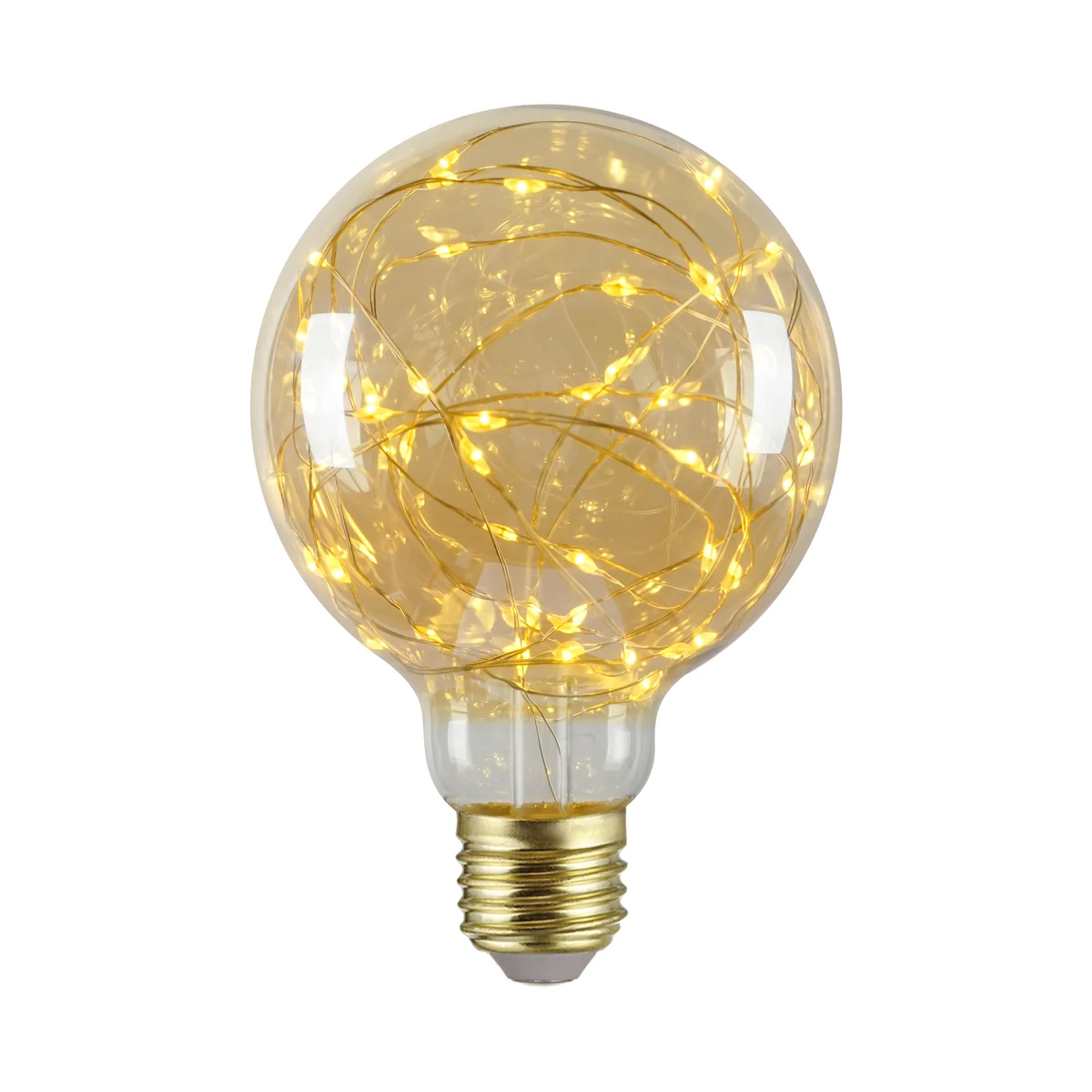
Two gold glass globes can occupy almost the same space in a pendant and still create completely different products. One shows a clearly defined spiral. The other contains small points of light distributed along fine wires. Calling both a "vintage G125" misses the feature the customer is actually choosing.
Our view: in a decorative bulb, the internal light pattern is part of the product design, not simply a component inside the glass. A specification that stops at shape, watts and colour temperature leaves that design unfinished.
Copper-wire LED bulbs create separate luminous points; conventional visible-filament bulbs create straight or flowing illuminated lines. Choose between those patterns before choosing the glass size. This gives a lighting brand a difference it can show, rather than another specification customers must decode.
For lighting brands, this opens a useful route to differentiation. The outer shape does not have to tell the entire story. HongYu's copper-wire LED bulb collection offers a point-light appearance in G95, G125, B80 and A160 forms, giving a buyer several ways to develop a recognizable decorative accent.
What Is Different Inside the Glass?
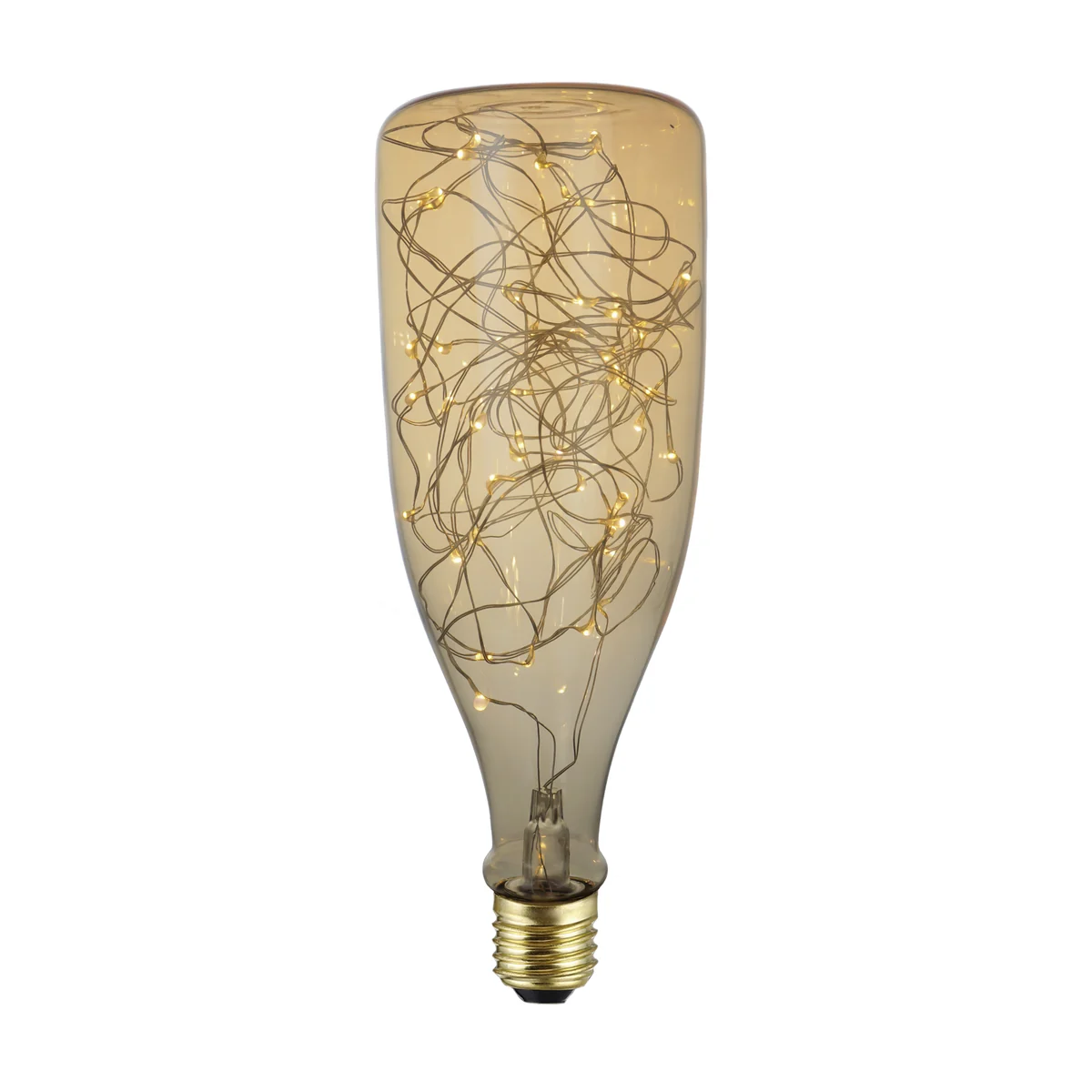
In the copper-wire products shown here, small LEDs sit along fine wires arranged inside the glass. The visible result is a network of light points and darker connecting lines. The wires themselves are not incandescent filaments that become hot enough to glow.
A straight-filament bulb presents regular luminous bars. A flexible-filament version bends the luminous element into a loop or spiral. These are different visual constructions, not three quality grades.
| Internal appearance | What the customer sees | A useful collection role |
|---|---|---|
| Copper wire with small LEDs | Separated points distributed through the glass volume | A decorative sparkle accent with visible internal detail |
| Straight LED filaments | Repeated, clearly defined illuminated lines | A structured Edison-style appearance |
| Flexible LED filament | A flowing loop or spiral | A sculptural line framed by the glass |
HongYu's gold and smoky flexible-filament bulbs provide the line-based alternative. Compare that loop with the copper-wire pattern in a similar envelope: the distinction is easier to explain when the customer is not also comparing completely different bulb sizes.

Buyer judgment 1: specify the internal pattern, not just "gold G125." The shape and glass finish alone leave a major part of the product undefined.
Here, "sparkle" describes the appearance of separate light points. It does not promise an animated twinkling, flashing or colour-changing mode.
Larger Glass Does Not Automatically Mean More Light
The listed HongYu copper-wire models share nominal 1.5W, 2200K and approximately 40-lumen specifications. Moving from G95 to G125 or A160 therefore changes the visible envelope without increasing the listed output.
That is a useful design distinction. A larger decorative object can establish more visual presence while retaining the same nominal light-output target. It does not have to compete with a room's main lighting to justify its place in the design.
The FTC distinguishes lumens, which describe light output, from watts, which describe power use.[1] Neither number tells the whole story of the internal pattern, and glass diameter is not a substitute for either specification.
Treat copper-wire bulbs as decorative accents: let them supply the visible points of light while other fixtures handle reading, work surfaces or merchandise illumination. This division makes the design brief more precise. The decorative lamp can be selected for its appearance instead of being asked to perform an unrelated lighting task.
Buyer judgment 2: buy a larger shape for its composition, not for an assumed increase in lumens. Compare the complete product specification when changing sizes.
Give Each Shape a Reason to Be in the Collection
The four HongYu formats support different proportions. Start with the display or fixture, then choose the envelope that belongs in it.
| Copper-wire model | Listed width x overall height | Design direction to explore |
|---|---|---|
| G95-E27-1.5W-G | 95 x 138 mm | A smaller round accent for an open table-light or grouped display |
| G125-E27-1.5W-G | 125 x 182 mm | A broader globe where the internal pattern should be prominent |
| B80-E27-1.5W-G | 80 x 220 mm | An elongated silhouette for a narrower vertical composition |
| A160-E27-1.5W-G | 160 x 280 mm | A large shaped envelope for a single statement position |
These are catalogue dimensions, not installation clearances. Confirm the selected drawing and fitting before ordering. Even two lamps sold as G125 can have different overall lengths.
For a compact collection, assign a role to each selected SKU: a round tabletop accent, a taller narrow version, or a larger focal piece. HongYu's four envelopes offer several proportions within a point-light family; the flexible-filament range offers a different visual language. That gives a brand two distinct decisions: extend a familiar pattern into another shape, or introduce a new pattern in a familiar shape.
For example, comparing the two photographed G125 models keeps the broad globe format familiar while making the internal design the focus. Comparing the copper-wire G95 with B80 instead tests round versus elongated proportions. Neither comparison requires calling one product a higher quality grade. Each can give the retailer a clear reason to include both.
Keep the Small Light Points Visible in the Finished Display
The internal detail is the reason to choose this product, so the fixture should give it a useful viewing window. An open fitting reveals a different amount of the wire pattern from a deep shade or a dense cage.
Three display directions are worth evaluating:
- An open table-light base: the pattern is close enough to inspect, making the bulb itself part of the object on the table. Keep any reading-light requirement separate.
- A simple pendant: the glass outline becomes more prominent from across the room. Review whether the individual points remain visible at the intended distance.
- A retail vignette: the illuminated bulb can contribute a decorative accent beside merchandise, while dedicated display lighting presents the merchandise clearly.
For each direction, compare the sample under the actual background lighting. Check it from the customer's approach, normal viewing position and close-up inspection distance. These are different views of the same product, and all three matter to how it is presented.
Buyer judgment 3: approve the pattern at the customer's viewing distance, not only in a close-up photograph. A detailed image is useful, but the installed composition is the product the customer will experience.
The warm glow is an appearance choice, not a colour-rendering claim. DOE distinguishes the colour of emitted light from how illuminated objects appear.[2] Where food, fabrics or product colours matter, specify the lighting for those surfaces independently of the decorative accent.
The Factory-Facing Insight: Specify the Arrangement, Not Just the Components
A conventional specification might stop at the model, power and finish. A copper-wire brief should also describe how the internal arrangement should look. Otherwise, two people can approve the same model name while expecting different visual results. The practical manufacturing question is not just "Does it light up?" but "Which visible features define the design we are approving?"
Separate the electrical specification from the visual specification, then approve both against an identified sample. Electrical conformity alone does not describe the arrangement a buyer wants; an attractive photograph alone does not establish electrical performance.
For this product family, we recommend defining three visual features:
- Distribution: should the illuminated points appear spread through the envelope, or should the composition have a more concentrated centre? Describe the intended result using marked sample photographs, not only words such as "full" or "premium."
- Negative space: review the unlit gaps and the relationship between the wire arrangement and the glass outline. More visible crossings are not automatically a better design; the question is whether they support the intended open or dense appearance.
- View dependence: turn the sample and compare the angles the customer will actually see. A pendant viewed from several sides needs a different review from a fixed-front display. Record which views are part of approval.
The useful distinction is between design-defining features and incidental details. If the brief requires an evenly spread appearance, that is a feature to discuss and approve. Requiring every crossing to occupy an identical coordinate is a different manufacturing requirement and needs a separate feasibility review. Do not leave that distinction hidden behind "same as sample."
For a practical sample brief, start with: "Gold G125 copper-wire decorative bulb, dispersed point-light appearance; review the distribution, central gaps and visible supports against the identified reference sample from the agreed viewing angles." Add the selected electrical specification and record any agreed appearance limits before the order. This is a proposed approval method, not a claim that HongYu has already validated a particular arrangement or tolerance.
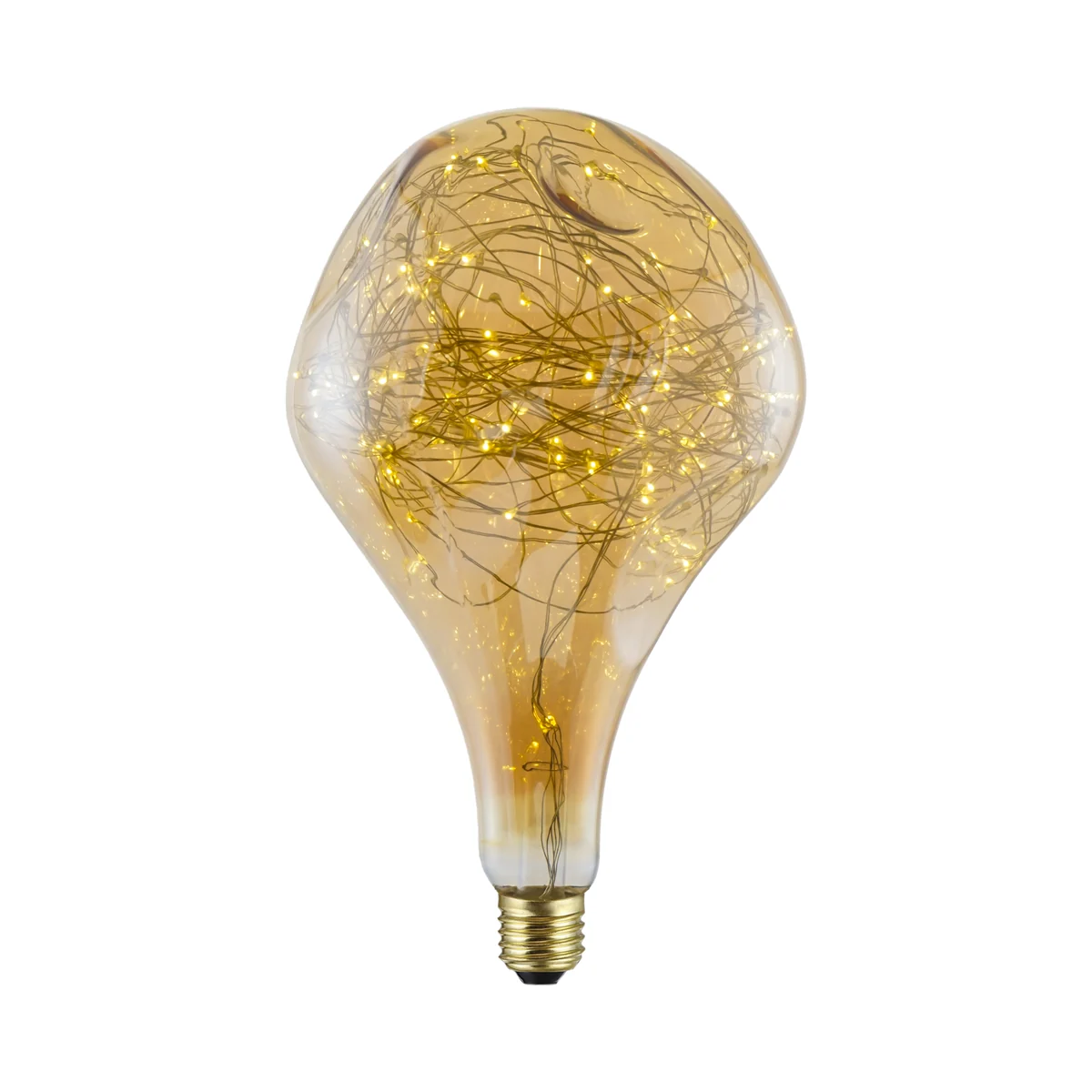
Buyer judgment 4: approve the overall visual arrangement as well as the electrical specification. The customer sees the distribution of light points, not a model code.
Turn the Difference into a Clear Retail Offer
Present copper-wire and flexible-filament products as different choices rather than a good/better ranking. A useful product card identifies the visible pattern, glass shape and intended decorative role, then states the electrical details clearly.
For the pictured HongYu models, a retailer can explain the difference as "dispersed points in gold glass" versus "a flowing spiral in gold glass." Show the internal construction in the product image and carry the same distinction into the shelf description. This makes the choice understandable without turning it into a contest over watts or bulb size.
The copper-wire models discussed here are listed as 230V, E27 and non-dimmable. They are screw-in lamps for a suitable powered fitting, not battery-operated string lights placed in a bottle. Specify a suitable on/off arrangement for this configuration. If adjustable output is part of the brief, discuss the appropriate lamp family and control combination rather than treating all decorative bulbs as dimmable.
HongYu's copper-wire shape and packaging options provide a starting point for a branded collection. Build the initial brief around the listed G95, G125, B80 or A160 models, then discuss packaging and any proposed pattern changes. The commercial opportunity is a coordinated offer in which the product, photograph and packaging all express the same design idea. Confirm quantities, any new development and the documents required for the destination market in the quotation.
For the sample request, send the intended fitting or display reference, preferred shape, viewing distance, target market, quantities and packaging brief. Ask for a copper-wire sample and a flexible-filament comparison where the buying decision is still between points and lines. This makes the sample set answer a specific question.
Frequently Asked Questions
Are copper-wire LED bulbs the same as spiral filament bulbs?
No. The copper-wire products shown here have small individual light points along fine wires. The illustrated flexible-filament model has an illuminated spiral line. Their glass shapes can be similar while the internal appearance is different.
Does "sparkle" mean the bulb flashes?
Not in this guide. It describes separated visible points of light. Do not add flashing, animation or colour-changing claims unless those functions are specified for the ordered model.
Which shape should I sample first?
Start with the available fixture envelope and the intended visual role. Compare G95 and G125 for round forms, B80 for a taller narrow outline, and A160 when a larger shaped object is wanted. The sample should answer a design decision, not simply include the largest lamp.
Can these bulbs replace the main light in a room?
The listed approximately 40-lumen models are intended as decorative accents. Use them to create visible detail within a lighting scheme, with other lighting selected for the room's functional requirements.
Conclusion
Copper-wire LED bulbs give a decorative collection something a familiar glass outline cannot provide on its own: a distinct pattern of small light points distributed inside it. HongYu's G95, G125, B80 and A160 options let that pattern take different proportions, from a smaller round accent to a larger statement object.
Our recommendation is to treat that internal arrangement as a specification worth buying, approving and showing. Choose the pattern first, the envelope second and the lighting role explicitly. A recognizable pattern gives the collection its design story; an identified sample gives that story a concrete reference.
Send HongYu the preferred shape, intended fitting or display, target market and packaging brief. Request a copper-wire sample proposal, with a flexible-filament comparison where useful, so the discussion starts with a visible product difference rather than a generic request for another gold bulb.
References
- Federal Trade Commission: Shopping for Light Bulbs. Explains the distinction between lumens and watts. This is general buying guidance, not a HongYu test report. Back to text.
- U.S. Department of Energy: LED Color Characteristics. Background on light-source colour appearance and colour rendition; not a specification for the pictured models. Back to text.