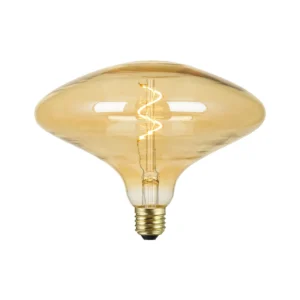
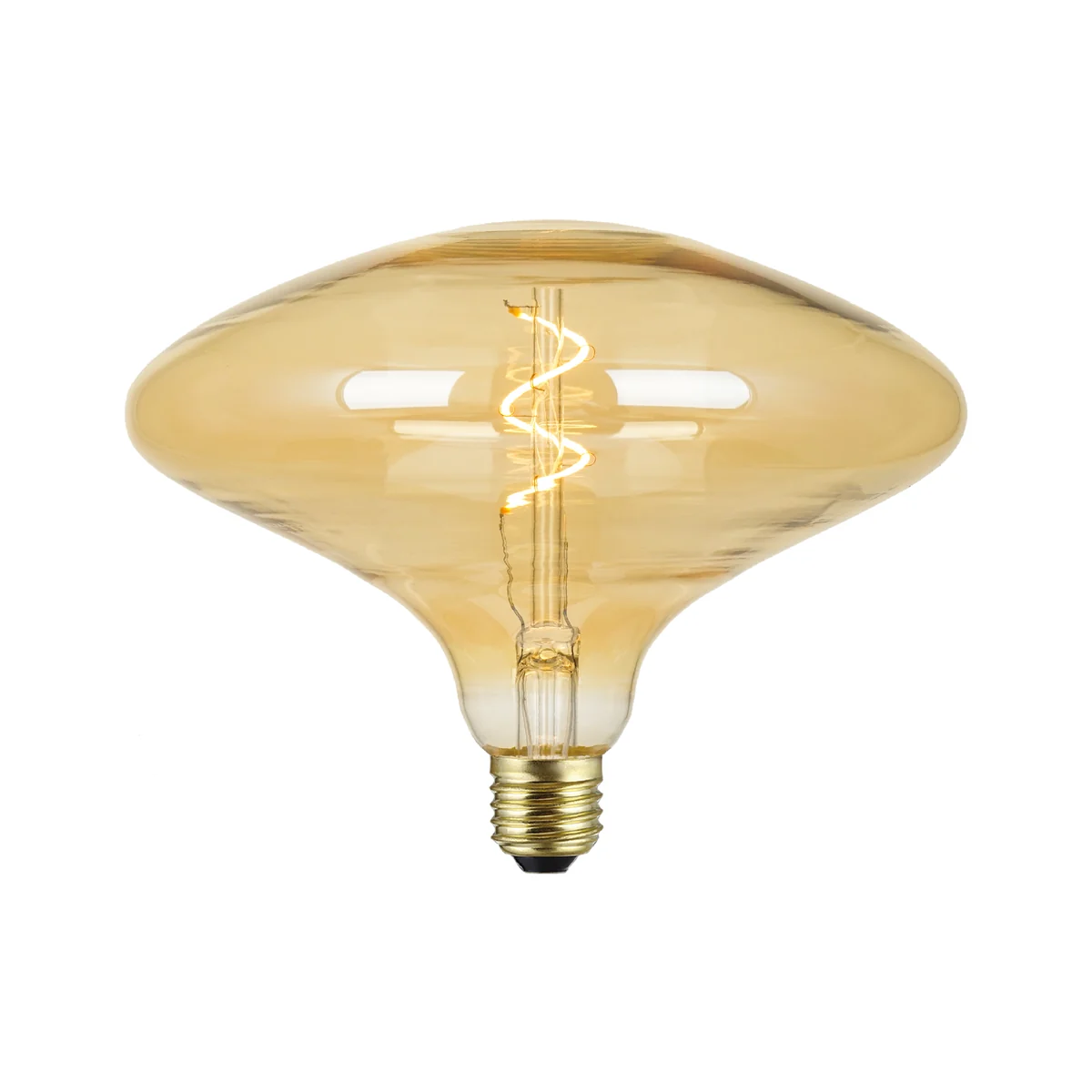
A statement bulb does not have to be large in every direction. HongYu's RT200 is listed at 200 mm wide and 145 mm long; the DR80 is only 80 mm wide but 326 mm long. One spreads across the composition. The other draws the eye along it. Both offer a distinctive alternative to a familiar globe, but they solve different design problems.
Our view: choose the direction of the visual statement before choosing the size of the bulb. For a fixture brand, that turns an unusual glass shape into a product with a clear role: a broad focal point, a slender repeated element, or a deliberate contrast within a pendant cluster.
The following guide uses real HongYu catalogue models and a simple layout method. It is intended for product selection and sample briefs, not as an installation-clearance standard.
RT200 vs DR80: Two Different Ways to Make a Statement
The RT200's broad, shallow profile gives a simple open pendant an immediately recognizable outline. It is a useful candidate when the design needs width without the long glass body of an elongated bulb. The DR80 takes the opposite approach: a narrow, extended profile that can carry a vertical composition without filling as much horizontal space.
These are existing models in HongYu's specialty-shape LED bulb collection. A buyer can begin with actual product references and samples instead of treating every distinctive silhouette as a new glass-development project.
| Catalogue model | Listed width x total length | Proportion | Design role to explore |
|---|---|---|---|
| RT200-E27-4W-G | 200 x 145 mm | Broad and shallow | A wide focal point on an open pendant |
| DR80-E27-4W-G | 80 x 326 mm | Slender and extended | A vertical feature or repeated narrow element |
| B100-E27-4W-G | 100 x 220 mm | Sculptural, multi-lobed outline | A rounded accent with an irregular silhouette |
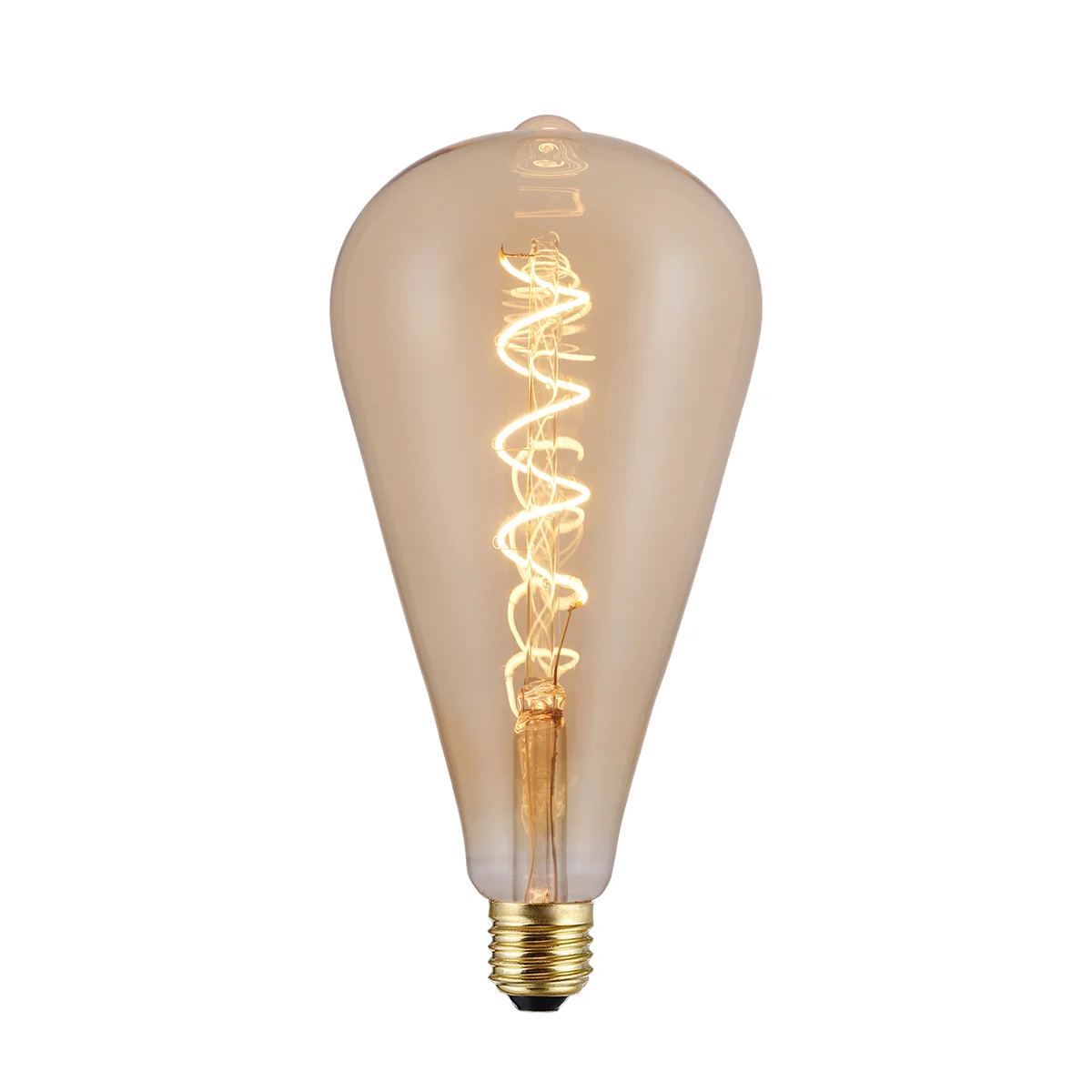
| ST95-E27-4W-G | 95 x 250 mm | Elongated tapered form | A vertical option with a broader upper body |
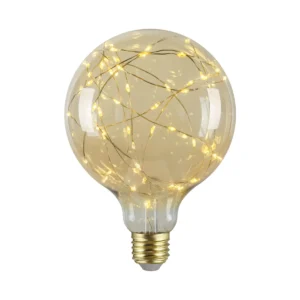
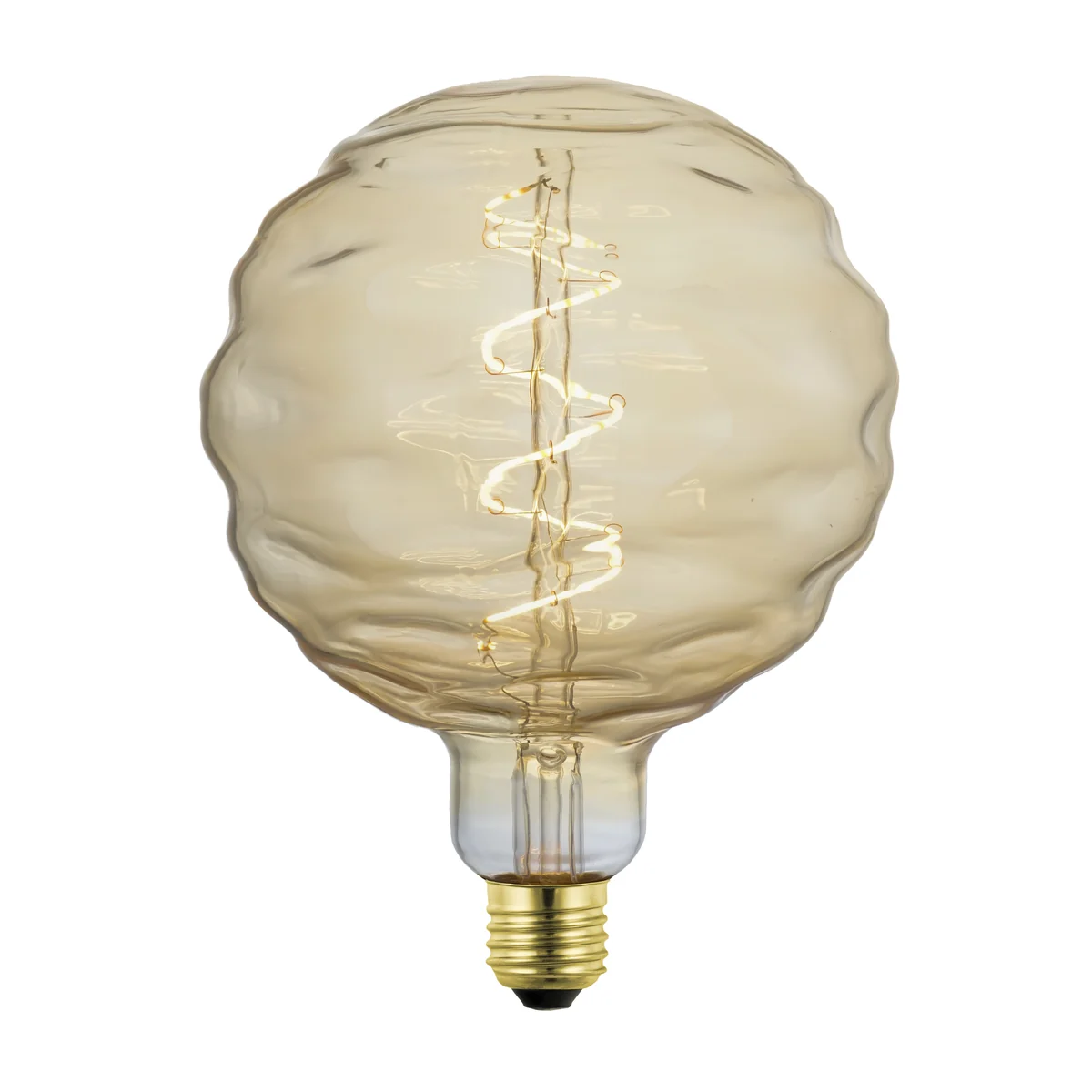
| GS150-E27-4W-G | 150 x 198 mm | Broad, textured rounded form | An intermediate proportion with surface detail |
Dimensions are nominal catalogue values, not approved tolerances. All five selected gold models are listed as E27, 230V, 4W, 2000K and dimmable. This identifies the catalogue configuration used here; a different supply, finish or light specification should be quoted separately.
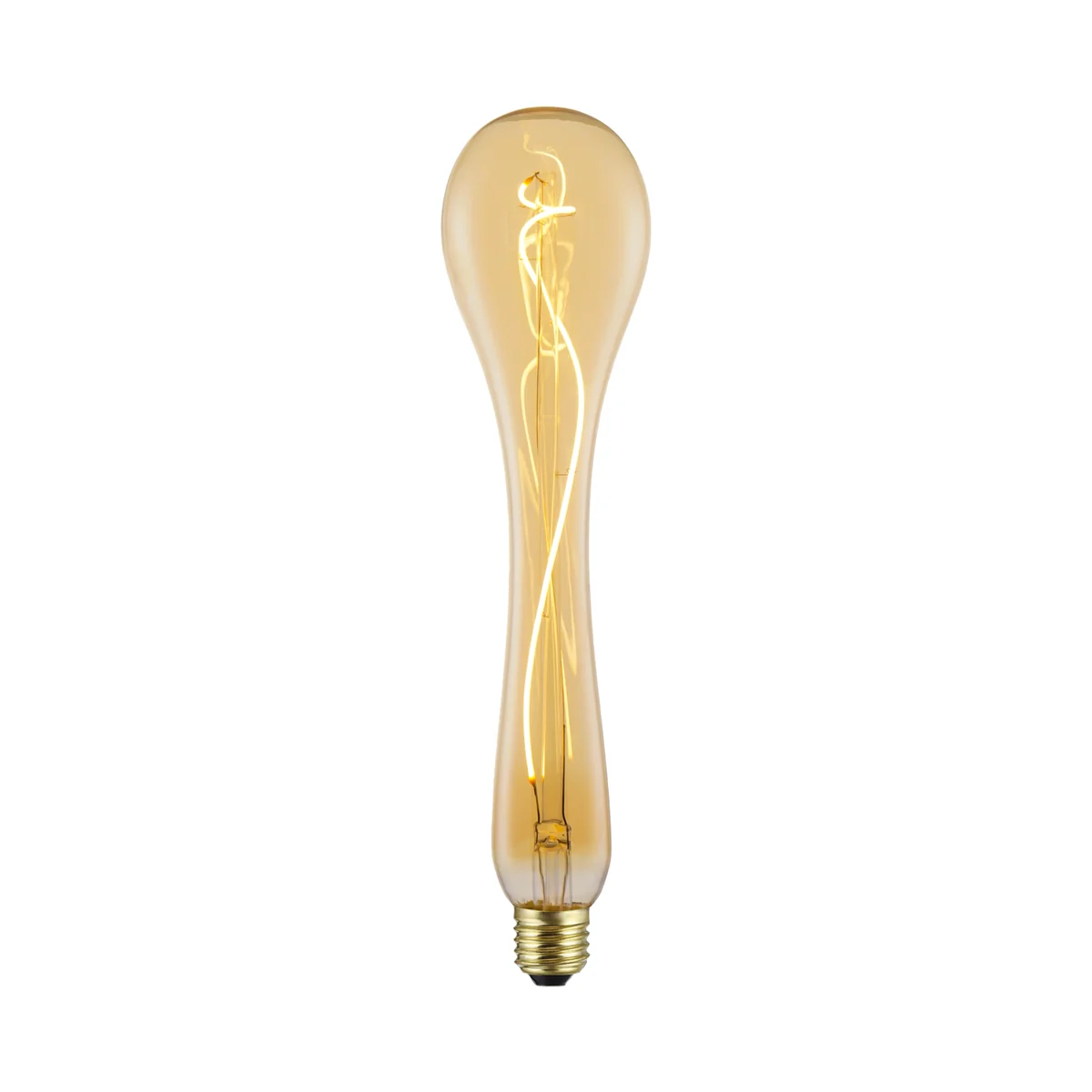
Design judgment 1: a narrow bulb is not necessarily a small visual feature. The DR80 has less than half the RT200's listed width, yet its total length is more than twice as great. Give width and length separate jobs in the design brief.
Start With the Space Between Bulbs, Not Just Between Cables
Equal cable spacing does not produce equal visible gaps when the bulbs have different widths. That matters when a pendant cluster is intended to feel ordered rather than crowded on one side and empty on the other.
For an initial front-elevation layout of two vertically mounted, centered envelopes, use:
Nominal horizontal envelope gap = socket-axis spacing - half the first width - half the second width.
At an illustrative 250 mm axis spacing, the catalogue dimensions give these results:
| Pair | Calculation | Nominal envelope gap |
|---|---|---|
| RT200 beside RT200 | 250 - 100 - 100 | 50 mm |
| RT200 beside DR80 | 250 - 100 - 40 | 110 mm |
| DR80 beside DR80 | 250 - 40 - 40 | 170 mm |
The mounting pitch is identical in all three cases. The visual spacing is not. If the design instead calls for an illustrative 80 mm envelope gap, the corresponding starting pitches are 280 mm, 220 mm and 160 mm. Neither 250 mm pitch nor 80 mm gap is a recommended safety distance; they are arithmetic examples for comparing layouts.
This method uses maximum-width bounding envelopes. When the widest parts sit at different heights, the actual visible gap can be larger. For an asymmetric shape, use the drawing's left and right extents from the socket axis rather than assuming each is half the overall width. Check the finished three-dimensional arrangement, dimensional tolerances, suspension movement, heat clearances and installation requirements with the fixture designer.
Design judgment 2: specify whether the collection should have equal mounting pitch or equal visible gaps. These are different design choices, and either can be intentional. Sending that decision with the model list gives the supplier a much clearer sample brief.
Use a Two-Dimension Shortlist
Rather than asking for a "large decorative bulb," give width and total length their own limits. The following hypothetical product envelopes show how the five catalogue models separate into useful candidates. These are nominal dimensional filters only: they are not fixture cavity sizes and include no safety clearance or manufacturing tolerance.
| Illustrative maximum bulb envelope | Candidates within both nominal limits | Why the distinction helps |
|---|---|---|
| 220 mm wide x 180 mm long | RT200 | A broad outline without a long body |
| 90 mm wide x 350 mm long | DR80 | A slender option with substantial vertical presence |
| 160 mm wide x 230 mm long | B100, GS150 | Two different sculptural directions within a more balanced envelope |
The last row is particularly useful. B100 and GS150 pass the same initial dimension filter, but the photographs show very different products: a multi-lobed outline versus a rounded textured body. Dimensions narrow the search; they do not finish the design decision.
Design judgment 3: do not let one generous dimension hide the other constraint. A 200 mm-wide product can be a practical candidate for a shallow composition, while an 80 mm-wide product can require much more vertical room. This is why an actual model shortlist is more useful than a request for "something smaller."
After shortlisting, define the intended lower edge of the arrangement. RT200 and DR80 differ by 181 mm in nominal total length, so equal holder levels will not create equal bulb-bottom levels. For final alignment, measure the installed extension from the same holder datum; do not use catalogue total length as a finished cord-length instruction.
Check the Silhouette From the Selling View
For a three-model sample set, RT200, DR80 and B100 make the differences easy to compare: broad, slender and multi-lobed. Their shared gold-glass direction allows the shape to lead the comparison. Ask for a straight-on view at a common scale as well as individual product photographs.
The B100 also introduces a different approval question. Its multi-lobed profile is not the same from every viewing direction. Compare the front and side views in the intended holder. If a particular face must point toward the viewer, include the holder and mounting approach in the review; an ordinary screw connection does not by itself specify a repeatable final viewing angle.
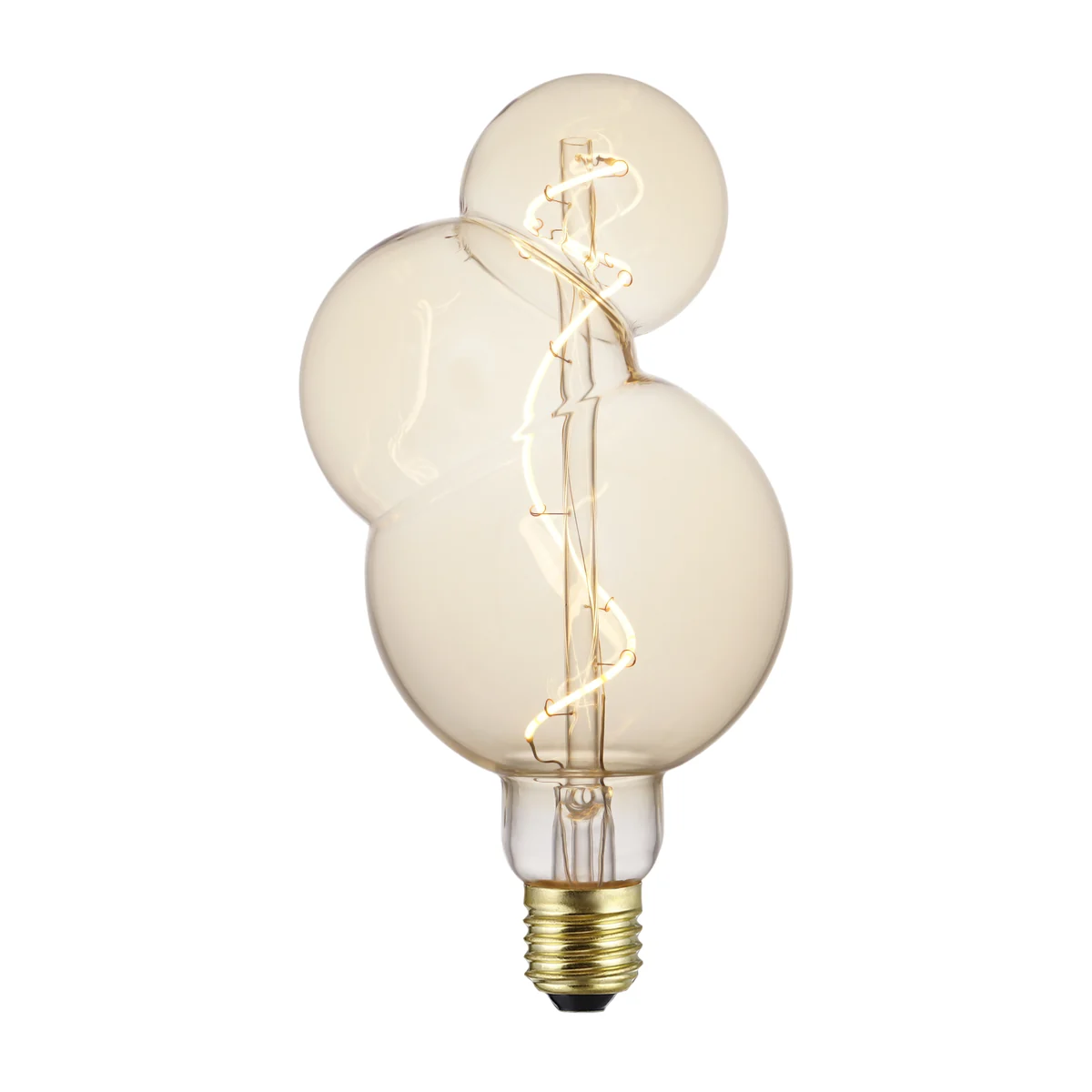
Design judgment 4: approve the shape from the angle the customer will see. A frontal outline that sells the concept may not be the outline visible from the room entrance, a seated position or the side of a display. For an asymmetric model, viewing direction belongs in the product brief.
The comparison also extends to HongYu's large decorative bulb range. Its G200 is listed at 200 x 262 mm: the same nominal width as RT200, but 117 mm longer. A G200 gives a fuller globe-like volume; RT200 gives a flatter outline. An enquiry for a "200 mm bulb" leaves that important design choice unresolved.
If material color is the collection's main differentiator, compare the silhouettes against HongYu's custom-color bulb options, including listed copper and silver finishes on selected models. Confirm the specific shape-and-finish combination rather than assuming every finish is available on every envelope.
Keep the Light Brief Separate From the Shape Brief
The five selected models share a listed 4W rating, but wattage does not describe the silhouette or establish how much useful light reaches a table. Specify finished-lamp output separately. FTC guidance distinguishes electrical watts from light output in lumens.[1] A broad glass body also does not establish a broad beam or a particular illuminance distribution.
For a decorative pendant collection, review two scenes: the full-output presentation and the intended dimmed setting. Check that the visible filament and the overall composition still look deliberate in both. The selected catalogue models offer a dimmable starting point, but compatibility belongs to the lamp-and-control combination. Lutron likewise directs users to tested combinations or the lamp manufacturer's recommendations.[2] Test the proposed controller with the actual mixed-model group and lamp count.
Design judgment 5: approve a composition, not just five individual bulbs. A group sample reveals spacing, lower-edge alignment, viewing-angle differences and the dimmed scene together. Those are the features the customer will actually see in the finished product.
Send HongYu a Composition Brief That Can Become a Quotation
For this kind of project, a simple front elevation and plan view can be more useful than a long mood board. Include the preferred model references, maximum installation envelope, socket positions, intended bottom alignment and the main viewing direction. Add the finish, target market and voltage, desired output and controls, quantities by model, and whether the bulbs will be sold separately or with a fixture.
Ask for a sample shortlist that represents the design decisions: a broad model, a slender model and any asymmetric accent. Request the selected drawings, relevant dimensions and weights, and a model-specific electrical specification alongside the commercial quotation. Fixture support, clearances and compliance remain part of the complete fixture review.
For a private-label range, carry the same roles into the catalogue photography and packaging. Show a dimensioned comparison at a common scale, then show each product in detail. Individually centered product photographs are valuable, but they should not imply that a 200 mm-wide RT200 and an 80 mm-wide DR80 occupy the same space.
Conclusion
Wide and tall decorative bulbs are not competing versions of "bigger." They create different compositions. The RT200 offers a broad, shallow focal point; the DR80 provides a long, narrow line; B100, ST95 and GS150 add other ways to shape a coordinated family.
HongYu's existing specialty models give brands tangible design choices to sample and quote. Start with the direction of the silhouette, calculate the layout, then approve the installed group. Send your pendant concept and model shortlist to HongYu for a product proposal built around the visual result your collection needs.
All photographs are supplied HongYu catalogue product images, proportionally resized and compressed for the website. The layout examples are calculated design illustrations, not records of a tested installation.
References
- Federal Trade Commission: Shopping for Light Bulbs. General distinction between light output and electrical power. Back to text.
- Lutron: LED Compatibility Resources. General guidance on tested lamp-and-dimmer combinations; not an approval of the HongYu models shown here. Back to text.