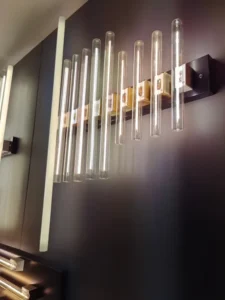
A mirror-light collection needs more than an attractive tube and a high-CRI label. The buyer is choosing how the lamp looks, how warm the light feels, how colors appear and how much light the finished model provides. Those decisions become easier when the product proposal includes data for the actual finish being considered.
Our view: the strongest specification is a combination of appearance and measured light quality, not the largest Ra number on its own. HongYu's S14d range gives fixture brands Clear, Strip Clear, Gold and Porcelain options, with published sample reports that make the comparison concrete.
Here we read four reports for the 500 mm versions. The purpose is to turn those records into a useful buying decision, rather than declare one finish universally better than the others.
Four Finishes, Four Sets of Recorded Results
The HongYu S14d product specifications and report section lists the 500 mm models at 7W, 230V, nominal 2700K and Ra 90, with dimming. The table below instead transcribes the individual sample measurements from the four published reports.
| Report model | Finish | Measured power | Measured flux | Measured CCT | Ra | R9 |
|---|---|---|---|---|---|---|
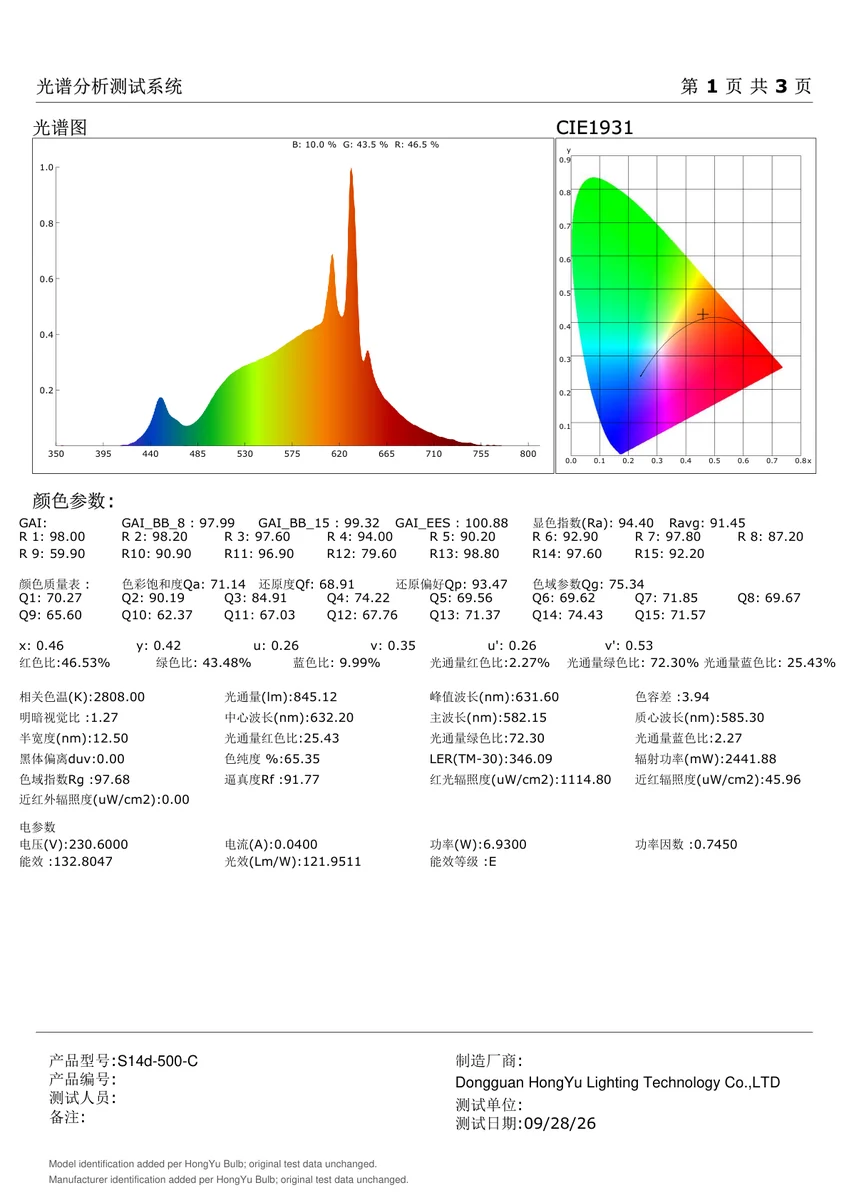
| S14d-500-C | Clear | 6.93 W | 845.12 lm | 2808 K | 94.4 | 59.9 |
| S14d-500-SC | Strip Clear | 6.90 W | 859.29 lm | 2821 K | 93.9 | 62.1 |
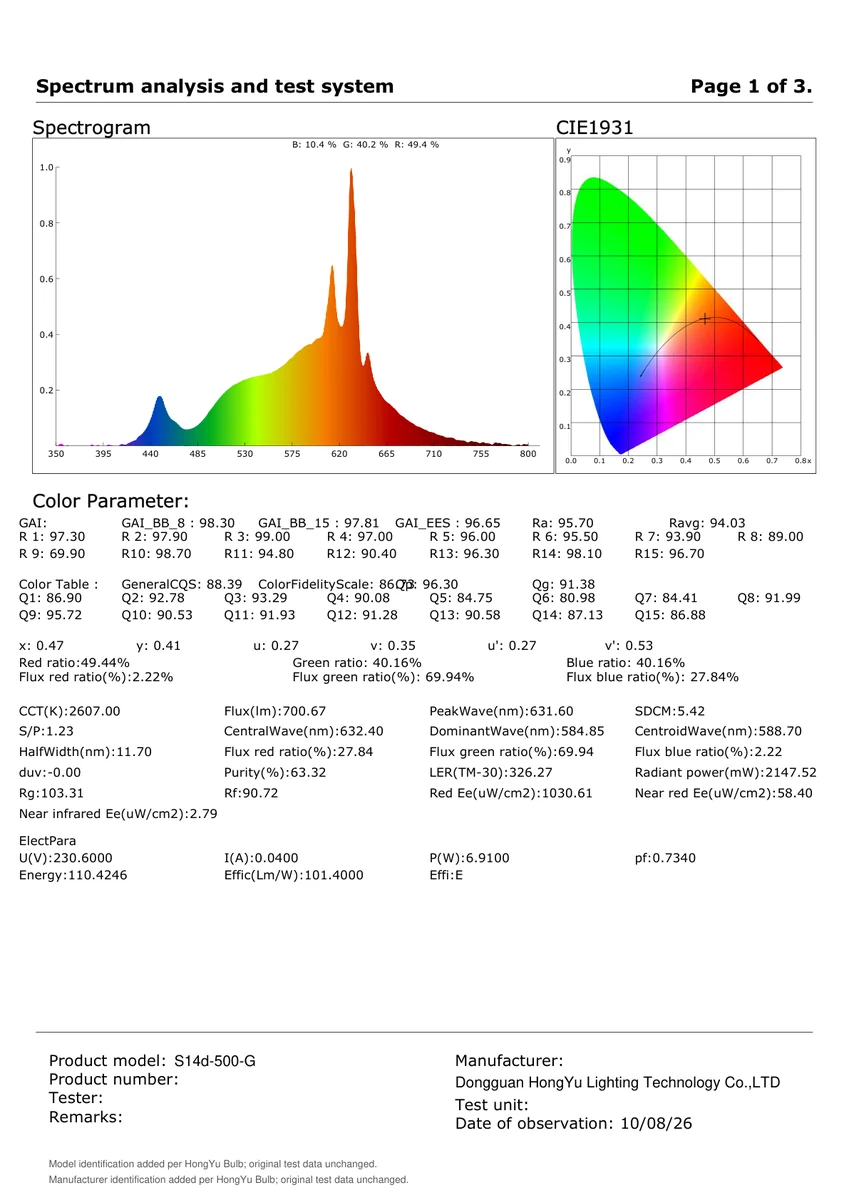
| S14d-500-G | Gold | 6.91 W | 700.67 lm | 2607 K | 95.7 | 69.9 |
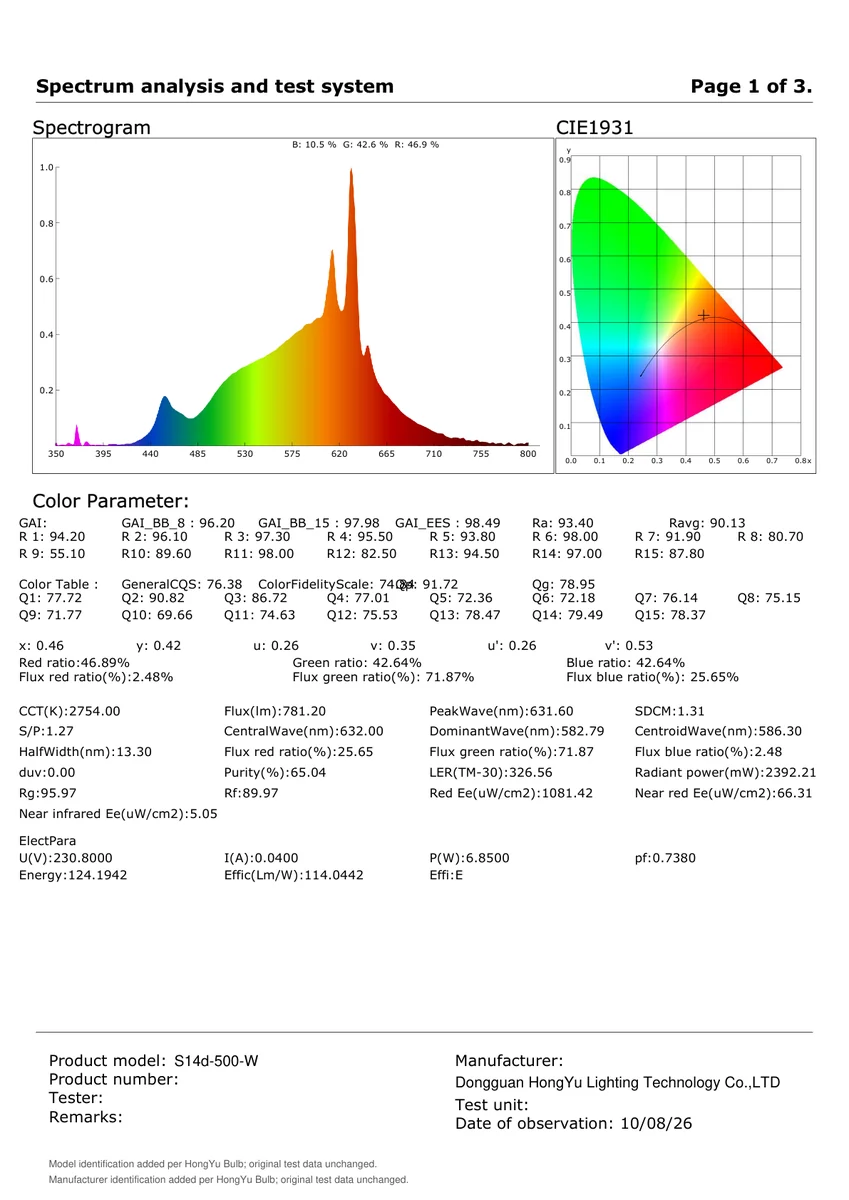
| S14d-500-W | Porcelain | 6.85 W | 781.20 lm | 2754 K | 93.4 | 55.1 |
The Clear and Strip Clear reports are dated September 28, 2026; Gold and Porcelain are dated October 8, 2026. Recorded supply voltages are 230.6 V for the first three and 230.8 V for Porcelain. Values above are rounded only where shown. Model and manufacturer labels were added to the supplied reports at HongYu's request, with the original measurements unchanged, as disclosed on the product page and report copies.
These are sample records, not four repeated measurements of one lamp. They are also not a controlled experiment in which only the glass finish was changed. They support model-level comparison; they do not establish a universal coating-loss percentage or a guaranteed value for every production unit.
Buying judgment 1: ask for the report attached to the finish you are ordering. A series-level Ra statement is useful for shortlisting; the finished-model record is more useful for selecting the sample.
What Ra Adds, and What R9 Adds
Ra summarizes fidelity across eight standard test colors. R9 evaluates a separate saturated-red test color and is not part of that average. The U.S. Department of Energy notes that this red-rendering information is relevant to skin tones and other materials; it also explains why color quality cannot be reduced to one ranking.[1]
The four HongYu records make the distinction visible. Their Ra values span 93.4 to 95.7, a range of 2.3 points. Their R9 values span 55.1 to 69.9, a range of 14.8 points. These are different indices, so the spreads are not directly comparable measures of visual difference. The useful observation is simpler: knowing Ra alone would not tell the buyer the R9 result.
For a mirror-fixture brand, this creates a more informative product discussion. Instead of asking only for "CRI 90," specify the desired Ra and R9 together, then review the complete fixture with representative skin tones, fabrics or objects appropriate to the intended use. A numerical report supports that review; it does not predict every person's preferred appearance.
Buying judgment 2: use R9 to add a specific requirement, not a vague premium label. The published samples all record R9 above 50. That is a useful evidence point for these samples, not an automatic all-model or all-batch guarantee. If the project requires a higher target, identify it before configuration and sample approval.
The Highest Ra Is Not Automatically the Best Match
In these four records, the Gold sample has the highest Ra and R9. It also has the lowest recorded CCT and luminous flux. A buyer wanting a warmer decorative direction may find that combination attractive. A buyer prioritizing a white diffusing form or a higher output target may shortlist a different model.
This is not a defect in the comparison. It is the reason to offer a family of products rather than one supposedly ideal lamp. The finish can create a recognizable fixture identity while the light specification is chosen for the application.
The Gold sample records 2607 K and the Clear sample 2808 K, a difference of 201 K. That comparison describes the measured lamps. It does not prove that adding gold glass to an otherwise identical lamp always shifts CCT by 201 K. Keep the sample identity, configuration and measured result together.
Buying judgment 3: shortlist a combination of properties. The best candidate is the one that addresses the brief, not necessarily the one that leads one column of the table.
Turn the Data Into a Joint Sample Target
Consider an illustrative screening brief: at least Ra 90, R9 50 and 800 lm at the report's operating point. This is a purchasing example, not a universal mirror-lighting standard or a new HongYu guaranteed specification.
| Published 500 mm sample | Ra at least 90 | R9 at least 50 | Flux at least 800 lm | Initial paper shortlist |
|---|---|---|---|---|
| Clear | Yes | Yes | Yes | Candidate for fixture review |
| Strip Clear | Yes | Yes | Yes | Candidate for fixture review |
| Gold | Yes | Yes | No | Review a different output brief or configuration |
| Porcelain | Yes | Yes | No | Review a different output brief or configuration |
Now suppose a white diffusing appearance is essential to the design. Choosing Clear simply because it passes the illustrative output threshold would discard a core product requirement. The useful next step is to send HongYu the combined brief: Porcelain appearance, desired output, Ra and R9 targets, control requirement and selected length. Ask for the corresponding configuration and sample proposal.
That is where factory-facing specification work adds value: it turns separate preferences into one product definition. The target is not to win every column independently. It is to develop or select the combination the customer can actually use.
Buying judgment 4: write the acceptance criteria together. Do not approve appearance on one sample, copy the lumen figure from a second model and borrow R9 from a third.
Keep Useful Output and the Mirror Scene Connected
The recorded powers are close, but the sample flux values range from 700.67 to 859.29 lm. This is another reason to specify the completed model rather than assume that every 7W option delivers the same light. FTC guidance distinguishes light output in lumens from electrical power in watts.[2]
Total lumens do not tell you the illuminance on a face. Placement, distance, the mirror, the fixture and surrounding light all influence the installed result. For sampling, keep those conditions consistent and compare both the appearance of the lamp and the illumination it provides.
For a coordinated collection using white globes as well as linear mirror lamps, HongYu's porcelain filament bulb range offers a related visual direction. Coordinate the selected finish and light specification across the products, without assuming that different shapes share identical color data.
From a Published Sample to Your Ordered Product
The value of these records is that they give a buyer something specific to discuss. They are not a substitute for agreeing the ordered configuration and acceptance limits. The report pages do not establish batch variation, measurement uncertainty or performance at every dimmed setting.
Start with the preferred finish and length. Add the voltage, nominal CCT and permitted color range, minimum finished output, Ra and R9 requirements, controller and lamp count. Identify any required dimmed operating point separately from full-output measurements. For paired mirror lamps, also state the desired color consistency between the two sides.
HongYu lists R9 and SDCM project targets in its S14d programme. Ask which configuration addresses your requirements and what sample evidence will be supplied; a listed project option is not a result already demonstrated by every report in the series.
Buying judgment 5: make the sample result the start of an approval record, not the whole order specification. Link the approved model, finish, electrical configuration and agreed limits so the quotation describes the product your brand intends to sell.
Conclusion
The four S14d reports show the value of looking beyond a generic high-CRI claim. Each recorded sample combines a particular finish with its own Ra, R9, color temperature and output. The practical buying decision is which combination supports the mirror-light collection you want to create.
HongYu brings finish choice and accessible model-level data into the same discussion. Send your preferred models and joint appearance-and-lighting brief through the S14d sample and quotation page, and request a proposal for the configuration your fixture needs.
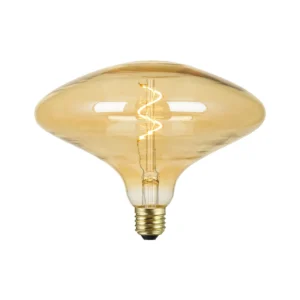
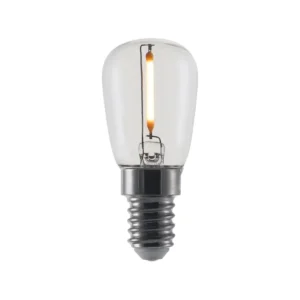
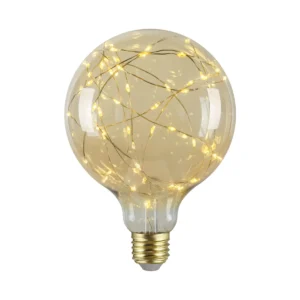
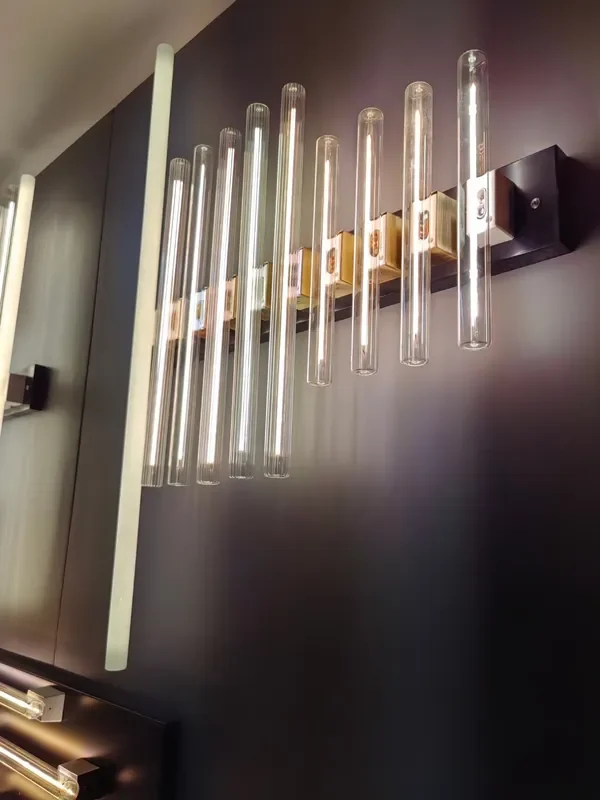
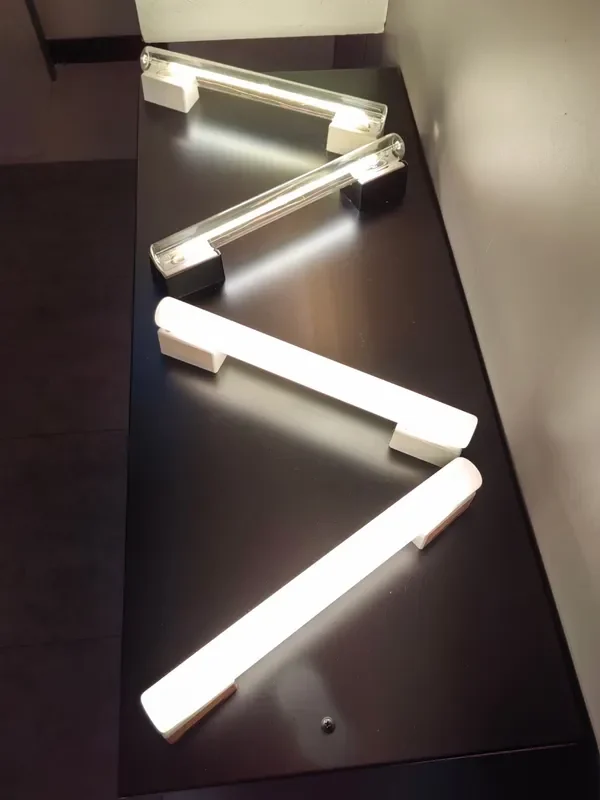
Product photographs are real HongYu display images, not photos of the measured samples. Report images reproduce the already-published model-labelled report pages. This article compares recorded sample values; it does not claim an independently verified production study.
References
- U.S. Department of Energy: LED Color Characteristics, April 2016. General explanation of Ra, R9 and color-quality interpretation, not a HongYu product approval. Back to text.
- Federal Trade Commission: Shopping for Light Bulbs. General distinction between lumens and watts. Back to text.