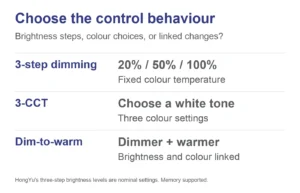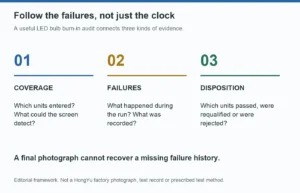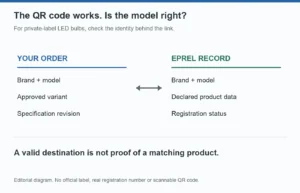
Featured image: Original comparison diagram. The 20%, 50% and 100% labels are HongYu's nominal three-step brightness settings; colour temperature stays fixed.
A buyer asks for a bulb with three settings. The supplier offers three brightness levels. The designer expects three shades of white. Both may call it a "three-mode bulb," but they are specifying different products.
Three-step dimming changes brightness. Three-CCT selection changes the selected white-light colour. Dim-to-warm links reduced brightness with a warmer colour. Start with that distinction before comparing bulb shapes, wattages or prices.
HongYu already manufactures a fixed-colour three-step dimming option in volume, with 20%, 50% and 100% nominal brightness settings and memory support. The colour temperature stays the same across the three levels. HongYu has also made three-CCT bulbs. These are separate product options, not two names for the same function.
Decide What Should Change When the User Adjusts the Light
The U.S. Department of Energy describes dim-to-warm as a linked change in light output and colour, distinct from white-tunable systems that can provide independent colour and intensity adjustment. [1] Fixed-colour step dimming does something simpler: it gives the user a choice of brightness levels without asking them to choose another white tone.
The practical comparison is therefore about what changes, what stays fixed, and which scenes the room needs.
| Product behaviour | What changes | When to choose it |
|---|---|---|
| Fixed-CCT three-step dimming | Brightness in discrete levels; HongYu's option is 20%, 50% and 100% | The room needs several useful light levels while keeping one white tone |
| Three-CCT selection | A choice of three colour temperatures; brightness control is a separate specification | The user or installer needs different white-light choices |
| Dim-to-warm | Light output and colour change together | The room should become warmer as the light is turned down |
Buyer judgment 1: Ask what the three settings represent. A list of percentages describes brightness settings; a list of Kelvin values describes colour settings. Neither should be substituted for the other on a quotation or package.
For projects requiring a warmer colour as brightness falls, HongYu's EU dim-to-warm filament bulbs provide a relevant product starting point. Select the model and finish, then review the actual dimming behaviour with the intended control.
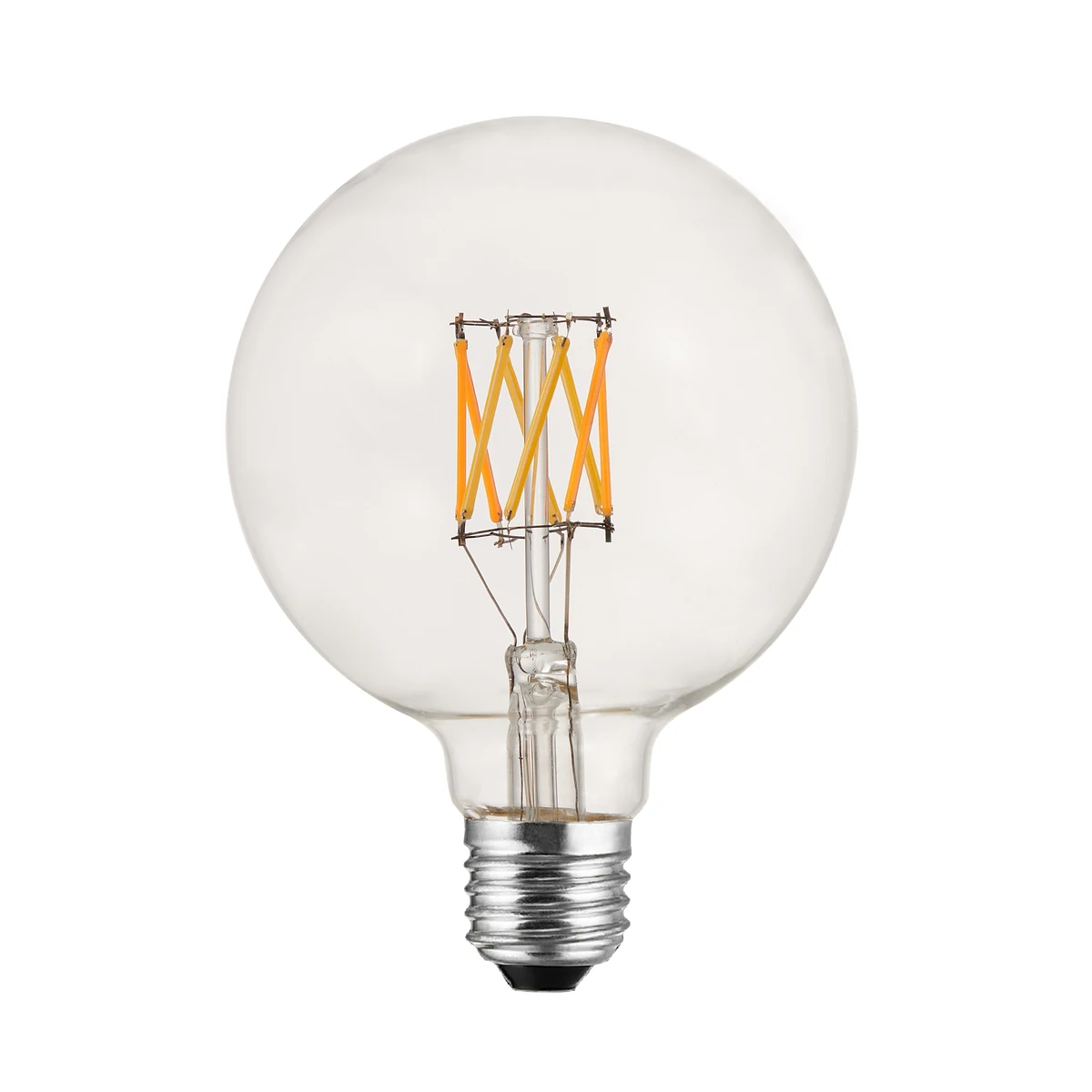
Three-Step Dimming Is a Deliberate Product Choice
For a room that needs a low, medium and full setting, three-step dimming can be the right specification rather than a compromise. It gives the buyer a defined set of operating states and keeps the selected colour temperature unchanged.
Consider a decorative bedside lamp. The same white tone may be wanted at full output for a task and at a lower level for ambience. In that brief, a warmer colour at the low setting is not automatically an improvement: it changes something the designer wanted to preserve. HongYu's fixed-CCT three-step option addresses the brightness choice directly.
The decision point is the lowest available level. A 20% setting is not the same requirement as very deep dimming. Review the low scene in the intended fixture. If the room needs a finer adjustment between levels or a lower minimum, specify that requirement instead of assuming three steps can deliver it.
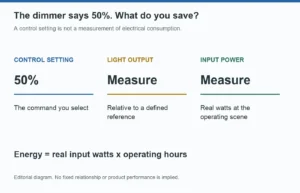
Treat 20%, 50% and 100% as nominal brightness settings in the product brief, not measured power percentages. Keep the actual lumen output and any acceptance tolerance in the selected model's specification.
The Number of Modes Does Not Define the Control Interface
Selectable-colour products can use a switch or dial on the bulb, power cycling at the wall switch, or an electronic control. Feit Electric's product guidance illustrates these different mechanisms and states that dimmability varies by model. [2]
For a three-CCT product, those differences change the purchase decision:
- A selector on the bulb suits a colour chosen during installation. It is a poor everyday interface if the lamp sits inside a shade that must be removed to reach it.
- Wall-switch cycling puts selection at the existing switch. The off/on sequence becomes part of normal operation, so the switching interval and memory behaviour matter.
- A touch button, remote or other controller needs its own action map. A short press could select colour while a long press changes brightness, but that behaviour must be specified rather than inferred from "3-CCT."
Also separate 3-CCT, three brightness steps, and 3-way socket operation. They are not synonyms. For example, Feit's OM30/100/5CCTCA combines five selectable colour temperatures with three brightness levels in a compatible 3-way fixture, while its specification lists it as non-dimmable. [3] Multiple brightness levels do not automatically mean compatibility with a wall dimmer.
Buyer judgment 2: Separate the function from the interface. Three brightness levels, three colour temperatures and compatibility with an external dimmer are three different specifications. State the switching method and permitted controls for the selected model.
Choose for the Room, Not for the Longest Feature List
For restaurant pendants that should become both dimmer and warmer during evening service, start with dim-to-warm. Linking the two changes is the intended benefit, not a missing feature. Review the intermediate scene the restaurant will actually use, rather than approving only full output and the warmest endpoint.
For a lighting collection where the installer chooses one white tone to suit the interior, start with a physical CCT selector. The purchaser gets a choice at commissioning without asking every subsequent user to manage a colour mode. Check access to the selector before approving the fixture.
For a lamp that needs several brightness settings while retaining one selected white tone, start with fixed-CCT three-step dimming. If the three levels meet the brief, there is no need to add colour selection. If the user also needs to choose different colours at each brightness, specify independent colour and brightness control; that is an additional requirement, not an automatic feature of either three-step or three-CCT operation.
When considering a shape from the EU standard filament bulb range, include the required control version in the enquiry. A shared glass shape or base does not mean every model has the same driver or three-step function.
Buyer judgment 3: More available settings are valuable only when they make the required scenes easier to reach. Evaluate the steps a guest, staff member or installer must perform, not just the number of modes on the packaging.
The Next Switch-On Is Part of the Product
HongYu's three-step brightness option supports memory. That is a useful feature: the purchase is not only about choosing a level, but also about what happens when the lamp is used again. Put the required recall behaviour into the model specification alongside the switching sequence.
Do not transfer that memory specification to a three-CCT version simply because both products have three settings. For each control version, identify which state is remembered and how an intentional mode change differs from an ordinary off/on operation.
This is a documented product distinction, not a theoretical concern. The Philips SceneSwitch 8719514307766 datasheet specifies a last-setting memory condition after more than six seconds off and a separate reset procedure for lamps that are out of sync. [4] Those instructions belong to that model; they are not a timing standard for other switching bulbs.
Use the following action/result table for the selected switching product:
| Action to demonstrate | Result to define |
|---|---|
| First switch-on after installation | Which brightness or CCT setting appears by default? |
| Deliberate setting change | What action selects another level or CCT, and in what order? |
| Ordinary off/on after leaving the room | Which setting is recalled, and what timing conditions apply? |
| Power restored after an interruption | What state appears without further user input? |
| One lamp replaced in a group | How can all lamps be brought to the same intended mode? |
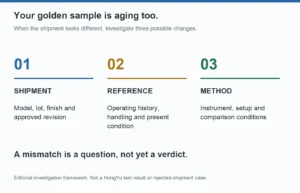
The important distinction is product variation versus different operating states. Two identical three-step lamps can look uneven if one is at 20% and the other at 100%. Two three-CCT lamps can show different white tones because different colour modes are selected. Check the mode before treating the difference as an optical consistency problem.
Equally, putting several lamps on one switch is not proof that every later operation will return them to the same mode. Include the replacement-lamp scenario in the demonstration. Define a recovery method staff can actually perform.
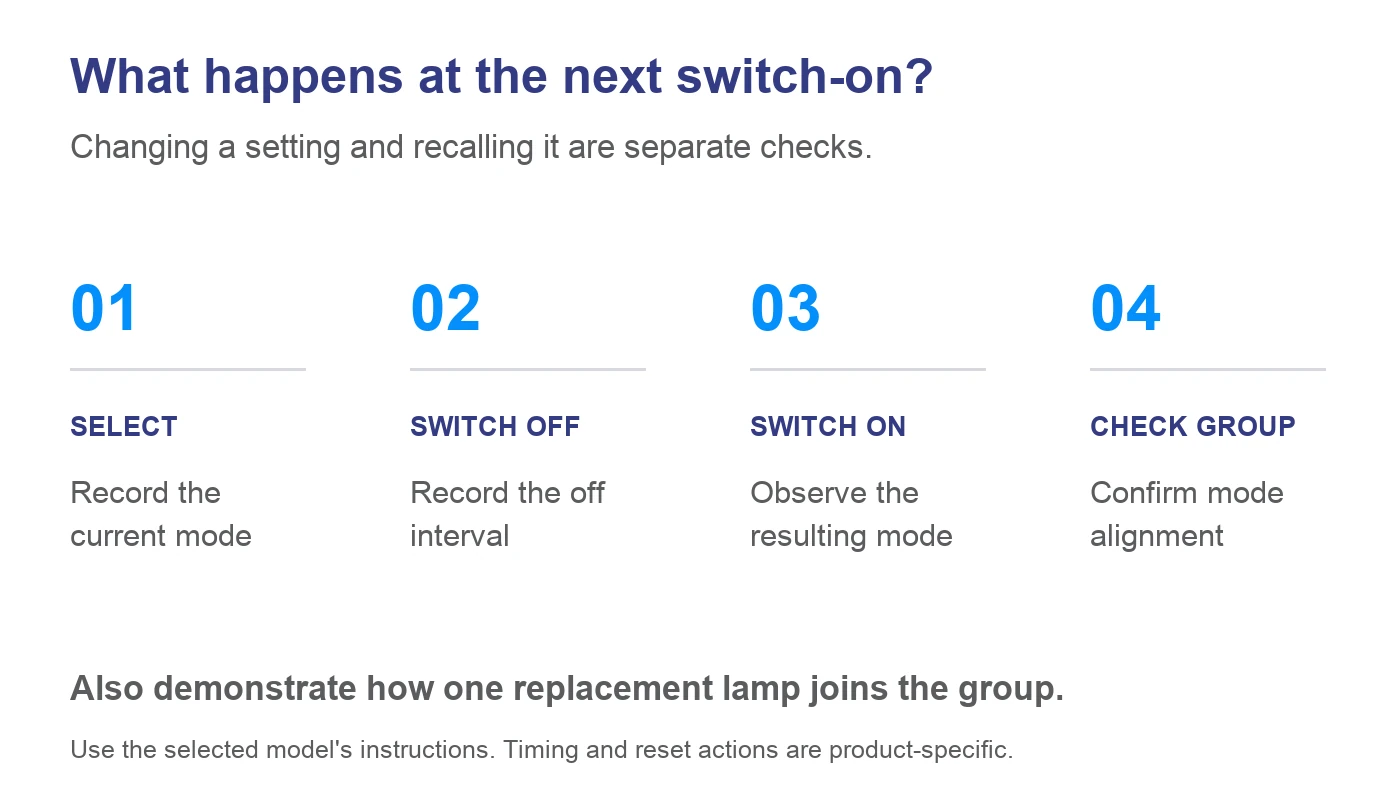
Buyer judgment 4: A product demonstration is incomplete until it includes switching the light back on. Reaching a desired setting is only half the experience; returning to the intended setting matters too.
Request a Demonstration That Can Resolve the Decision
Ask for one continuous recording showing the control and lamps together. It should start from the declared initial state, show each selection action, include the off periods, and end with the restart and group-recovery checks. Keep the model and control identity in the record.
Use the video to judge sequence and usability. Request measurements that answer the selected brief: brightness and colour at all three levels for fixed-CCT step dimming; output at each colour setting for three-CCT; and the intended intermediate scene for dim-to-warm. This checks the function you are buying instead of collecting unrelated catalogue numbers.
A camera's automatic exposure and white balance can disguise brightness and colour changes. A video is therefore useful operational evidence, not a substitute for photometric results.
Send a brief such as this, replacing the brackets with the project's requirements:
We need [fixed-CCT three-step dimming / three-CCT selection / dim-to-warm]. For the three-step option, specify 20%, 50% and 100% nominal brightness, unchanged colour temperature and memory. For a three-CCT option, list the required Kelvin values and state brightness control and memory separately. Please confirm the available model, switching method, selection order, recall conditions and permitted external controls. Demonstrate normal operation, restart and replacement of one lamp in a group.
This brief gives the supplier a behaviour to quote, not just three numbers to print. It also keeps the factory's three-step and three-CCT offerings distinct through sampling, packaging and order approval.
Conclusion
Choose fixed-CCT three-step dimming when the room needs different brightness levels without a colour change. Choose three-CCT when the required choice is between white-light colours. Choose dim-to-warm when lower light should also become warmer.
HongYu's mass-produced 20% / 50% / 100% option with memory belongs to the first category; its three-CCT work and dim-to-warm range address different needs. Specify what changes, what stays fixed and what the lamp remembers. That is more useful than asking for a bulb with "three modes."
References
- U.S. Department of Energy, Understanding LED Color-Tunable Products. Definitions of linked warm dimming and white-tunable control. Back to text.
- Feit Electric, Color Selectable LED Light Bulbs FAQs. Selection mechanisms and model-dependent dimmability. Back to text.
- Feit Electric, OM30/100/5CCTCA product specifications. Example distinguishing selectable CCT, 3-way brightness and dimmability. Back to text.
- Signify, Philips SceneSwitch 8719514307766 datasheet, issued 15 April 2026. Model-specific memory and group-reset instructions. Back to text.