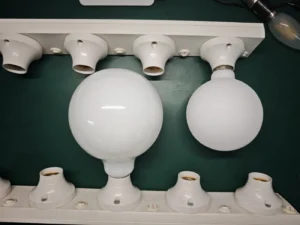
Featured image: HongYu-supplied reference photograph: glossy opal on the left, matte porcelain-style finish on the right. These are different existing samples, not proof of a double-treatment process.
An opal sample hides the filament, but its shiny exterior does not suit an exposed pendant. An outside-frosted sample has the desired texture, but its lit appearance is not acceptable. Should the manufacturer combine the two treatments?
Only if the combination closes that specific gap better than an available single-finish product. Two processes are not a quality grade. They are a proposed solution that needs to earn its place in the design.
Here, "inside opal" means an internal white diffusion treatment; "outside frosted" means an additional exterior matte treatment. The exterior may involve textured glass or a coating. Confirm the actual construction before discussing feasibility or price.
Name the Problem the Second Treatment Must Solve
Separate the image of the filament from reflections on the outer surface. Internal diffusion addresses the view through the glass; an exterior matte treatment addresses the surface appearance as well as potentially affecting transmitted light. A reflected window and a visible filament are not the same defect.
Edmund Optics describes surface-textured and opal-coated diffusers as different optical constructions with diffusion/transmission trade-offs.[1] That supports treating them as distinct design variables, not predicting a combined bulb's output from their names.
Write one acceptance sentence before requesting a prototype: "Retain the approved filament concealment of sample A, but reduce its sharp surface reflections to the approved appearance reference." If the requirement cannot identify what the second treatment should improve, the project is not ready to specify it.
Also compare an existing matte-white alternative, such as a suitable model from HongYu's EU porcelain filament bulb range. Its appearance does not prove a double-treatment construction. If it already meets the brief, an additional custom route needs a separate benefit.
Design judgment 1: Do not pay for a second treatment until its intended contribution can be named. "More premium" is not an acceptance criterion.
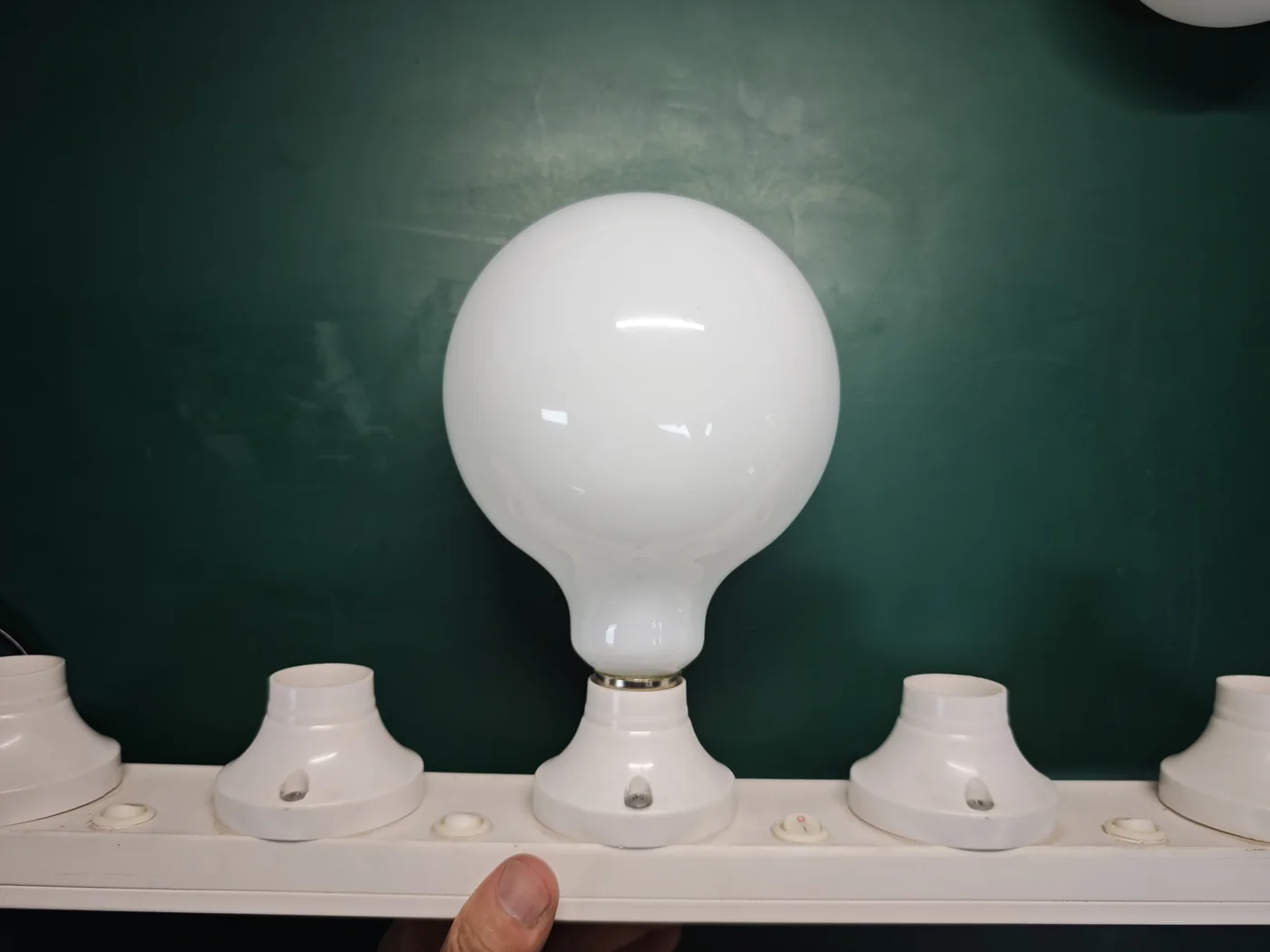
Ask About the Interface Between the Two Processes
The manufacturing question is not simply whether the factory can perform each treatment separately. It is whether the proposed sequence preserves both results on the same envelope.
Ask three focused questions:
- What happens to the first treatment during the second? Request the proposed sequence and identify any cleaning, handling or thermal stage that could affect the previously treated surface. Do not prescribe a curing sequence without the manufacturer's process review.
- Where does the exterior treatment stop? Agree the appearance around the neck and shoulder, including any transition near the base. A uniform crown does not establish an acceptable whole envelope.
- What happens when only one surface fails inspection? Ask whether rework is feasible without changing the other treatment, or whether the piece must be rejected. This distinguishes a workable process from a successful one-off sample.
For a design from HongYu's custom-shape bulb range, review these questions on the proposed geometry. A round-globe trial does not establish coverage or process access on an irregular envelope.
Design judgment 2: Evaluate the interaction between the processes, not merely the supplier's ability to perform each one. Cost and yield need route-specific evidence; neither follows from counting treatments.
Use Three Sample Groups to Test the Contribution
The following is a proposed development comparison, not a report of completed HongYu testing. Request several identified samples per group, with the same glass geometry, filament layout, LED selection and driver wherever practicable.
| Group | Treatment combination | Useful comparison |
|---|---|---|
| A | Internal opal; smooth exterior | Baseline for filament concealment |
| B | Proposed exterior matte treatment; no internal opal | Baseline for the exterior treatment alone |
| C | Internal opal plus the proposed exterior matte treatment | Candidate that must improve on the single-treatment alternatives |
Compare C against A to establish what adding the exterior treatment changes. Compare C against B to establish whether the internal treatment provides a necessary benefit. If C's filament layout or drive level also changes, record that difference: the comparison no longer isolates the finish.
Use the acceptance sentence to select the inspection conditions. Review reflected highlights under the agreed ambient illumination, then source concealment at the intended operating scene. Fix the viewing geometry and photographic settings; an overexposed photograph can hide unevenness.
If gloss is specified numerically, agree a method suitable for the curved envelope. Rhopoint explains why flat-surface gloss instruments can misread curved parts when reflected light misses the detector.[2] A number without a repeatable measurement geometry does not settle the comparison.
Design judgment 3: Group C must solve a problem that remains in A or B, without losing a result already approved. If it only looks different, that is not yet evidence that it is better for the project.
Keep the Process Experiment Separate From Product Selection
Matched hardware helps identify the effect of adding a treatment. It does not guarantee that the preferred sample delivers the required finished-lamp output.
Measure the combined version directly. Do not add generic "opal loss" and "frosted loss" percentages from different products. CIE S 025 covers electrical, photometric and colorimetric measurements of LED lamps; use an appropriate method agreed with the test provider.[3]
If the supplier changes the drive level to recover output, assess that revised lamp separately, including its electrical and thermal performance. It is no longer the unchanged-hardware experiment. The commercial comparison is now between finished products meeting the same lighting requirement.
Design judgment 4: First establish what the second treatment changes; then decide whether the resulting product is worth buying. Combining those questions can conceal why a sample improved or what it cost to achieve the improvement.
Decide Whether to Continue, Revise or Stop
Use the results to make a specific development decision:
- Continue to a pilot when C provides the required visible improvement, meets finished performance requirements and has a documented process route. The pilot must still establish repeatability.
- Revise the design when C improves the target appearance but misses another requirement. Identify whether the next change concerns the finish, source arrangement or drive conditions, then repeat the relevant comparison.
- Stop the double-finish route when A, B or an existing alternative already meets the brief, or when C introduces a trade-off the project cannot accept.
For a HongYu technical enquiry, send the two appearance references, the exact difference you want to eliminate, the proposed bulb geometry and the required finished output. Request a feasibility review and a defined comparison set rather than treating "inside opal plus outside frosted" as an already-qualified catalogue specification.
Conclusion
A double finish is justified by a demonstrated improvement, not by an extra manufacturing step. Define the missing result, test the contribution of each treatment, and review their process interaction. If a simpler product reaches the same approved result, the second treatment has not earned its place.
References
- Edmund Optics, Ground Glass and Opal Glass Diffusers. General optical principles, not HongYu bulb test data. Back to text.
- Rhopoint Instruments, Measuring Gloss on Curved Surfaces. Measurement geometry and curvature. Back to text.
- CIE, Test Method for LED Lamps, LED Luminaires and LED Modules, CIE S 025/E:2015. Public scope; not a claim that these proposed samples have been tested. Back to text.