Porcelain LED filament bulbs are one of the most nuanced products in the decorative lighting category. Superficially, they look similar to frosted bulbs — both appear white and both diffuse the filament. But the differences in manufacturing, optical performance, and design application are significant. This guide explains the science behind porcelain coating, compares it rigorously against competing finish options, and identifies the specific applications where porcelain delivers results that no other finish can match.

What Is Porcelain Coating? Manufacturing and Materials
Porcelain coating — also called matte white, milk white, or enamel coating in various markets — is an opaque white enamel applied to the glass envelope of the bulb before the glass is fired. The coating material is typically a barium-titanate or calcium-silicate-based ceramic slip, applied by dipping, spraying, or screen printing, then fired at temperatures that bond the ceramic particles to the glass surface at a molecular level.
The firing process is critical to coating quality. Under-fired coating is chalky, lacks adhesion, and will flake or powder under normal handling. Over-fired coating may develop micro-cracks or discoloration. The correct firing profile — temperature curve, dwell time, and atmosphere — is a key process control parameter that distinguishes quality manufacturers from commodity producers. When evaluating suppliers, request samples and perform a basic adhesion test: run a fingernail firmly across the coated surface. Quality porcelain coating shows zero powder or flaking. Inferior coating shows white powder on the fingernail.
The Optical Physics of Porcelain Coating
Understanding what porcelain coating does to light — at a physics level — helps buyers predict its performance in specific applications and explain its value to end customers.
When a clear LED filament bulb emits light, the light exits the glass envelope with minimal scattering — the glass is essentially transparent, and the light distribution follows directly from the geometry of the filament. This produces high luminance (high brightness per unit area) at the filament location, with relatively lower luminance in the surrounding glass areas. The result is a visible hotspot — the bright line or point of the filament — which creates glare when viewed directly.
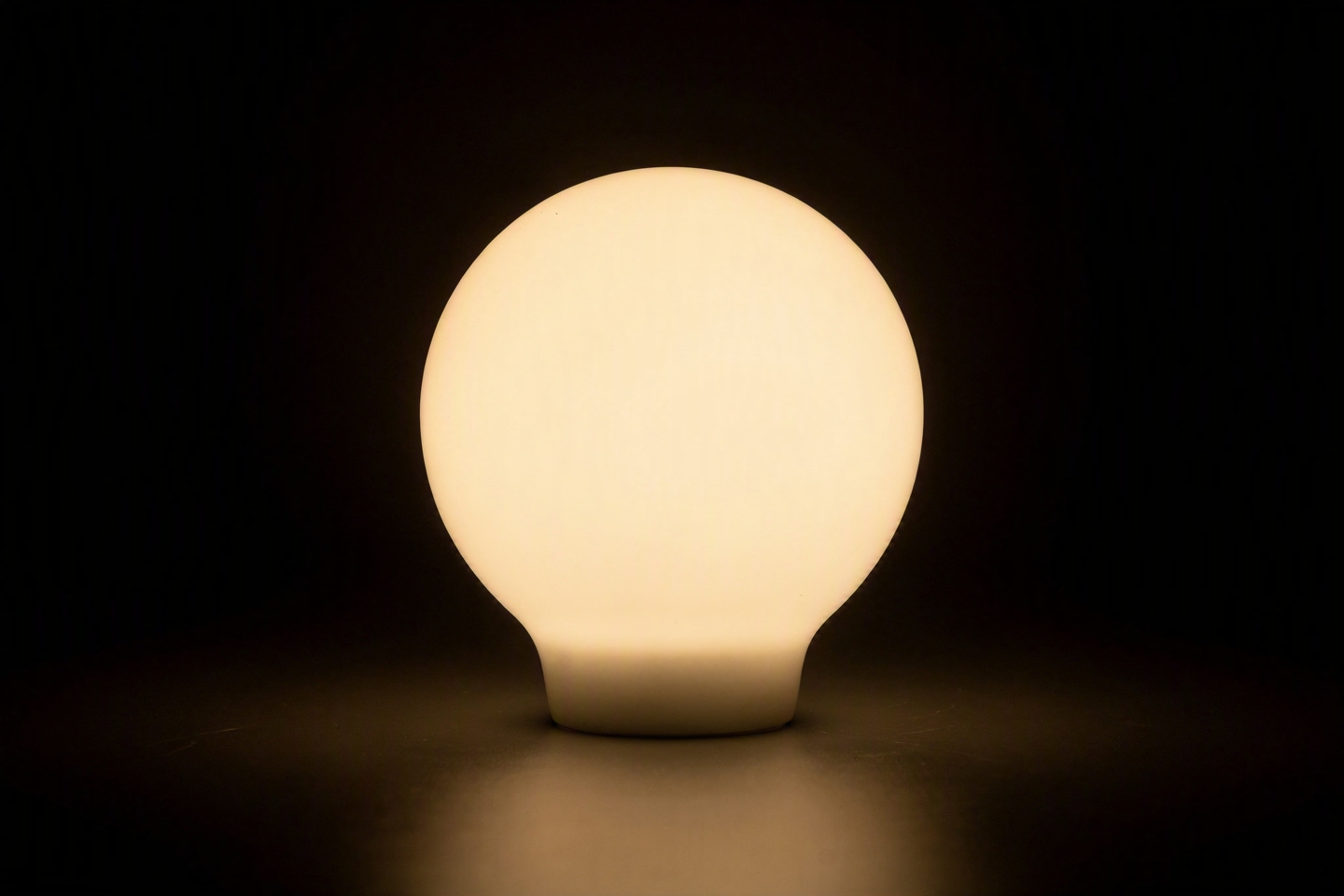
Porcelain coating completely changes this behaviour. The ceramic particles in the coating scatter incident light in all directions — a process called diffuse reflection. Light striking the coating from inside the bulb is scattered randomly rather than transmitted directly. The result is that the entire outer surface of the coated bulb becomes an emitter — every point on the surface emits light equally, producing a uniform luminance with no visible hotspot. Simultaneously, the scattering process is highly lossy: most of the photons that hit the coating are scattered back into the bulb rather than transmitted forward, where they are absorbed by the glass or re-emitted at a different point. This is why porcelain coating softens and redistributes the light. In normal decorative bulb applications, a well-controlled porcelain or matte white finish usually retains roughly 80–90% of the clear-glass lumen output. The expected reduction is about 10–20%, depending on coating thickness, glass shape and LED structure.
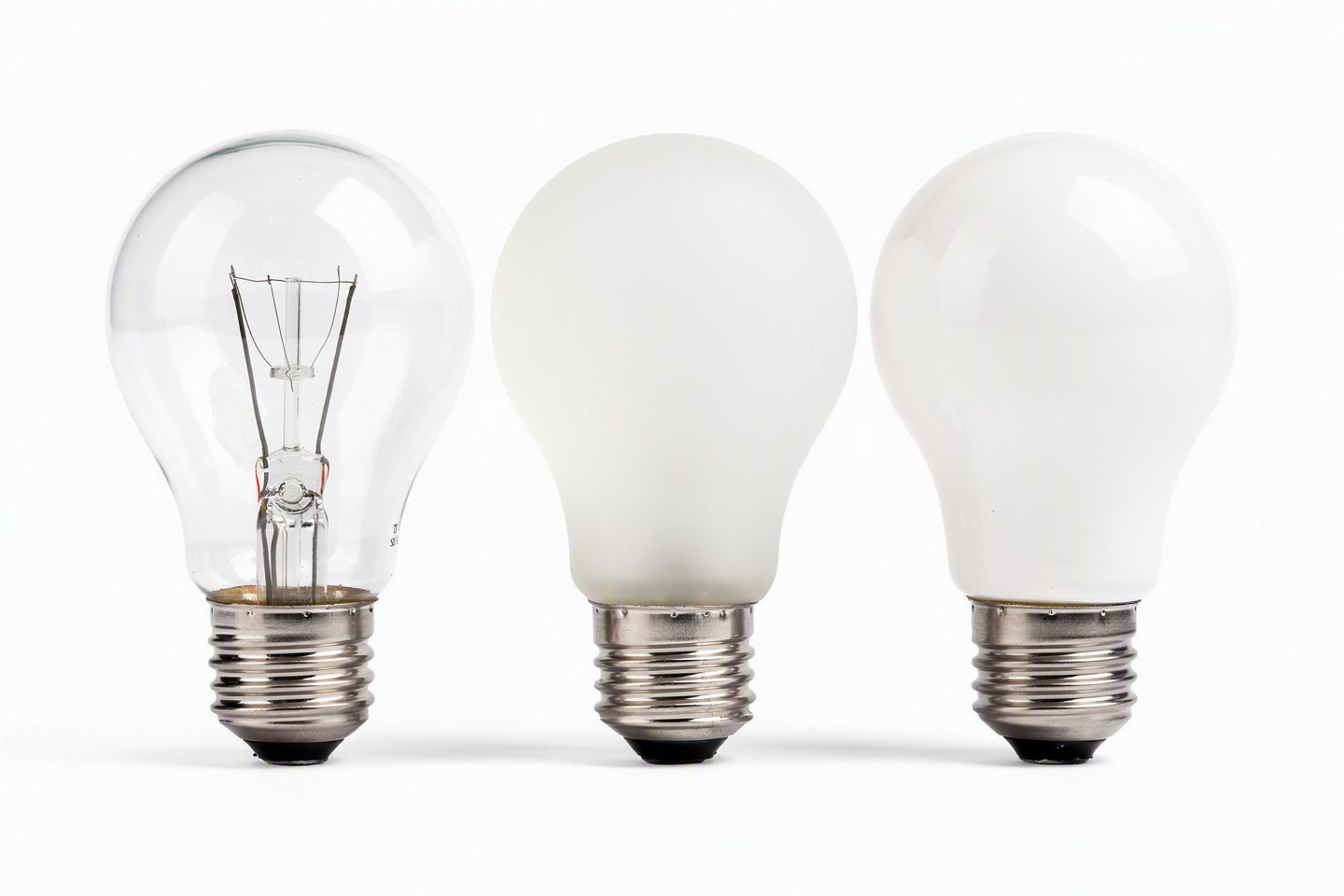
Porcelain vs. Frosted vs. Clear: A Detailed Comparison
| Property | Clear Glass | Acid-Etched Frosted | Porcelain / Matte White |
|---|---|---|---|
| Filament visibility | Fully visible | Partially visible (hazy) | Not visible |
| Surface luminance | Non-uniform (hotspot) | Near-uniform | Fully uniform |
| Lumen transmission | ~95% | ~85–90% | ~80–90% |
| Glare control | None | Moderate | Complete |
| CCT shift through coating | Negligible | Negligible | 200–300 K warmer |
| Appearance when unlit | Clear glass | White/hazy | Solid white / opaque |
| Best application | Exposed decorative pendant | Enclosed shades, general use | Accent lighting, photography, beauty/spa |
Specification note: In this table, porcelain transmission means the finished bulb typically retains about 80–90% of the clear-glass lumen output. The expected reduction is about 10–20%.
The 10–20% lumen loss of a well-controlled porcelain coating is an important specification detail, but it does not mean porcelain bulbs are only decorative low-output products. Buyers should still confirm tested lumen output for the actual coated model, especially for hospitality, vanity, wall-light and table-lamp applications. Buyers who understand that porcelain is fundamentally an accent and decorative product will find that it delivers results unavailable from any other finish type.

The Colour Temperature Effect
Porcelain coating has a measurable effect on the perceived colour temperature of the emitted light. Because the white ceramic coating preferentially scatters short-wavelength (blue-white) light more than long-wavelength (amber-red) light — a phenomenon analogous to Rayleigh scattering — the transmitted light spectrum has a slightly reduced blue component compared to the original LED spectrum. The effect is an apparent CCT shift of 200–300 K toward warmer tones.
In practice, this means a 2700 K LED viewed through a porcelain-coated envelope appears to be emitting approximately 2400–2500 K light. For most applications this warming effect is welcome — it enhances the cosy, skin-flattering character of the light. For applications where precise CCT is important, buyers should verify the actual CCT through the coating with a calibrated colour meter rather than relying on the underlying LED specification.

Applications Where Porcelain Delivers Unique Value
Professional Photography and Videography
This is the killer application for porcelain bulbs. In product photography and video production, visible bulbs in the frame (called "practicals") create bright-spot reflections on product surfaces, cause flare in the camera lens, and create high-contrast light-and-shadow patterns that are difficult to grade in post-production. Porcelain bulbs eliminate all of these problems. Their uniform surface luminance creates soft, shadowless reflections on product surfaces; their low lumen output prevents lens flare; and their even glow renders consistently across different camera exposure settings.
Major e-commerce platforms and consumer brands use porcelain filament bulbs as practical light sources in photography studios precisely because they provide the vintage aesthetic of a filament bulb with the optical behaviour of a soft box. The styling department gets the visual they want; the photography team gets the lighting they need.
Spa, Wellness, and Beauty Environments
The spa and wellness market values two specific qualities from its lighting: flattery and calm. Flattery comes from warm, diffused light with high CRI that renders skin tones accurately and without harsh shadows. Calm comes from even, glare-free illumination that does not create visual focal points that distract from relaxation.
Porcelain filament bulbs deliver both. Their uniform surface luminance eliminates the visual "activity" of a visible filament — the eye does not track the filament the way it does with clear glass bulbs. Their low lumen output (used in appropriate fixtures) creates gentle, layered illumination without relying on dimming. And their slightly warmer apparent CCT enhances skin-tone rendering relative to the underlying LED specification.
In treatment rooms, changing areas, and steam rooms (where bulbs are typically in enclosed IP-rated fixtures), porcelain G45 and A60 bulbs in E14 and E27 are the standard specification for premium spa operators who have moved beyond standard frosted lamps.
Hollywood-Mirror and Dressing Room Installations
The Hollywood-mirror aesthetic — exposed globe bulbs arranged around a mirror frame, providing soft front lighting for makeup and grooming — has expanded from professional make-up artists' studios into high-end residential bathrooms, boutique hotel rooms, and beauty retail fitting rooms. The defining requirement is soft, even, shadow-free front lighting at face height.
Porcelain G45 or G80 bulbs in E14 or E27 are the preferred specification for Hollywood mirror installations. Their uniform surface luminance creates the classic "bare bulb surround" look with none of the glare that clear filament bulbs would produce at close viewing distances. Multiple units in the same fixture benefit from the inherent consistency of porcelain coating — any slight unit-to-unit variation in CCT or lumen output is obscured by the diffusing effect of the coating, making colour matching less critical than with clear bulbs.
Pendant Lighting in Bedrooms and Living Spaces
For residential buyers who want the visual appeal of an exposed pendant bulb but find the visual "busyness" of a clear filament too stimulating for bedroom and living space use, porcelain offers a quieter alternative. The uniform glow of a porcelain globe pendant reads as a softly luminous sphere — calming, decorative, and warm — without the high-contrast filament display of a clear pendant.
Specifying Porcelain Bulbs: Shape and Base Guide
Porcelain coating is available across the standard filament bulb shape range. The most commonly specified configurations:
| Shape | Base | Wattage | Best Application |
|---|---|---|---|
| A60 | E27 | 4 W, 8 W | Residential pendants, table lamps |
| G45 | E14 | 4 W | Chandelier, Hollywood mirror, wall sconces |
| G45 | E27 | 4 W | Small pendants, decorative fittings |
| G95 | E27 | 4 W, 7 W | Statement pendants, spa |
| G125 | E27 | 4 W, 7 W | Large pendants, photography studio practicals |
| G200 | E27 | 7 W | Statement photography, ultra-premium spa |
Quality Control Points for Buyers
- Coating adhesion: Fingernail scratch test. Zero powder or flaking indicates properly fired ceramic coating.
- Uniformity: Hold the lit bulb against a plain white wall in a dark room. The coating should glow absolutely uniformly with no light or dark patches.
- Colour consistency: Compare 10 units from a production sample side by side when lit. Visible CCT variation indicates inconsistent coating thickness or poorly controlled firing.
- Thermal stability: Run the bulb at full output for 4 hours, then examine the coating for any yellowing, crazing, or bubbling near the base (the hottest point). Quality coating shows zero thermal degradation.
- Lumen output: Request LM-79 test data for the specific coated model — not the uncoated base model. Lumen output through porcelain should usually remain around 80–90% of the uncoated equivalent. Record the expected 10–20% reduction in the finished-bulb specification.
Related HongYu Bulb product pages
- LED Filament Bulb Product Range → — standard and decorative LED filament bulbs for wholesale and project sourcing.
- Porcelain Filament Bulbs → — soft low-glare bulbs for hospitality, wall lamps and premium fixtures.
- ETL, CE & RoHS Certification Guide → — sourcing guidance for certification and import compliance.
- Big Decorative Bulbs → — oversized decorative filament bulbs for hospitality, retail and statement fixtures.
- Contact HongYu Bulb → — send specifications, target market, quantity and packaging requirements for quotation.
Conclusion
Porcelain LED filament bulbs are a specialist product that performs brilliantly in the right applications and poorly in the wrong ones. Their defining characteristic — strong filament concealment, soft surface luminance and moderate lumen loss of about 10–20% in normal applications — makes them useful for hospitality, vanity, spa, wall-light and accent lighting applications where light quality and visual comfort matter. For these applications, no other finish type delivers the same visual result.
HongYu Bulb's Porcelain range includes A60, G45, G95, G125, G150, and G200 forms in E14 and E27 bases, Ra 80/90/95 options, and 2700 K CCT, with CE+RoHS certification. Contact us for samples and wholesale pricing.