A buyer replaces ten 20W halogen lamps with ten 4W LED filament bulbs. Every lamp is marked 12V. The samples illuminate on a laboratory supply, the shipment passes incoming inspection, and the finished installation still flickers, refuses to dim below 40%, or leaves one lamp glowing after switch-off.
The failure is often described as a bad bulb. That diagnosis is incomplete.
In a low-voltage installation, the lamp is only one component in a chain: mains supply, dimmer, transformer or electronic converter, wiring, connector and lamp driver. Changing the load from 200W of resistive halogen to 40W of electronic LED can change how the transformer starts, how the dimmer detects its load and what waveform reaches each lamp.
The central purchasing insight is:
Voltage is a boundary condition, not a compatibility approval. A low-voltage lamp must be approved as part of a named electrical system.
This article explains how importers, lighting brands and project buyers should turn “12V LED bulb” into a testable specification before approving bulk production.
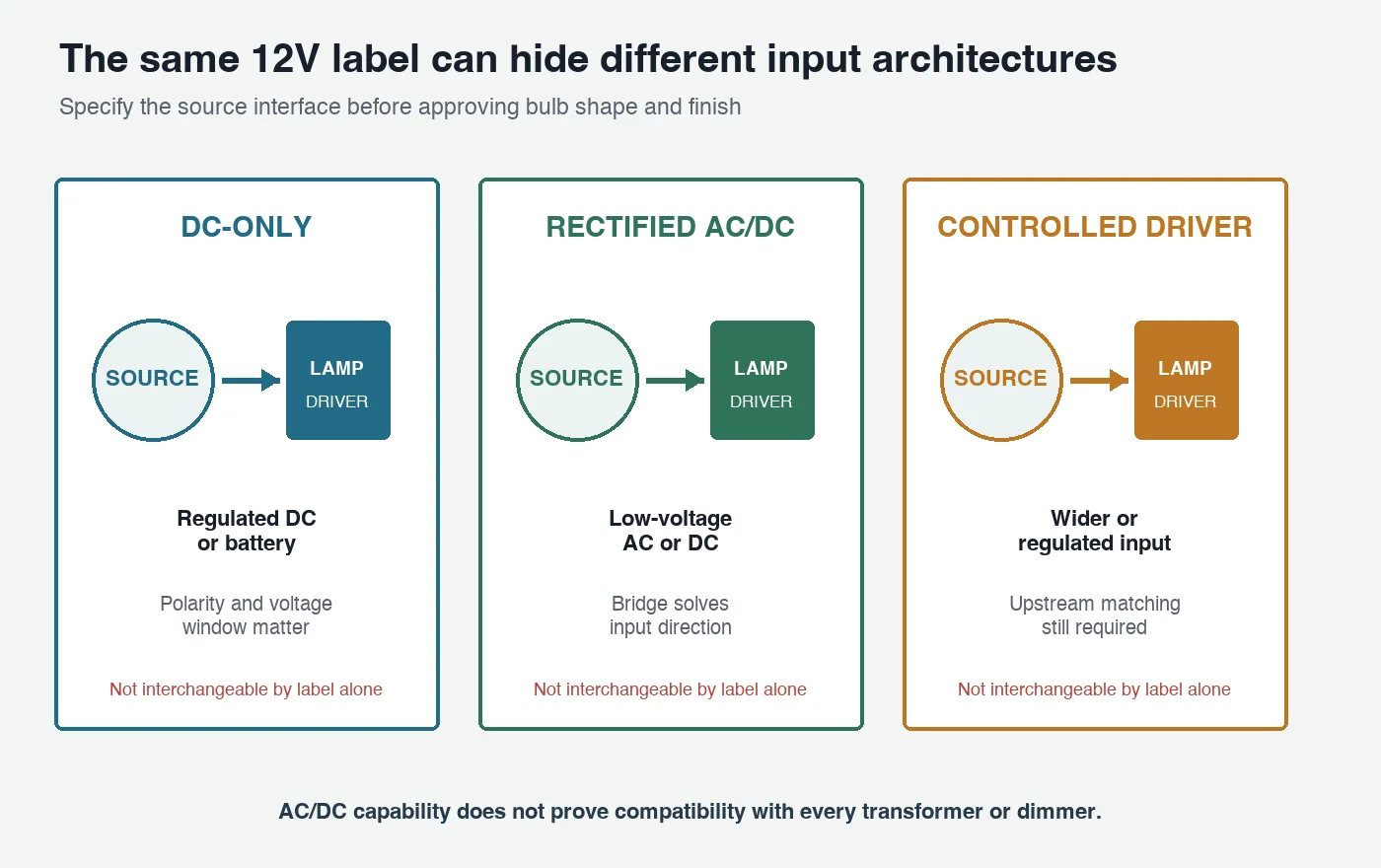
The Same 12V Label Can Describe Three Different Products
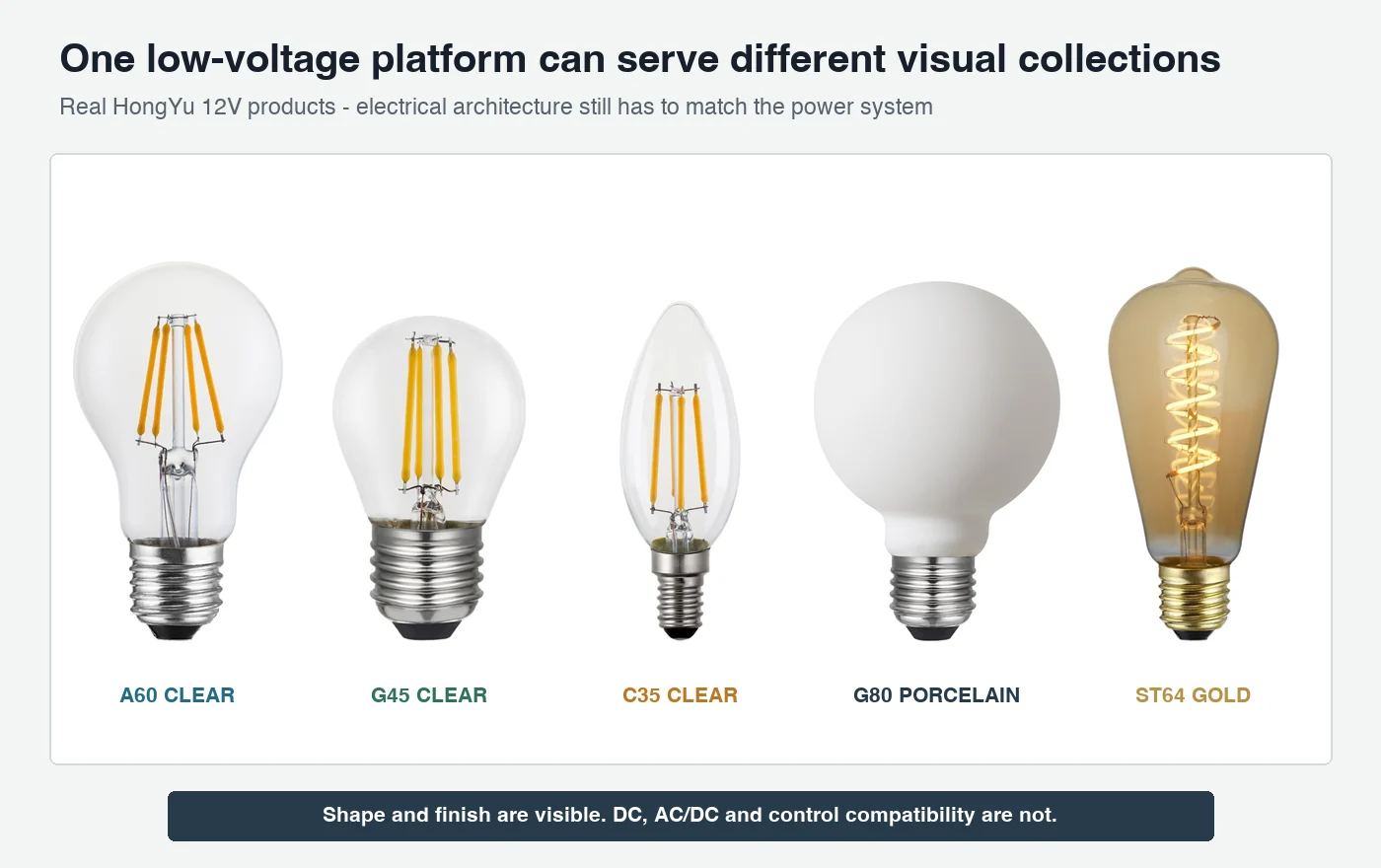
Two lamps can share the same glass, cap, wattage and 12V marking while using different electrical architectures.
DC-only resistor design
A DC-only lamp is intended for a constant-voltage DC source such as a battery, regulated power supply or suitable solar system. Its circuit can be compact and efficient, but it is not automatically suitable for a 12V AC transformer. Polarity may matter, and light output or power can move when the source voltage moves.
Rectified AC/DC design
An AC/DC lamp includes a bridge and driver arrangement that accepts the intended low-voltage AC or DC input. “AC/DC” solves polarity and rectification requirements; it does not prove that every electronic transformer or dimmer will operate correctly with the lamp.
Wide-input controlled design
A controlled driver can provide a wider operating window or more stable current, but its starting current, minimum holding current, capacitance and control behavior create a different load for upstream equipment. Better regulation inside the lamp can therefore require more careful system matching outside it.
HongYu's low-voltage LED filament bulb range separates 3.7V/5V DC, 12V/24V DC and 12V/24V AC/DC architectures because they are not interchangeable options on one generic electrical platform.
Concrete judgment 1
Reject a specification that says only “12V.” It must state DC or AC, the allowed input range, polarity behavior and the approved driver architecture.
Why a Halogen Transformer Can Reject a Smaller LED Load
Many legacy 12V installations were designed around tungsten-halogen loads. A transformer marked 20–105W was expected to operate one or more resistive lamps within that range. Replacing the lamps with LEDs can reduce connected wattage below the transformer's minimum load.
An electronic transformer may then fail to start consistently, pulse while searching for a valid load, shut down, or restart repeatedly. A lamp can appear normal when tested alone on a bench supply and fail only when connected to the installed converter.
The U.S. Department of Energy's LED MR16 study tested lamps with different transformers and dimmers and found that the choice of transformer could materially affect electrical and photometric behavior.[1] That study is about MR16 lamps, but the procurement lesson applies to replaceable 12V LED products generally: the upstream control gear is part of the operating condition.
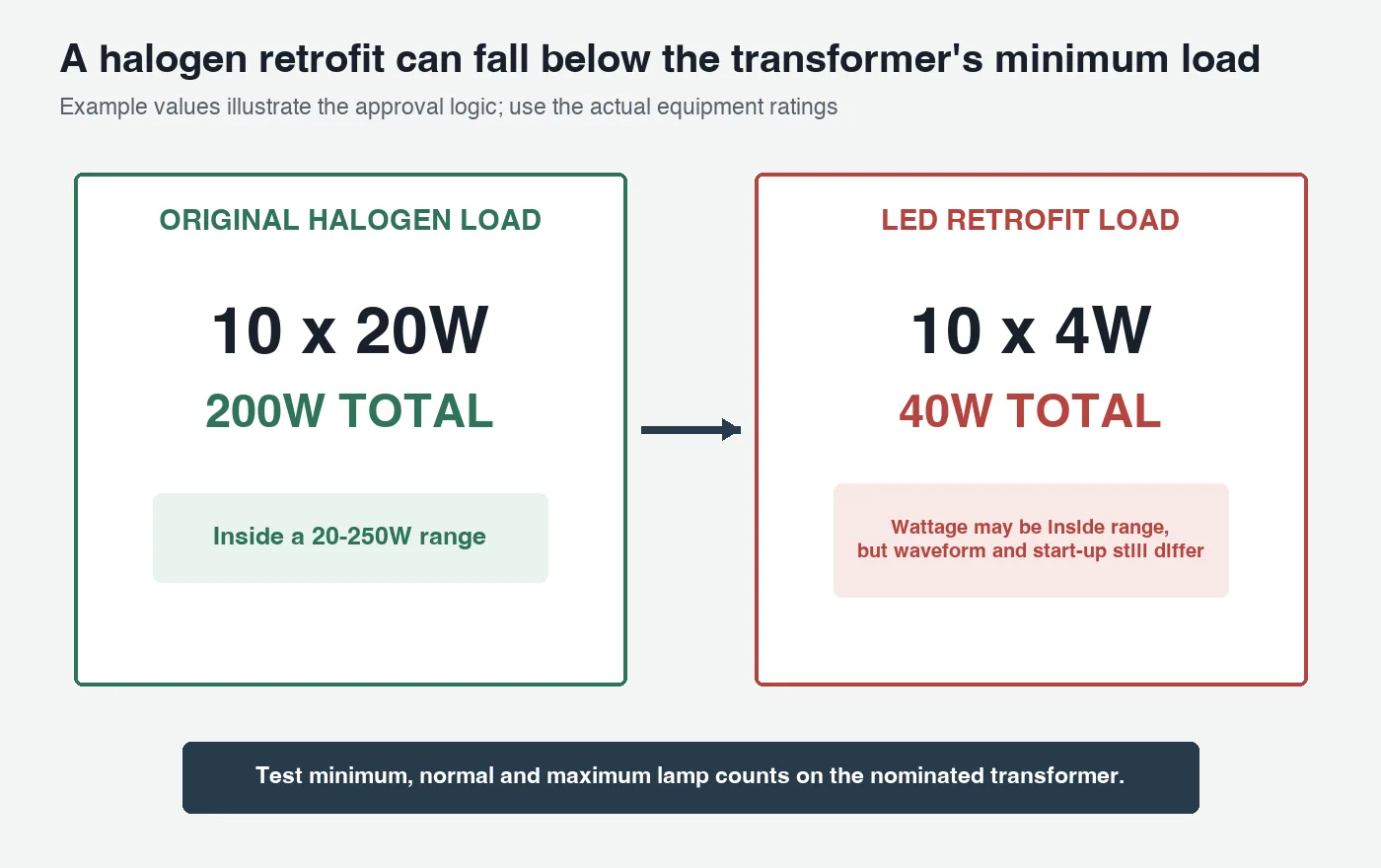
The simple wattage total is also not the whole load. An LED driver draws current in a different shape from a hot filament. Two 40W systems can present different peak current, conduction angle and start-up behavior to the transformer.
Concrete judgment 2
If the installed transformer has a minimum load, calculate the post-retrofit total and test below, at and above the intended lamp count. A single successful lamp does not approve a ten-lamp circuit.
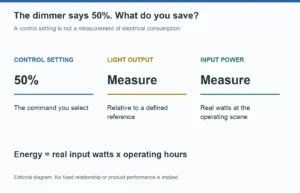
“Dimmable” Describes a Feature, Not a Guaranteed Pairing
Low-voltage dimming often contains two control stages:
- A mains dimmer modifies the waveform delivered to the transformer.
- The transformer converts that waveform to a low-voltage output that the lamp driver must interpret.
Each stage can have its own start threshold, holding-current requirement and protection logic. A combination may illuminate at full output but fail at low settings. Typical symptoms include:
- dead travel at the bottom of the dimmer;
- sudden turn-on rather than a smooth fade;
- shimmer at one position;
- visible flicker during camera recording;
- drop-out when only one lamp remains connected;
- pop-on at a higher setting after switch-on;
- afterglow caused by leakage current through the control circuit;
- acoustic noise from the dimmer, transformer or lamp.
The word “dimmable” should therefore be followed by a compatibility record. At minimum, record dimmer brand and model, dimmer type, transformer brand and model, lamp quantity, wiring length, mains voltage and the useful dimming range.
For compact capsule applications, HongYu's G4, G9 and spotlight lamp range is a reminder that base, supply and control method must be matched together; physical fit does not establish electrical compatibility.
Concrete judgment 3
A “dimmable” checkbox without named dimmer, transformer and lamp-count combinations is marketing language, not project approval.
Flicker Must Be Measured at More Than Full Output
A phone video can reveal severe flicker, but it cannot provide a comparable engineering value. Camera frame rate, shutter behavior and rolling shutter can either exaggerate or hide modulation.
For EU ecodesign requirements, PstLM and SVM are defined metrics for flicker and stroboscopic effects at full load.[4] Project approval should go further when the lamp will be dimmed: measure or document behavior at representative points across the useful dimming range, because the worst modulation may occur near the lower end rather than at 100% output.
The test record should separate three questions:
- Does the lamp meet the applicable regulatory requirement at the prescribed condition?
- Is the system visually stable across the promised dimming range?
- Does the system behave consistently across transformer, dimmer and lamp tolerances?
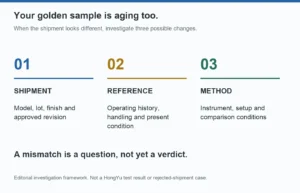
A result from one golden sample at room temperature cannot answer the third question.
Voltage at the Lamp Is Not Always the Transformer Nameplate
Long cable runs, small conductors, connectors and parallel branches create voltage drop. In RV, marine and battery systems, the source itself can move between charging, nominal and discharged conditions. A “12V” battery system can therefore expose the lamp to a changing input rather than a fixed laboratory value.
The correct input window should come from the real application. Buyers should provide:
- minimum and maximum steady voltage at the lamp holder;
- AC frequency or converter switching characteristics when relevant;
- expected ripple and transient conditions;
- polarity-reversal possibility for DC systems;
- maximum wiring length and conductor size;
- number of lamps per branch;
- battery charge-state or solar-controller conditions.
IEC 61347-2-13 covers electronic controlgear for LED light sources and explicitly includes constant-voltage or constant-current controlgear operating at SELV or higher voltages.[2] For procurement, that reinforces a useful distinction: the lamp input and the controlgear output form one interface that must be defined.
Concrete judgment 4
Approve the measured voltage window at the lamp terminals, not only the nominal voltage printed on the transformer or battery.
Low Voltage Does Not Mean “No Compliance Work”
The name “Low Voltage Directive” causes a common sourcing mistake. Buyers sometimes assume that every 12V or 24V lamp needs an LVD certificate; others assume that products below the LVD voltage range need no safety or compliance review.
Both shortcuts are wrong.
The European Commission states that the LVD applies from 50–1000V AC and 75–1500V DC; consumer products below those thresholds fall outside that directive's voltage scope and are addressed through other applicable product-safety rules.[3] EMC, RoHS, ecodesign, radio-disturbance limits, general product safety, luminaire requirements and destination-market rules may still be relevant depending on the final product and how it is sold.
CISPR 15 addresses radiated and conducted radiofrequency disturbances from electrical lighting and similar equipment.[5] A driver change made to improve dimming or widen input voltage can also change EMC behavior, so certification evidence must match the production circuit revision.
This article is not a substitute for destination-market conformity assessment. The practical point is narrower: do not request a generic “CE certificate” before the exact lamp, driver architecture, input and intended market are defined.
Build a Compatibility Matrix Before You Build Inventory
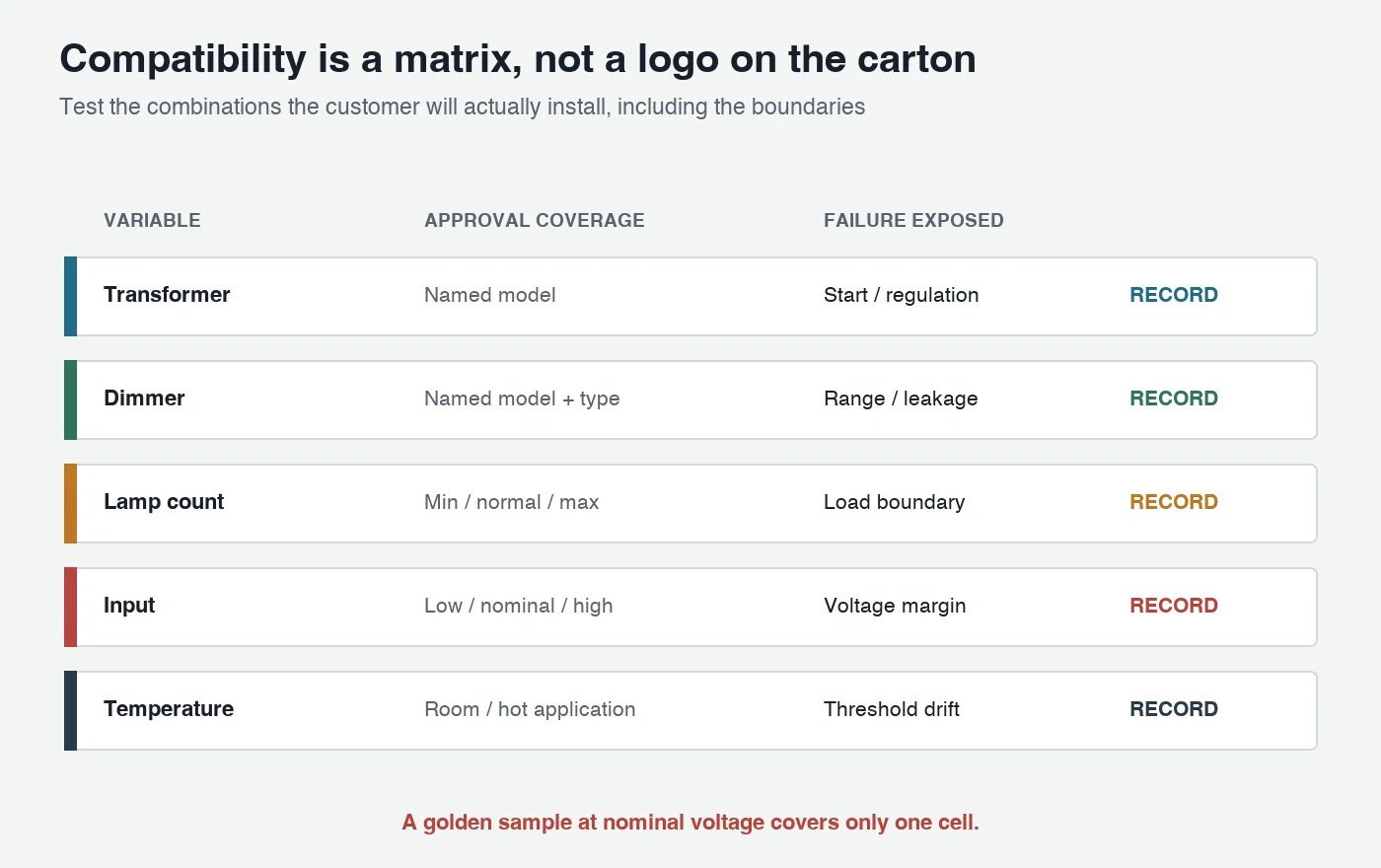
A useful test matrix does not attempt every product on the market. It covers the combinations the buyer will actually sell or install, plus boundary conditions that expose weak margin.
| Variable | Minimum approval coverage | Why it matters |
|---|---|---|
| Power source | Each nominated transformer, converter or battery profile | Defines waveform, start-up and voltage window |
| Dimmer | Each nominated model and control type | Defines conduction and leakage behavior |
| Lamp count | Minimum, typical and maximum per circuit | Exposes minimum-load and aggregate-current issues |
| Input | Low, nominal and high application voltage | Exposes regulation and stress margin |
| Dimming points | Off, start, low, mid and full | Exposes pop-on, drop-out, flicker and afterglow |
| Temperature | Room condition plus intended hot application | Driver and transformer thresholds can move with heat |
| Production samples | Multiple units across driver-component lots | Separates a golden sample from repeatable production |
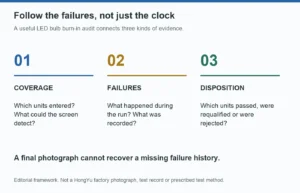
Record actual observations and values, not only PASS. For dimming, note the setting at first light, stable minimum, drop-out, restart and full output. For non-dimmed systems, record start behavior, stabilized voltage, current, power, visible modulation and temperature.
Factory Experience: Troubleshoot the System in the Correct Order
When a field complaint says “the bulb flickers,” replacing the LED filament first is usually inefficient. Our troubleshooting sequence starts upstream and moves toward the lamp:
- Reconstruct the exact circuit, including every model number and lamp quantity.
- Measure source output with the real load connected, not open circuit.
- Compare behavior at full output and at the complaint dimmer position.
- Substitute one component at a time: dimmer, transformer, lamp, then wiring branch.
- Compare retained production samples with the approved sample.
- Inspect whether the driver BOM, bridge, capacitor, resistor or filament configuration changed.
This order distinguishes four different root-cause classes:
- source failure: the transformer does not start or regulate at the LED load;
- control failure: the dimmer-transformer waveform is outside the useful lamp range;
- distribution failure: voltage drop or wiring asymmetry creates branch-to-branch differences;
- lamp failure: the production driver or assembly cannot tolerate the approved input condition.
The customer sees one symptom. The corrective action depends on which class produced it.
From Engineering Sample to Bulk: Lock the Complete Pairing
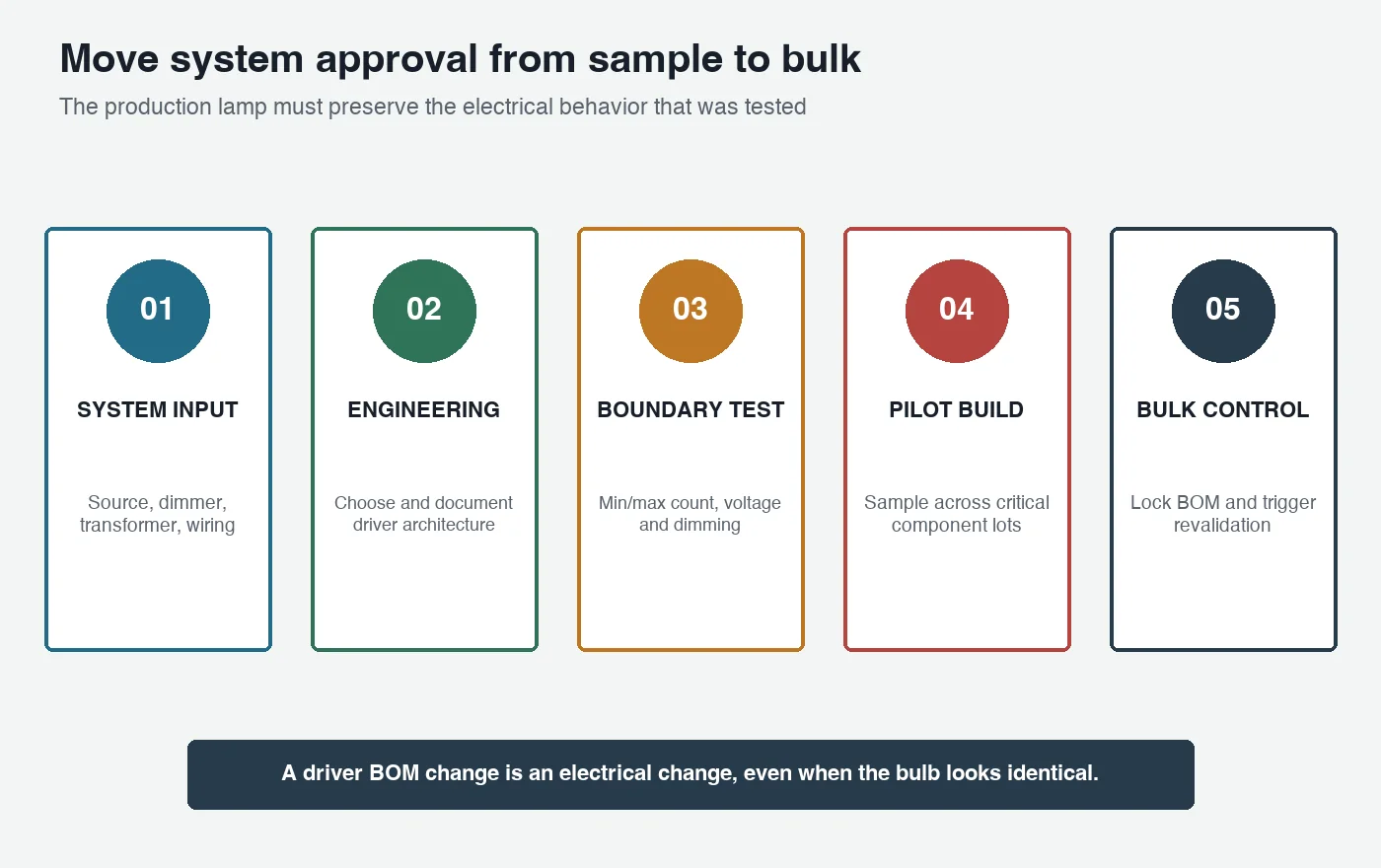
The signed sample should carry more than a lamp code. Its approval record should identify:
- bulb shape, finish, cap, wattage, lumen and CCT;
- driver architecture and revision;
- nominal and allowed input range;
- DC polarity behavior or AC/DC capability;
- approved transformer and dimmer combinations;
- minimum and maximum lamp quantity per circuit;
- useful dimming range and flicker criteria;
- application temperature and enclosure condition;
- critical driver components and permitted alternates.
Pilot production should repeat the boundary combinations, not only the easiest nominal case. Bulk inspection should then sample across cartons, shifts or component lots. A change to bridge rectifier, control IC, capacitor, filament voltage or current-limiting element should trigger compatibility revalidation.
For projects that actually require mains input rather than a low-voltage source, use a purpose-designed product such as HongYu's EU standard LED filament bulbs instead of adding an unapproved external conversion chain.
Concrete judgment 5
If the transformer, dimmer, driver BOM or lamp count changes, the previous system approval does not automatically transfer. Re-test the affected boundary conditions.
Five Questions to Put on the RFQ
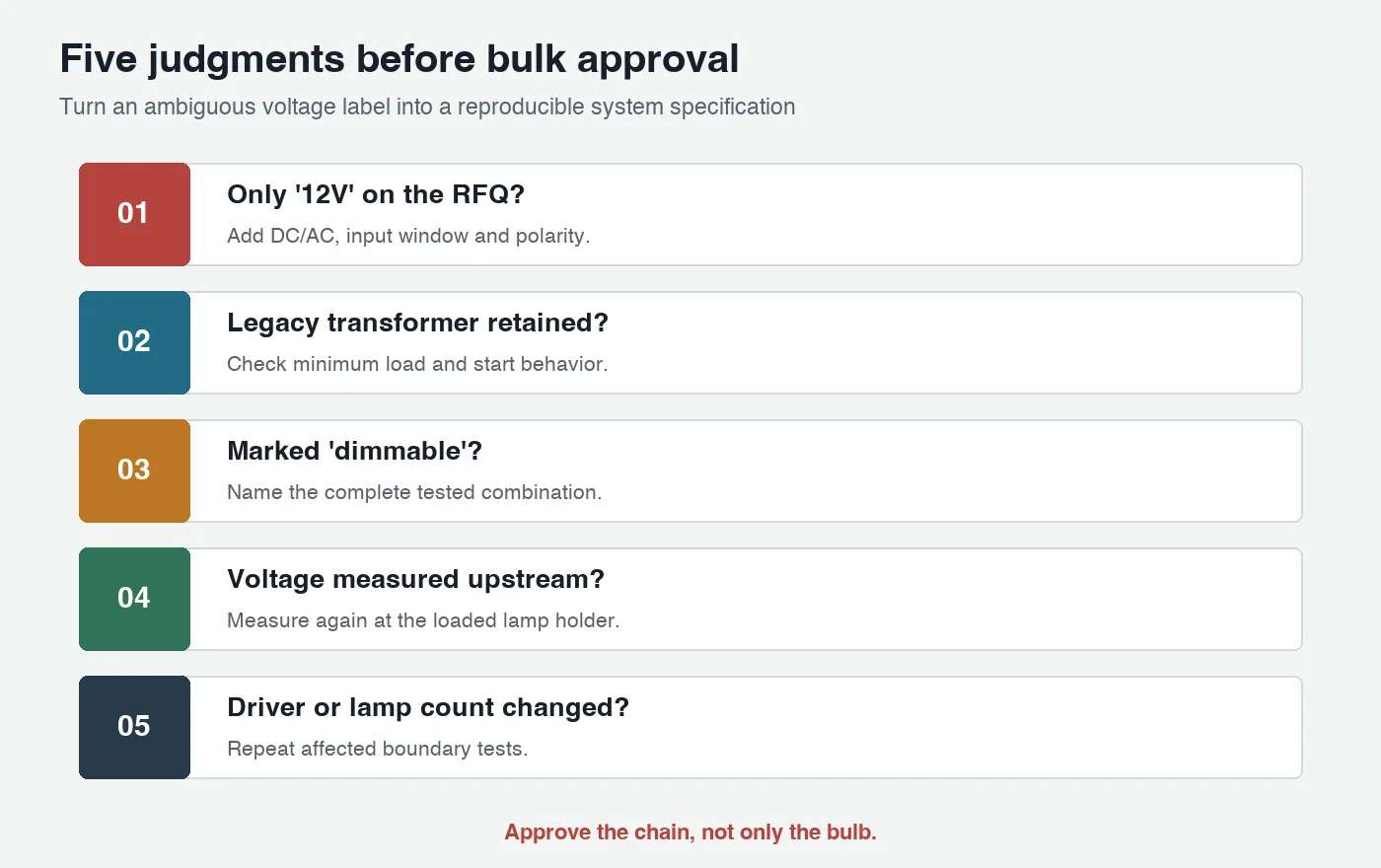
- What reaches the lamp? State DC, AC or AC/DC, nominal voltage, actual minimum/maximum and polarity conditions.
- What is upstream? Name the transformer or converter and the dimmer model, not only the technology family.
- How many lamps share one circuit? Give minimum, normal and maximum quantities.
- What behavior is acceptable? Define start, dimming range, flicker, noise, afterglow and restart expectations.
- What changes require reapproval? Lock the driver revision and critical components in the change-control agreement.
These five questions are more valuable than requesting a longer generic datasheet. They turn an ambiguous voltage label into a system that a factory can reproduce and a buyer can inspect.
Conclusion
Low-voltage LED failures are rarely explained by voltage alone. A lamp marked 12V may be DC-only or AC/DC, may present too little load for a legacy transformer, may interact poorly with a dimmer, or may receive a different voltage at the socket than the source nameplate suggests.
The purchasing solution is to approve the electrical chain, not just the bulb. Define the source, waveform, transformer, dimmer, lamp quantity, wiring condition and operating window. Test minimum, normal and maximum combinations. Measure behavior across the useful dimming range. Lock the driver revision and repeat boundary tests after relevant changes.
The sharp rule is simple:
“12V” tells you where to begin testing. It does not tell you what will work.
References
- U.S. Department of Energy, LED MR16 Lamps: Transformer and Dimmer Compatibility Testing. ↩
- IEC 61347-2-13:2014, Particular Requirements for DC or AC Supplied Electronic Controlgear for LED Modules. ↩
- European Commission, Low Voltage Directive (LVD). ↩
- European Commission Regulation (EU) 2019/2020, Ecodesign Requirements for Light Sources and Separate Control Gears. ↩
- CISPR 15:2018+A1:2024, Radio Disturbance Characteristics of Electrical Lighting and Similar Equipment. ↩