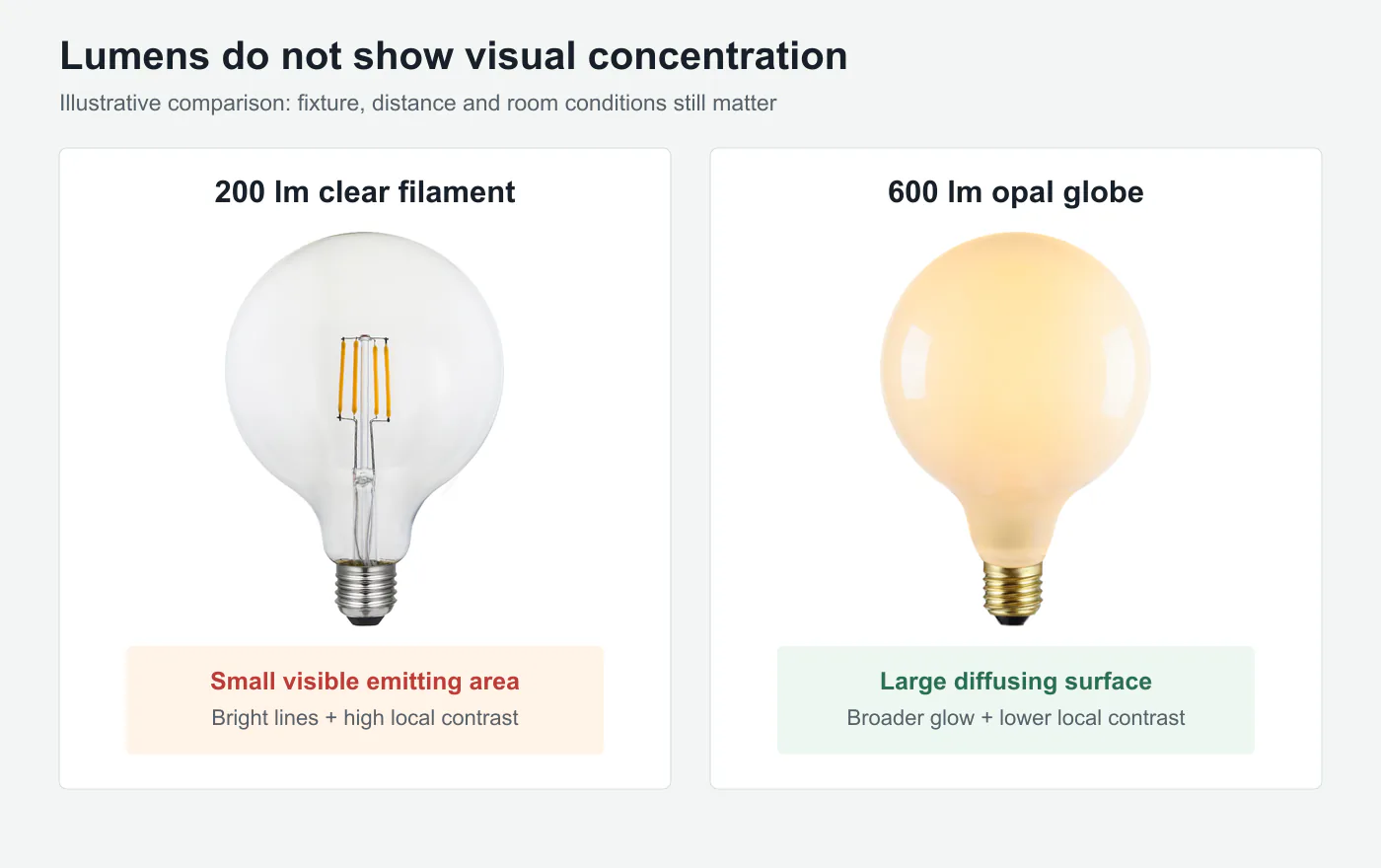
A 200-lumen decorative filament bulb can feel more uncomfortable than a 600-lumen opal bulb.
That sounds wrong if brightness is judged only by the lumen number.
The 600-lumen lamp sends more total visible light into the room. But the 200-lumen clear bulb may concentrate much of its visible output into several narrow filament lines. Those small, high-contrast emitters sit directly in the field of view. The opal bulb spreads its higher output across a much larger glowing surface.
The room may receive more useful light from the opal bulb while the eye experiences less direct visual stress.
This is the distinction many decorative lighting specifications miss:
Lumens describe the total quantity of light. They do not describe how concentrated that light appears to the eye.
For lighting brands, fixture manufacturers, hospitality buyers and importers, this matters because a low-lumen bulb can still generate complaints such as:
- too bright to look at
- uncomfortable above the dining table
- sharp reflection in the window
- distracting in the mirror
- harsh even when the room feels dim
- attractive in a product photo but tiring in the actual installation
The solution is not always to reduce wattage again. Buyers need to evaluate the emitting area, luminance pattern, viewing angle, background adaptation, number of visible sources and fixture geometry.
This article explains why total light output and visual comfort are different, and how to test decorative LED bulbs before approving a product or project.
Lumens Measure Quantity, Not Visual Concentration
Luminous flux, measured in lumens, represents the total flow of visible light weighted for human photopic vision.[1]
That number is essential. It helps buyers compare useful output, estimate whether a fixture can illuminate a space and check whether a lamp meets its claimed performance.
But lumens do not tell you:
- how large the emitting surface is
- whether the source is uniform or broken into bright lines
- whether the source is directly visible
- where it sits in the field of view
- whether it is reflected by glass or a mirror
- how dark the surrounding room is
- how many identical sources are visible together
These factors influence glare and perceived harshness.
Luminance is the more relevant photometric idea when discussing how intense a visible surface appears in a particular direction. It is measured in candelas per square metre and relates luminous intensity to projected emitting area.[2]
The technical definition is more complicated than most buyers need. The practical interpretation is simple:
Put a similar amount of visible light through a much smaller apparent emitting area, and that area can look dramatically more intense.
This is why the filament lines inside a clear decorative bulb may dominate the visual experience even when the lamp's total lumen output is modest.
The 200-Lumen versus 600-Lumen Example
Consider two lamps used in exposed pendant holders:
| Parameter | Clear decorative filament bulb | Opal globe bulb |
|---|---|---|
| Total luminous flux | 200 lm | 600 lm |
| Visible emitting pattern | Several narrow filament lines | Large diffusing glass surface |
| Filament visibility | Very high | Hidden |
| Apparent contrast | High | Lower |
| Direct-view comfort | Application-dependent; often sharper | Usually softer |
| Useful room illumination | Limited | Higher |
The clear lamp may create a bright line image on the retina while leaving much of the room relatively dark. The opal lamp distributes three times the total flux over a broad surface and into the surrounding space.
This does not mean every 200-lumen clear bulb is harsher than every 600-lumen opal bulb. Fixture shielding, distance, filament orientation, glass transmission, background brightness and dimming can reverse the result.
The point is that the lumen ranking alone cannot predict which lamp feels more comfortable.
Concrete judgment 1
If the bulb is directly visible near normal eye level, do not approve it by lumens alone.
The direct-view appearance is part of the specification.
Why Visible Filaments Create a Different Glare Pattern
A decorative filament bulb is intentionally non-uniform.
The glass envelope may be large, but the active light comes from thin LED filaments. To the eye, these can appear as several extremely bright lines surrounded by much darker glass.
That high local contrast is one reason a clear filament lamp can feel sharper than its total output suggests.
The U.S. Department of Energy has explained the basic source-size problem in direct language: when a similar amount of light comes from a smaller space, people can experience a greater glare impression.[3]
The CIE has also found that conventional glare calculations based on average source luminance can underestimate discomfort from LED luminaires with highly non-uniform luminance patterns. Its recommended approach gives greater attention to the actual luminance image and effective glare-source area.[4]
This is highly relevant to decorative bulbs:
- A clear straight-filament bulb has several narrow bright strips.
- A spiral filament creates a concentrated bright graphic.
- A multi-filament globe creates repeated high-luminance lines.
- A lightly frosted bulb may blur the lines without fully hiding them.
- An opal or porcelain lamp turns the envelope into a broader emitting surface.
The last two are not simply “dimmer-looking glass.” They change the luminance pattern presented to the eye.
HongYu's comparison of frosted, opal, matte frosted and porcelain LED bulbs explains how these finishes differ physically. For visual comfort, the critical question is how completely the finish spreads or hides the filament image.
Why a Dark Room Makes the Same Bulb Feel Worse
Glare is relative to adaptation.
A filament bulb viewed against a bright daytime interior may appear decorative and manageable. The same lamp viewed at night against a dark wall or window can feel much more aggressive.
The lamp did not necessarily become brighter. The background became darker, increasing visual contrast.
The Illuminating Engineering Society notes that glare depends on source size, position, luminance, number of sources and the luminance level to which the eyes are adapted.[5] These variables explain why one bulb can feel acceptable in a showroom and uncomfortable in a restaurant after sunset.
This creates a common approval error:
The buyer reviews samples on a brightly lit office desk, then installs them in a dark hospitality environment.
The sample test and the real application are not visually equivalent.
Concrete judgment 2
A bulb intended for evening hospitality use should be reviewed under evening-level ambient light, not only in a bright sample room.
Daylight inspection is still useful for glass, base and construction quality. It is not sufficient for glare approval.
Fixture Position Can Matter More Than a Small Lumen Difference
The same bulb can be comfortable or uncomfortable depending on where the fixture places it.
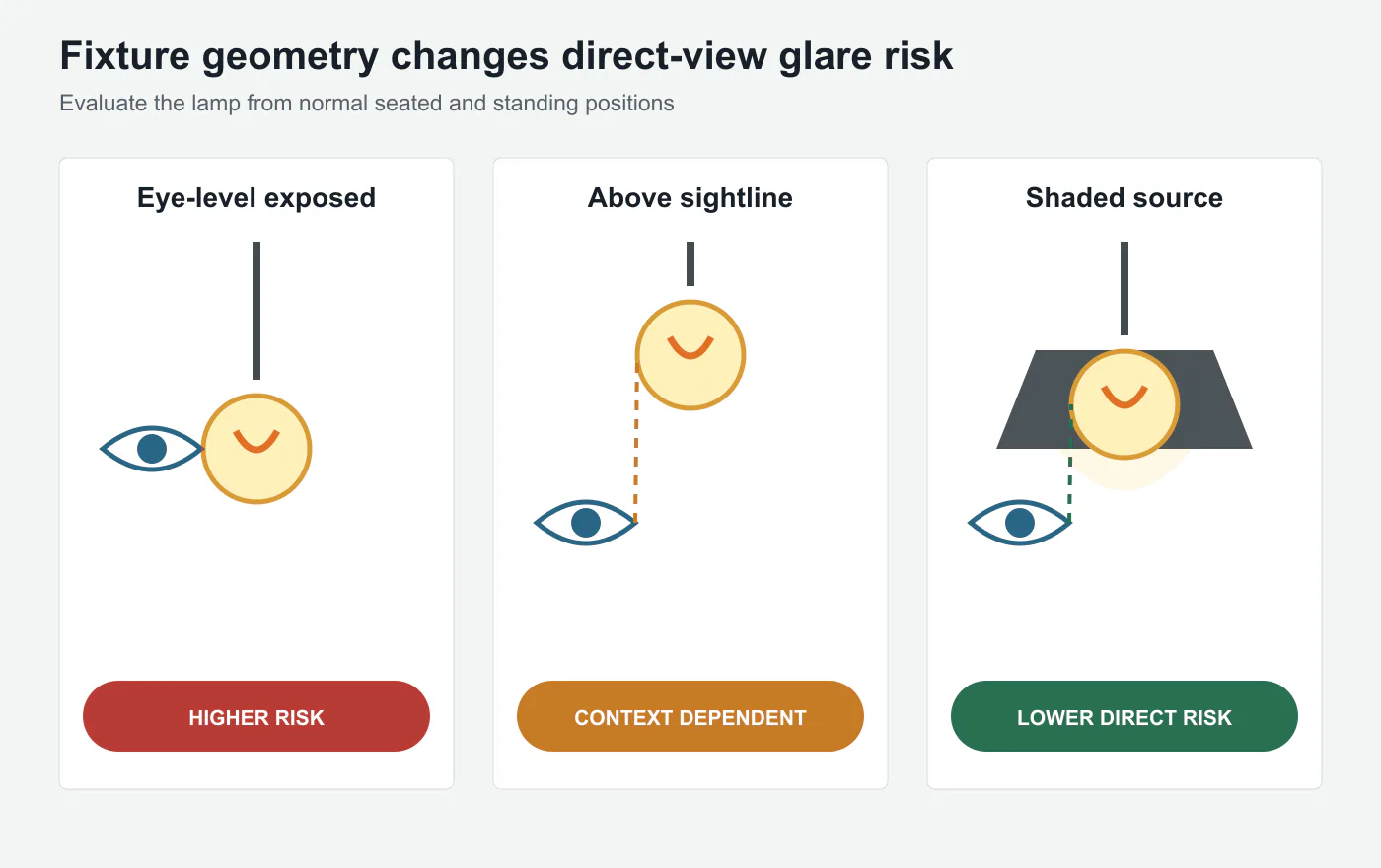
Exposed bulb near eye level
A wall sconce beside a mirror, a low pendant over a table or a bedside lamp with no shade can place the filament directly in the normal field of view. This is the highest-risk arrangement for clear filament glare.
Pendant above the normal viewing angle
An overhead pendant may be more comfortable if the socket, shade or fixture body blocks the brightest part of the filament from common viewing positions.
Bulb inside a shade
A shade can intercept direct light and turn the lamp into an indirect source. In this case, a clear bulb may work well because the user mainly sees the illuminated shade rather than the filament.
Bulb behind decorative glass
A second glass layer can diffuse, reflect or multiply the filament image. The result depends on transparency, curvature and surface finish. A clear shade may create extra reflected highlights instead of reducing glare.
This is why bulb shape must be matched to fixture geometry. HongYu's guide to LED filament bulb types and shapes is useful when comparing ST64, globe, candle and tubular forms for different holders and shades.
Concrete judgment 3
If the fixture exposes the filament from the user's normal seated or standing position, the sample must be approved inside that fixture.
A bare-bulb test on a factory socket does not reproduce socket depth, shade edge, mounting height or viewing angle.
Mirrors and Windows Can Multiply the Problem
A customer may not look directly at the bulb and still experience its glare.
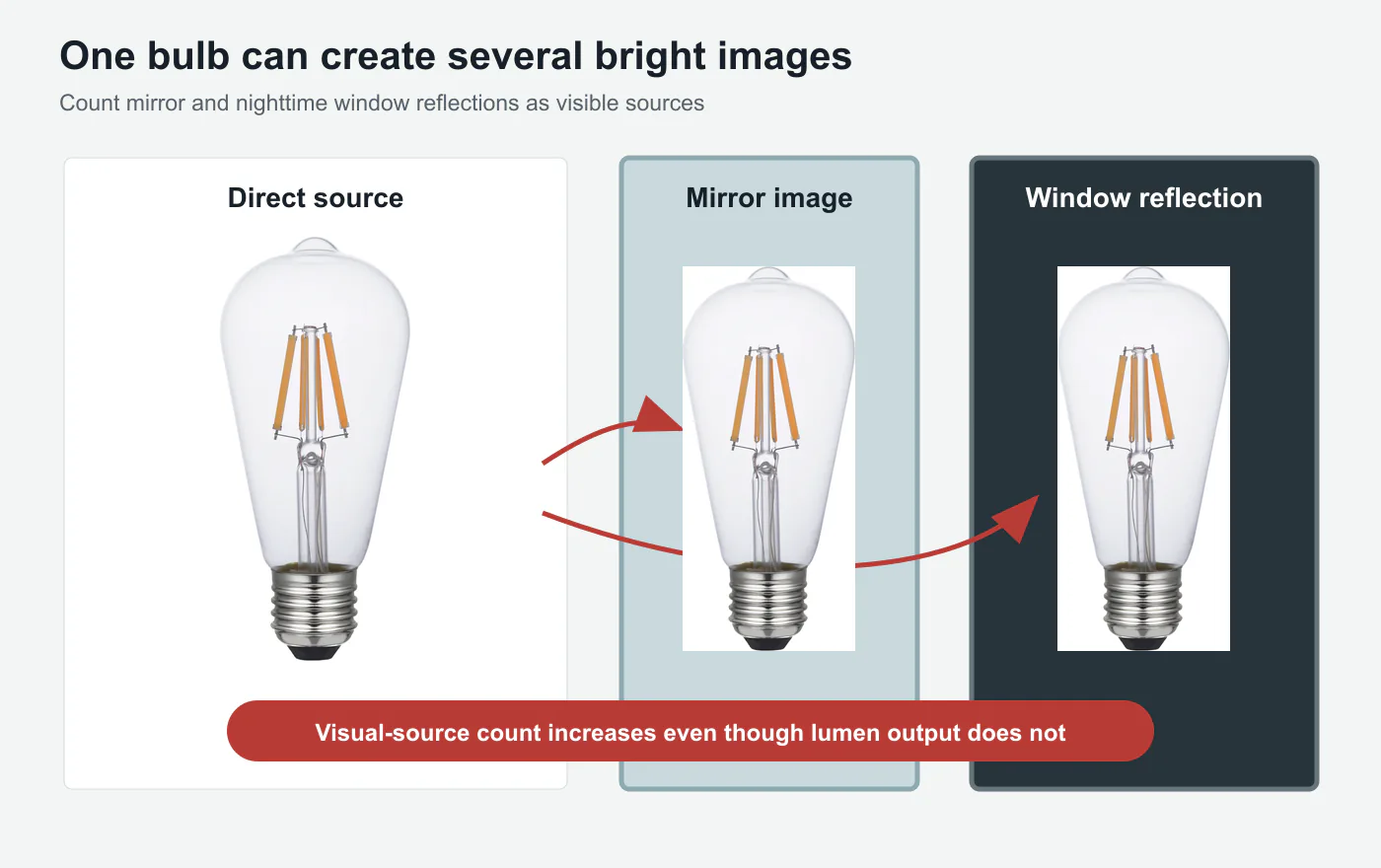
Mirrors, dark windows, polished metal, glossy tiles and glass tabletops can create secondary images of visible filaments. In bathrooms, vanity areas, bars and restaurants, these reflections may place the bright filament image directly where users look.
One bulb can become:
- one direct source
- one mirror image
- several window reflections
- multiple highlights in polished fixture parts
The lumen output has not increased, but the number of distracting bright images in the visual field has.
This is especially important for vanity and hospitality lighting. A lamp selected only for its attractive exposed filament may create sharp repeated lines around a mirror or in a nighttime window.
Smoky or amber glass does not automatically solve this. These finishes can reduce output, but the filament may remain a visible high-contrast feature. A darker envelope can sometimes make the bright filament line appear even more visually prominent.
HongYu's amber versus smoky glass LED bulb comparison shows that tinted glass can change measured output substantially. Optical attenuation and true diffusion, however, are not the same function.
Concrete judgment 4
If the filament is clearly reflected in the final mirror or window, treat that reflection as another visible source during approval.
Do not evaluate only the direct view.
More Bulbs Can Increase Discomfort Before the Room Looks Bright
Multi-lamp fixtures create another mismatch between lumen logic and visual comfort.
A chandelier with twelve 150-lumen clear filament bulbs provides 1,800 nominal lumens before fixture losses. That may not be excessive for the room. Yet the user sees dozens of individual filament lines distributed across twelve lamps.
The room can still feel dim because the light is decorative and poorly directed toward working surfaces. At the same time, the chandelier can feel visually busy and harsh.
This is not a contradiction.
Illuminance on tables and walls, total room flux and direct source luminance are different outcomes.
For multi-head fixtures, buyers should evaluate:
- total lamp count
- spacing between lamps
- whether all filaments are simultaneously visible
- distance from the viewer
- background brightness
- mounting height
- reflected duplicates
- dimmer behavior at the intended evening scene
A single sample bulb cannot answer these questions.
Why Simply Lowering Wattage Often Fails
When a clear decorative lamp feels harsh, the first response is often to request lower wattage or fewer lumens.
That may help, but it can also create a bad compromise:
- The filament remains visibly sharp.
- The room becomes darker.
- The contrast between filament and background remains high.
- Useful light on tables and faces becomes insufficient.
The project now has less illumination without fully solving the visual-comfort problem.
Optical changes may work better:
- use opal or porcelain glass
- select a larger diffusing envelope
- use a top-mirror or shielded design
- recess the socket deeper
- add a shade or diffuser
- move the lamp out of the normal field of view
- provide indirect background light
- reduce the number of simultaneously visible filaments
HongYu's broader decorative bulb finish guide helps match glass treatments to fixture and interior goals.
Concrete judgment 5
If reducing lumens makes the room too dark before the source becomes comfortable, the problem is optical distribution, not simply excessive output.
The bulb or fixture needs better luminance control.
Frosted, Opal and Porcelain Are Not Interchangeable
Buyers sometimes specify “frosted” as a generic anti-glare solution.
That is risky because different diffusion processes produce different visual results.
A light frost may soften the glass while leaving individual filaments visible. A stronger internal opal coating spreads the light more broadly. A porcelain-style finish can hide the filament and create a smooth luminous surface, but it may also reduce output and change the product's aesthetic.
The correct finish depends on the application:
| Application | Main visual requirement | Likely direction |
|---|---|---|
| Vintage exposed pendant | Filament remains part of design | Clear or amber, but control viewing angle and output |
| Restaurant table pendant | Atmosphere plus seated-eye comfort | Deeper shielding, diffusion or careful low-level dimming |
| Vanity mirror | Smooth face lighting and low reflected glare | Opal or porcelain |
| Bedside wall light | Comfortable close-range viewing | Diffused lamp or shaded fixture |
| Large decorative globe | Visible object with broad glow | Opal, porcelain or controlled filament layout |
| Multi-head chandelier | Consistency without visual overload | Lower source luminance, shielding or diffusion |
The strongest finish is not always the best. A porcelain bulb may be too visually solid for a vintage fixture, while a clear spiral filament may be wrong for a mirror light.
The specification should start from the viewing condition.
Dimming Is a Tuning Tool, Not a Complete Optical Fix
Dimming is valuable because it lets the user adjust output for different scenes.
But dimming should not be used to rescue a fundamentally uncomfortable source.
If a clear filament bulb is acceptable only below 10% output, several problems may follow:
- the room may not receive enough useful light
- the dimmer may become unstable
- different lamps may drop out at different points
- flicker or camera banding may appear
- the lamp may remain too sharp despite low total output
The practical target is a useful dimming range, not merely the lowest possible level.
Buyers should test the complete bulb-and-dimmer combination at the actual lamp count. HongYu's guide to TRIAC dimming, flicker and compatible dimmers explains why driver, dimmer and total circuit load must be evaluated together.
For projects where warmth should increase as output falls, dim-to-warm LED bulbs can improve atmosphere. They still need the same direct-view comfort check.
A Practical Factory and Fixture Approval Method
Visual comfort cannot be approved from a specification sheet alone.
Use a simple mock-up process before bulk production.
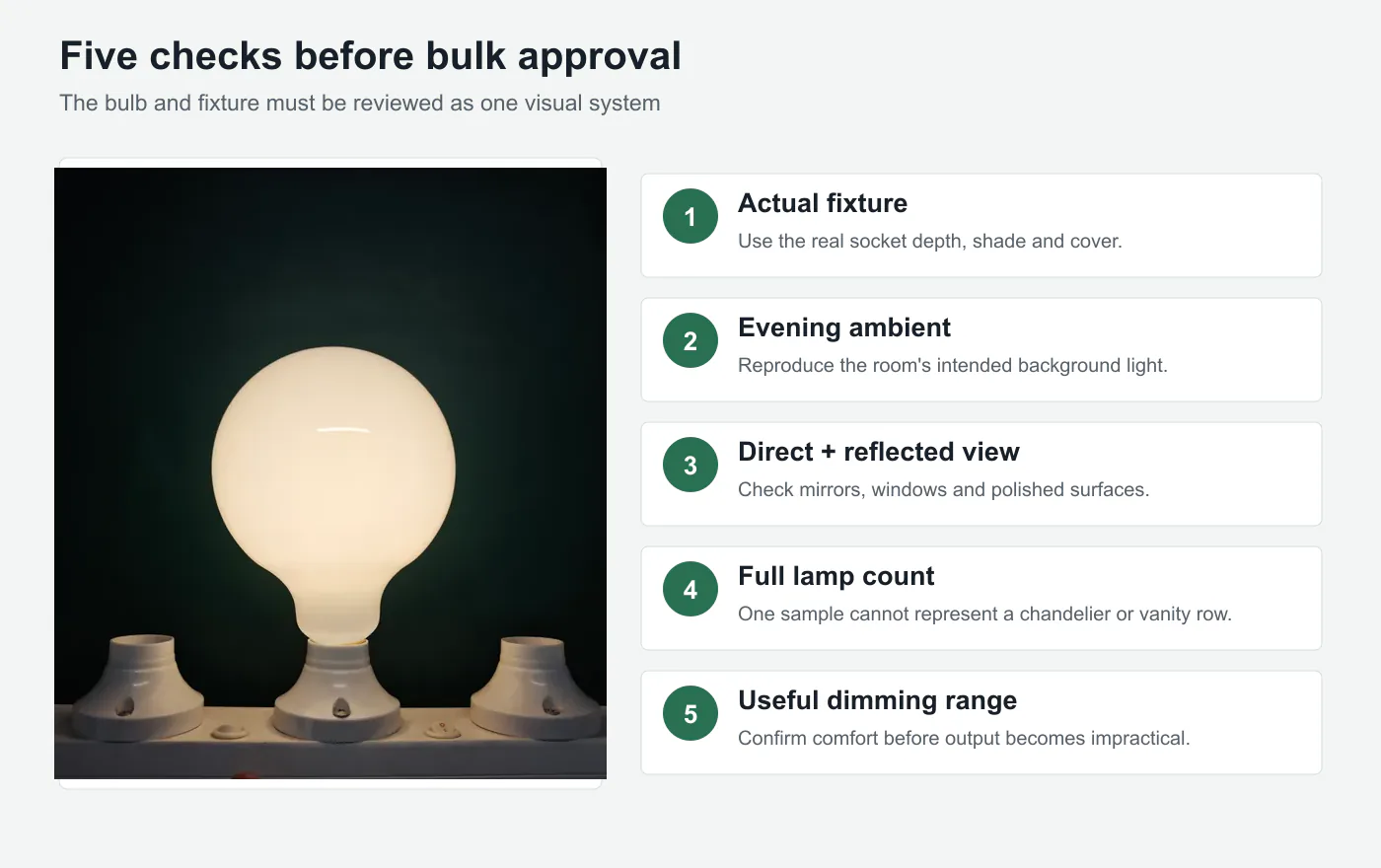
Step 1: Define the real viewing positions
List where users will sit, stand, walk, look into a mirror or face a window. Measure the approximate eye-to-lamp distance and fixture height.
Step 2: Install the bulb in the actual fixture
Use the real holder, socket depth, shade, glass cover and lamp count. A temporary bare socket is not enough.
Step 3: Reproduce daytime and nighttime conditions
Inspect construction and finish in daylight. Then reduce ambient light to the intended evening scene and evaluate direct-view comfort.
Step 4: Check direct and reflected images
Observe normal task and conversation directions. Check mirrors, windows, polished metal and glossy surfaces without deliberately staring into a high-luminance source.
Step 5: Compare optical alternatives
Test clear, amber, light frost, opal or porcelain versions at useful output levels. Do not compare only equal wattage; compare the complete visual result.
Step 6: Test the full lamp count
For chandeliers and vanity rows, install the intended number of lamps. Multiple visible sources change adaptation, reflections and visual complexity.
Step 7: Record the approved combination
Keep the bulb model, lumen range, glass finish, filament layout, fixture, mounting position, dimmer and approved operating range in the project record.
This prevents the common reorder problem where the bulb specification is retained but the reason it was comfortable is forgotten.
What Buyers Should Put in the Specification
A useful decorative-lighting specification should include more than wattage and lumens.
Ask for:
- finished-lamp luminous flux
- bulb shape and dimensions
- glass finish and diffusion process
- filament type and layout
- CCT and CRI
- dimmable or non-dimmable driver
- approved dimmer combinations where relevant
- intended fixture and mounting position
- number of visible lamps per fixture
- direct-view or shielded application
- approved physical sample
For glare-sensitive applications, add a mock-up approval requirement.
The purchase specification does not need to invent one universal luminance limit for every decorative lamp. Context matters too much. It should, however, prevent a low lumen value from being treated as automatic proof of comfort.
The Manufacturer's View: The Bulb and Fixture Form One Visual System
From a factory perspective, buyers often ask a bulb to solve a fixture problem.
They request lower wattage because the socket is too exposed. They request darker glass because the pendant hangs at eye level. They request a different filament because the mirror duplicates the original one.
Sometimes the bulb change is correct. Sometimes the fixture needs better shielding, socket depth or mounting height.
The most useful question is not:
“Which bulb has fewer lumens?”
It is:
“Where does the light appear in the user's field of view, and how concentrated is that visible source?”
That question connects lamp construction, glass finish, fixture geometry and room context.
It also produces better commercial decisions. A comfortable 600-lumen opal lamp may satisfy both illumination and visual-comfort requirements. A 200-lumen clear lamp may work beautifully as a decorative accent when positioned above eye level or behind a shade. Neither product is inherently better.
The application decides.
Conclusion
Lumens measure total light output. They do not measure how harsh a decorative bulb will feel.
A low-lumen clear filament bulb can create a strong glare impression because its output is concentrated into small, high-contrast lines. A higher-lumen opal bulb can feel softer because the light is distributed across a larger emitting surface.
The outcome also depends on viewing angle, background adaptation, reflections, lamp count, fixture shielding and dimming.
For buyers, the practical rule is:
Use lumens to plan how much light the space receives. Use a fixture mock-up to judge how comfortably the eye receives it.
Before approving a decorative bulb, install it in the actual fixture, reproduce the real evening environment, test the full lamp count and inspect both direct and reflected views.
The right question is not whether 200 lumens is “low.”
The right question is whether those 200 lumens are delivered in a way that the application can use comfortably.
References
- Illuminating Engineering Society, Luminous Flux ↩
- Illuminating Engineering Society, Luminance ↩
- U.S. Department of Energy, Glare in LED Lighting ↩
- International Commission on Illumination, CIE 232:2019 — Discomfort Caused by Glare from Luminaires with a Non-Uniform Source Luminance ↩
- Illuminating Engineering Society, Glare ↩